

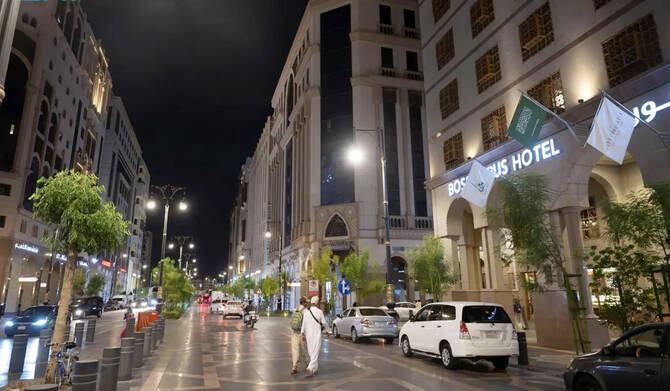
Saudi tourism ministry opens new offices to boost services

A recent report indicated that tourism is a major economic sector in Madinah, employing 11 percent of the region’s workforce in the first quarter of 2025. (SPA)
Short Url
Updated 13 October 2025
Follow

Saudi tourism ministry opens new offices to boost services

  • Madinah ranks second after Makkah in average length of stay, with visitors spending about four nights

JEDDAH: The Ministry of Tourism has inaugurated new offices in the Makkah and Madinah regions as part of its initiative to improve the efficiency of tourism services, according to the Saudi Press Agency.

Ministry spokesperson Mohammed Al-Rasasimah said that the offices would oversee inspections, ensure regulatory compliance, support investors, enhance service quality, coordinate with government entities and provide a more integrated approach to managing tourism services for pilgrims and visitors.

A recent report indicated that tourism is a major economic sector in Madinah, employing 11 percent of the region’s workforce in the first quarter of 2025.

The Madinah Chamber of Commerce’s sectoral report also highlighted strong performance in hospitality, with the highest hotel occupancy rate in the Kingdom during the last quarter of 2024. Serviced apartments recorded an occupancy rate of 48.7 percent, the SPA reported.

Madinah ranks second after Makkah in average length of stay, with visitors spending about four nights. These trends align with Vision 2030’s aim to develop tourism and hospitality as sustainable economic sectors that create diverse job opportunities.


Royal reserve intensifies efforts for environmental conservation

Updated 05 December 2025
Follow

Royal reserve intensifies efforts for environmental conservation

  • Protection contributes toward sustainability to align with Saudi Vision 2030

RIYADH: The King Salman bin Abdulaziz Royal Reserve Development Authority is intensifying efforts to protect the vegetation, wildlife, and public property within its reserve, the largest in the Kingdom at 130,700 sq. km.

Distinguished by its nature, terrain and archaeological sites (some dating back to 8000 B.C.), its protection contributes to environmental sustainability and aligns with Saudi Vision 2030’s goal of making the Kingdom a global environmental tourist destination, the Saudi Press Agency reported.

The authority’s efforts include enforcing regulations against violators, in partnership with the Special Forces for Environmental Security; rehabilitating damaged lands affected by overgrazing and desertification; planting nearly 4 million seedlings; rehabilitating 750,000 hectares of degraded land to restore plant life; and distributing tonnes of native wild seeds.

The authority has urged adherence to regulations, stressing continuous monitoring and enforcement against violations.

The royal reserve, a vast ecological haven across the Northern Borders, Jouf, Tabuk and Hail regions, is a vital hub for migratory birds. It is home to more than 290 bird species, with 88 percent being migratory and 12 percent resident.

This accounts for 58 percent of all bird species recorded in the Kingdom. The reserve also protects 26 bird species listed as threatened on the International Union for Conservation of Nature Red List.

The reserve serves as the Kingdom’s first stop for flocks arriving from Asia and Europe in the autumn, and their last station before departing in spring.

With its rich biodiversity, balanced environment and varied landscapes, the reserve also stands as a natural sanctuary, hosting remarkable species such as the steppe eagle, the eastern imperial eagle, and the houbara bustard.