

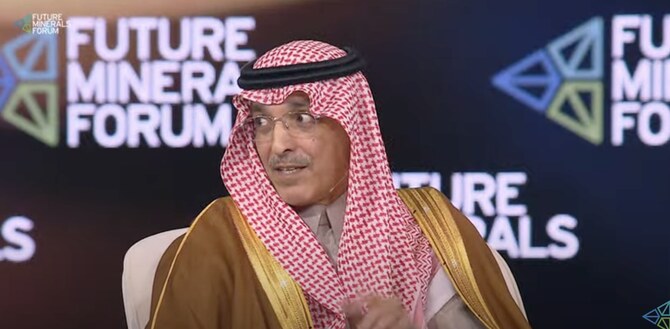

RIYADH: The mining sector’s success in Saudi Arabia hinges on strong private sector partnerships, according to Finance Minister Mohammed Al-Jadaan. Given the significant investments and expertise required, the government alone cannot drive the sector’s growth, he said.
Speaking on the second day of the Future Minerals Forum in Riyadh, Al-Jadaan emphasized the need for collaboration between public and private sectors to unlock the full potential of the mining industry. The forum, which runs from Jan. 14-16, aligns with Saudi Arabia’s ambitious goal to increase the mining sector’s contribution to the nation’s gross domestic product from $17 billion to $75 billion by 2035.
It also supports the country’s Vision 2030 objective of establishing mining as a critical pillar of the industrial economy.
“This is a very complex industry that requires significant investments that, you know, the government alone cannot do. It requires significant know-how that the government alone cannot do, and you need to make sure that you actually partner with the private sector to enable this sector,” Al-Jadaan said.
Al-Jadaan outlined three key enablers for the mining sector's development: cross-sectoral alignment, the strategic use of data, and a competitive regulatory framework.
“If you want to do the right thing within mining, it is not the mining alone that will make it. You will need to make sure that you are aligning multiple sectors together — energy, mining, logistics, and possibly even a few others,” he explained.
He pointed to the National Industrial Development and Logistics Program as a successful example of how integrated sectors can collectively drive progress.
On the importance of data, Al-Jadaan emphasized its foundational role in shaping the sector's future. “There was real focus on making sure that we make an investment early on in data relating to mining, including specific technicalities and budgeting for supporting surveys throughout the mining sectors, and actually providing even support to companies who are coming for exploration,” he said.
The minister also highlighted the necessity of a stable and investor-friendly regulatory environment. “These are long-term investments investors would need to make. You know, we need to have predictability, confidence in the regulatory framework, and we need to ensure it is investor-friendly. They must be able to obtain their licenses on time and with certainty,” he added.
Al-Jadaan further acknowledged the challenges faced by emerging economies, particularly those in the Global South, which possess abundant mineral resources but often lack the capital, expertise, and infrastructure to exploit them fully. He suggested that with the right support, these nations could leverage their mineral wealth not only for industrial growth but as a key driver of broader economic development.
“With the right setup, they can utilize these resources not only for the mineral and metal industries but as part of a package for economic development,” he said, stressing that targeted support such as subsidized logistics and services could unlock the mining potential of these nations.
In a related panel discussion, Saudi Arabia’s Minister of Industry and Mineral Resources Bandar Alkhorayef highlighted Africa’s critical role in the global energy transition. He pointed out the disparity between the continent’s vast resource potential and its actual contribution to the market.
“Today, investment needs to happen not only in extraction but also in infrastructure. We have seen great assets today in Africa are falling behind because of infrastructure challenges, not mining challenges,” Alkhorayef noted.
As the Future Minerals Forum continues, the collaboration between the private sector and government remains central to advancing the sector, not only in Saudi Arabia but across the global mining landscape.


