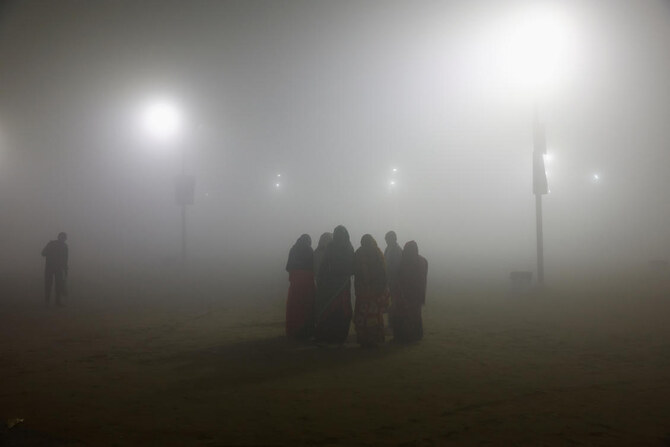
Dense fog and cold weather delayed train and flight departures in several parts of northern India, including its capital New Delhi, on Wednesday.
India’s weather office issued an orange alert for Delhi, the second highest warning level, forecasting dense to very dense fog in many areas.
Visibility at Delhi’s main airport was between zero to 100 meters (328.08 ft), the weather office said, and more than 40 trains across northern India were delayed because of fog, local media reported.
Some aircraft departures from Delhi were delayed, airport authorities said on social media platform X, warning that flights lacking the CAT III navigation system that enables landing despite low visibility would face difficulties. Delhi’s main airport handles about 1,400 flights every day.
“Low visibility and fog over Delhi may lead to some delays,” the country’s largest airline IndiGo said in a social media post.
Local media showed images of vehicles crawling along highways through the fog, and people huddled indoors as the temperature dipped to 7 degrees Celsius (44.6 degrees Fahrenheit).
Delhi was ranked as the world’s most polluted city in live rankings by Swiss group IQAir on Wednesday, with a reading of 254, ranked as “very unhealthy.”
The Indian capital has been battling poor air quality and smog since the beginning of winter.

Dense fog over Indian capital delays flights, trains
Short Url
https://arab.news/y5kbj
Dense fog over Indian capital delays flights, trains
- Delhi was ranked as the world’s most polluted city in live rankings by Swiss group IQAir
Hong Kong rings in 2026 without fireworks after deadliest blaze in decades
HONG KONG: Fireworks are typically a celebratory centerpiece of Hong Kong’s New Year celebrations. Not this year.
The territory will ring in 2026 without spectacular and colorful explosions in the sky over its iconic Victoria Harbor after a massive fire in November that killed at least 161 people.
The city’s tourism board will instead host a music show Wednesday night featuring soft rock duo Air Supply and other singers in Central, a business district that also is home to the famous nightlife hub Lan Kwai Fong. The facades of eight landmarks will turn into giant countdown clocks presenting a three-minute light show at midnight.
Fireworks have long been part of the city’s celebrations for the New Year, Lunar New Year and National Day. The pyrotechnic displays against Hong Kong’s world-famous skyline of skyscrapers typically draw hundreds of thousands of people including many tourists to both sides of the promenade.
Hotels and restaurants likely affected
Rosanna Law, the territory’s secretary for culture, sports and tourism, acknowledged Tuesday that having no fireworks would affect some hotel and restaurant businesses.
Annie Wang, a tourist from Shanghai, said that although she had planned to watch the fireworks show, she understood the city’s decision because she found news of the blaze heart-wrenching.
“It’s quite regretful. But there’s no way around it after the fire,” said Wang, a university student.
Wang Miao, a teacher from the neighboring economic hub of Guangzhou, planned to join the official countdown activities in Central despite the absence of fireworks. She said it was a pity that she could not see pyrotechnics, but she could understand why.
“It doesn’t affect our experience in Hong Kong,” Wang said.
By early Wednesday evening, crowds of revelers had already gathered near the performance stage in Central, hoping to secure the best views of the musical performance.
Worst fire since the 1940s for Hong Kong
The financial hub’s worst blaze since 1948 broke out at Wang Fuk Court, in the northern suburban district of Tai Po, in late November. The apartment complex was undergoing a monthslong renovation project with buildings covered by bamboo scaffolding and green netting.
Authorities have pointed to the substandard netting and foam boards installed on windows as contributing factors in the fire’s rapid spread. Thousands of affected residents have moved to transitional homes, hotels and youth hostels, struggling to recover from the loss of lives and homes that took them years to buy. The casualties pained many residents across the city.
Past tragedies in Hong Kong have forced similar cancelations of fireworks. They include the 2013 National Day festivities following a vessel collision that killed 39 people on Oct. 1, 2012, and the 2018 Lunar New Year celebration after a bus crash that left 19 dead. During the 2019 anti-government protests and the COVID-19 pandemic, multiple displays also were scrapped.
The origin of fireworks is believed to date to China in the second century B.C., when someone discovered bamboo stalks exploded with loud bangs when thrown into fire, creating the first natural “firecrackers,” according to the American Pyrotechnics Association, a US trade group.
The Guinness World Records organization says the first accurately documented firework, the Chinese firecracker, was created by Li Tian, a monk from China’s Tang dynasty dating to around 618 to 907 C.E. Li discovered that putting gunpowder in enclosed hollow bamboo stems created loud explosions and bound crackers together to create the traditional New Year firecrackers to drive out evil spirits, Guinness said.
The territory will ring in 2026 without spectacular and colorful explosions in the sky over its iconic Victoria Harbor after a massive fire in November that killed at least 161 people.
The city’s tourism board will instead host a music show Wednesday night featuring soft rock duo Air Supply and other singers in Central, a business district that also is home to the famous nightlife hub Lan Kwai Fong. The facades of eight landmarks will turn into giant countdown clocks presenting a three-minute light show at midnight.
Fireworks have long been part of the city’s celebrations for the New Year, Lunar New Year and National Day. The pyrotechnic displays against Hong Kong’s world-famous skyline of skyscrapers typically draw hundreds of thousands of people including many tourists to both sides of the promenade.
Hotels and restaurants likely affected
Rosanna Law, the territory’s secretary for culture, sports and tourism, acknowledged Tuesday that having no fireworks would affect some hotel and restaurant businesses.
Annie Wang, a tourist from Shanghai, said that although she had planned to watch the fireworks show, she understood the city’s decision because she found news of the blaze heart-wrenching.
“It’s quite regretful. But there’s no way around it after the fire,” said Wang, a university student.
Wang Miao, a teacher from the neighboring economic hub of Guangzhou, planned to join the official countdown activities in Central despite the absence of fireworks. She said it was a pity that she could not see pyrotechnics, but she could understand why.
“It doesn’t affect our experience in Hong Kong,” Wang said.
By early Wednesday evening, crowds of revelers had already gathered near the performance stage in Central, hoping to secure the best views of the musical performance.
Worst fire since the 1940s for Hong Kong
The financial hub’s worst blaze since 1948 broke out at Wang Fuk Court, in the northern suburban district of Tai Po, in late November. The apartment complex was undergoing a monthslong renovation project with buildings covered by bamboo scaffolding and green netting.
Authorities have pointed to the substandard netting and foam boards installed on windows as contributing factors in the fire’s rapid spread. Thousands of affected residents have moved to transitional homes, hotels and youth hostels, struggling to recover from the loss of lives and homes that took them years to buy. The casualties pained many residents across the city.
Past tragedies in Hong Kong have forced similar cancelations of fireworks. They include the 2013 National Day festivities following a vessel collision that killed 39 people on Oct. 1, 2012, and the 2018 Lunar New Year celebration after a bus crash that left 19 dead. During the 2019 anti-government protests and the COVID-19 pandemic, multiple displays also were scrapped.
The origin of fireworks is believed to date to China in the second century B.C., when someone discovered bamboo stalks exploded with loud bangs when thrown into fire, creating the first natural “firecrackers,” according to the American Pyrotechnics Association, a US trade group.
The Guinness World Records organization says the first accurately documented firework, the Chinese firecracker, was created by Li Tian, a monk from China’s Tang dynasty dating to around 618 to 907 C.E. Li discovered that putting gunpowder in enclosed hollow bamboo stems created loud explosions and bound crackers together to create the traditional New Year firecrackers to drive out evil spirits, Guinness said.
© 2025 SAUDI RESEARCH & PUBLISHING COMPANY, All Rights Reserved And subject to Terms of Use Agreement.