

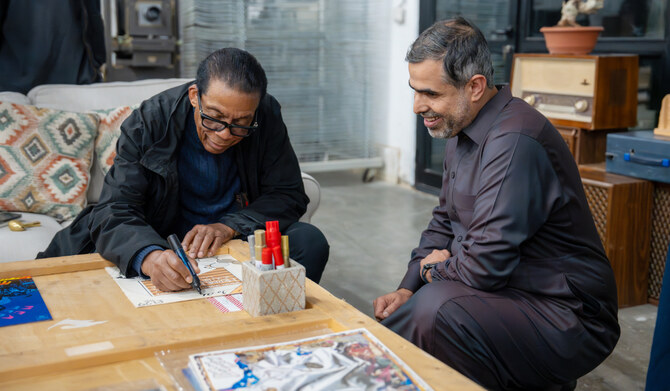

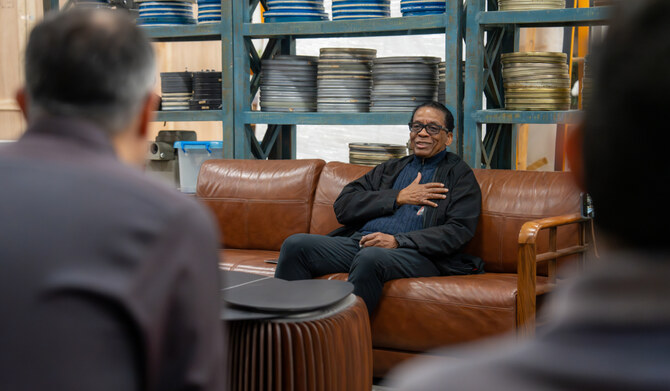
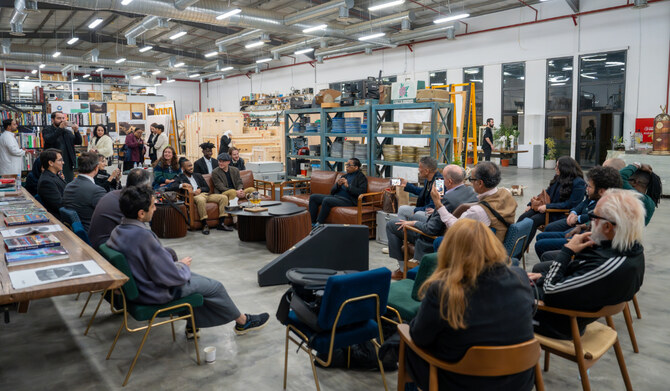
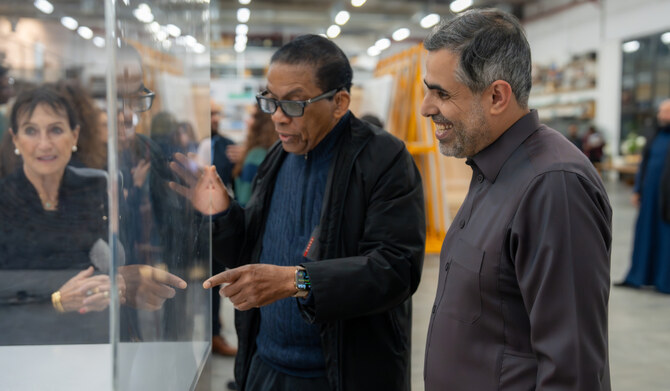

RIYADH: In an evening of musical and cultural exchange, Saudi artist Ahmed Mater hosted an American delegation of musicians featuring jazz legend Herbie Hancock, Manhattan Transfer singer Janis Siegel, and local Saudi artists in his studio in JAX on Monday.
“One of the most important aspects of this visit was the arts. The arts intersect and converge … art such as jazz, contemporary art, visual art, there is a dialogue between them,” Mater told Arab News.
He also underlined the importance of “dialogue between art that is local, Saudi, and historical, and art that is western, American, (such as) jazz.”
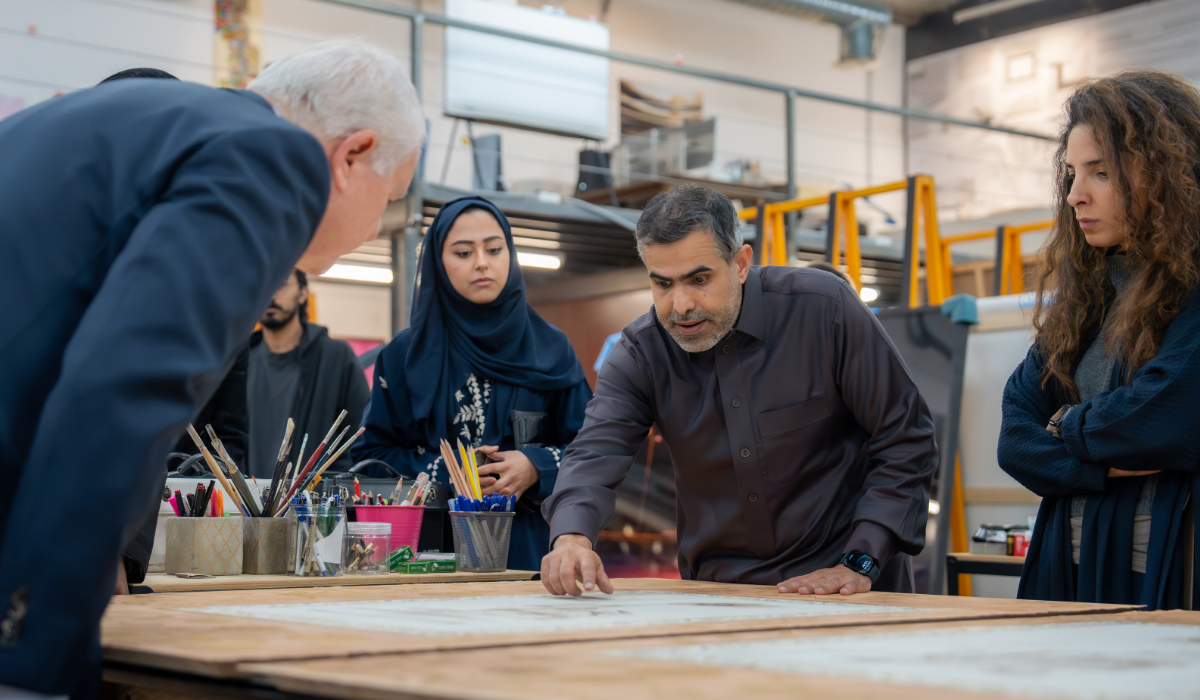
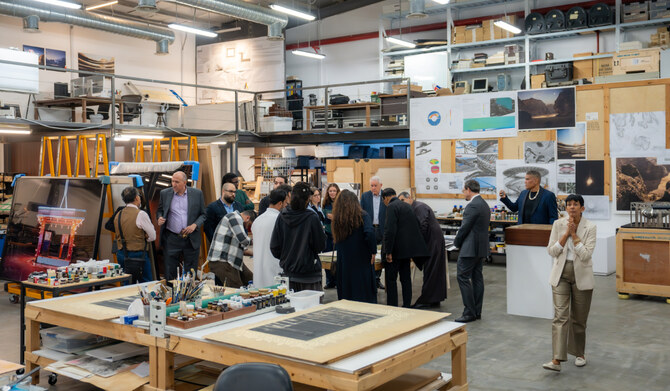
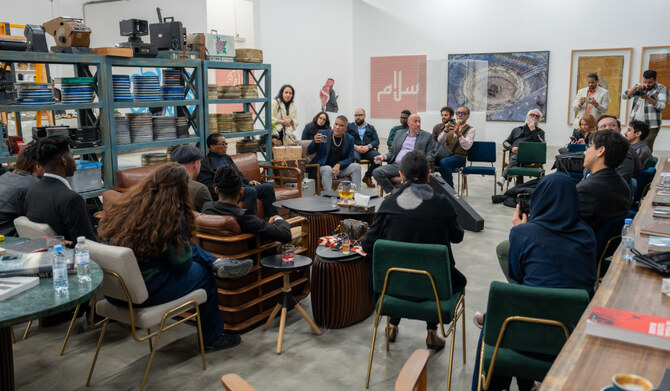
Saudi artists and American musicians from the Herbie Hancock Institute of Jazz Performance at UC Los Angeles visited Ahmed Mater's studio for a private tour. (AN photo by Jafar Saleh)
Mater himself specializes in a range of art forms including photography, video, sound, installations, video art, filmmaking and drawing.
His studio in JAX is filled with historical books, vintage film reels, and equipment, along with art supplies that he offers to artists for learning and creating. His mission is to use the studio as a foundation to support and nurture artistic talent.
Mater welcomed local Saudi artists and American musicians from the Herbie Hancock Institute of Jazz Performance at the University of California, Los Angeles to his studio for a private tour and discussion.
Davida MacDonald, cultural attache at the US Embassy, attended the gathering and outlined her experience touring the studio with the delegation of musicians.
“Dr. Ahmed Mater is a legend … I always love coming here. It is just a place of creative ferment, there are filmmakers and artists and musicians,” she said. “We are so excited the US Embassy has partnered with the Saudi Music Commission and the Ministry of Culture to bring these jazz legends to the Kingdom for the first time.”
Hancock’s visit to the Kingdom is part of a celebration of Saudi-US cultural ties, sponsored by the Arts Envoy Program from the US Bureau of Educational and Cultural Affairs, the Saudi Music Commission, the Ministry of Culture, Music Hub, and the King Fahd Cultural Center.
“The genuine interest and affection with which this group of stellar musicians has been received by Saudi musicians, as well as the public at large, is just a testament to the energy, dynamism and creativity of the Saudi music scene,” she said.
The cultural attache underlined the importance of the visit, which she described as a “two-way exchange” with “American jazz musicians sharing their craft with Saudi musicians and learning from Saudi musicians.”
MacDonald said the tour was meant to be a five-minute affair but instead lasted an hour, with detailed discussions of art and music.
Mater said that Hancock had “a unique and memorable reaction” to the studio and that “the spirit of his visit was friendly and familiar, rather than formal,” leading to a longer and more comprehensive tour.
“For example, he (Hancock) was curious and asked me about Saudi artists and the music they make, such as Mohammed Abdu, whose pictures were presented in the studio.”
Mater highlighted that his colleague and fellow artist in the studio, Abdullah Al-Qarni, a qunun player and maker, was present and played alongside Hancock in a spur-of-the-moment performance.
“The studio team was present and Al-Qarni played the qunun and explained the eastern and western maqams. They worked on comparing how the sounds resonated,” he said.
Afterward, Al-Qarni and Mater presented Hancok with a qunun to take with him back to the US.
“It was a beautiful night for everyone,” Mater said. “Art, like jazz, fine art, and visual art … there is a dialogue between them, this is the beauty of today.”


