
DHAHRAN: Visitors are immersing themselves in a vibrant celebration of art as Hussain Alismail unveils his compelling solo exhibition, “W’ard,” at the SASCA Art Gallery in Dammam, Saudi Arabia.
Launched on Dec. 30 last year and running until Jan. 10, the exhibition is a captivating journey through the artist’s evolving vision.

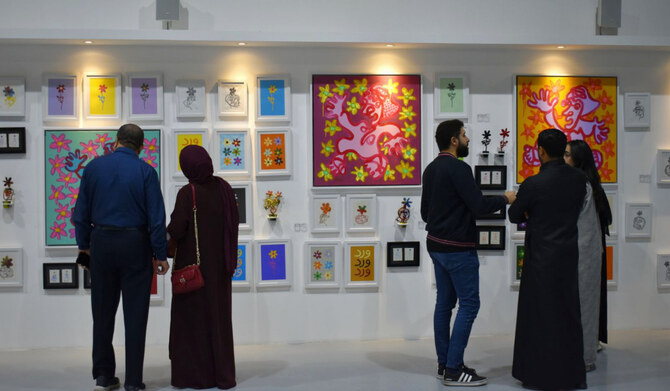
‘Wa’rd’ series by Hussain Alismail showcases a rich blend of experimentation with different materials, colors and artistic techniques. (Supplied)
In the “W’ard” series, Alismail breaks free from his signature style, which often features bold continuous-line drawings in striking shades of black and red.
Instead, the collection showcases a rich blend of experimentation with different materials, colors and artistic techniques.
HIGHLIGHTS
• Primarily focused on drawing and painting, Hussain Alismail’s artworks delve into the intricate complexities of Saudi social dynamics.
• His works are a way to spark everyday conversations, encouraging viewers to think about the small details of human relationships and expressions.
Visitors can expect to encounter an array of fascinating works, from collages that fuse imagery, mixed media pieces with texture, three-dimensional sculptures, to dynamic video installations that spark imagination.

Hussain Alismail creates a new piece while visitors watch at his W’ard exhibition in Dammam. (Supplied)
At the heart of Alismail’s work lies the symbol of the rose, a timeless emblem of unity that surpasses differences, inviting connection among visitors.
He said: “For this exhibition, I selected flowers to represent the unity among Saudis from different regions, reflecting the shared appreciation for Talal Maddah’s songs that gained popularity in the late 1950s and resonated with both youth and older generations.”
This cultural reference runs throughout the exhibition, highlighting the themes in Alismail’s artwork.
For this exhibition, I selected flowers to represent the unity among Saudis from different regions, reflecting the shared appreciation for Talal Maddah’s songs that gained popularity in the late 1950s and resonated with both youth and older generations.
Hussain Alismail, Saudi artist
Through his collection, Alismail creates an artistic experience that celebrates unity in the diversity of humanity.
“I see my artwork as a reflection of who I am, but once it’s out in the world, it belongs to everyone to interpret and connect with however they choose,” he told Arab News.
Alismail is not only a gifted artist, but also a committed scholar, having recently relocated to Melbourne, Australia, to pursue a master’s degree in design innovation and technology at RMIT.
His time in academia, which he describes as research-focused, has significantly influenced his art. “I’ve found these skills super useful for my art in this exhibition and they’ll definitely play a bigger role in my upcoming projects.”
Alismail holds a bachelor’s degree in fine arts in drawing and painting from OCAD University in Toronto, Canada, as well as a bachelor’s degree in creative arts in visual effects and entertainment design from Flinders University in Adelaide, Australia.
His academic background enriches his creative practice, fueling his artistic exploration.
Primarily focused on drawing and painting, Alismail delves into the intricate complexities of Saudi social dynamics.
His works are a way to spark everyday conversations, encouraging viewers to think about the small details of human relationships and expressions.
Beyond canvas and paper, Alismail’s artistic skills include photography, videography and digital graphics, allowing him to create stories that invite exploration.
“Medium serves as a platform for discovery. I constantly challenge myself to go deeper into techniques and artistic presentations,” he said.
For the exhibition, Alismail embraced a variety of innovative mediums. “I played around with 3D design, 3D printing, AI generative imagery and various other hands-on mediums,” he said.
Additionally, he aims to create a vibrant experience, expressing his desire that viewers feel “joyful and leave with a smile on their face.”
Inspired by cultural stories around him, Alismail combines personal and community tales in his art, enhancing the diverse narratives he shares.
With an eye toward revitalizing cultural connections, his work fosters an enriched understanding of our shared human experiences.
“What my audience has seen from me before is different from what I’m creating now, and I know it’ll have even more depth down the line.”