

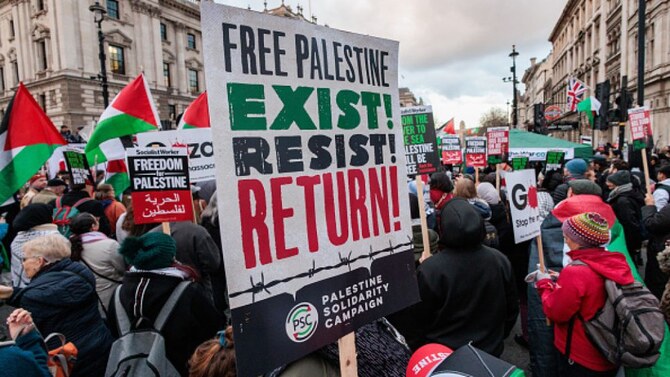
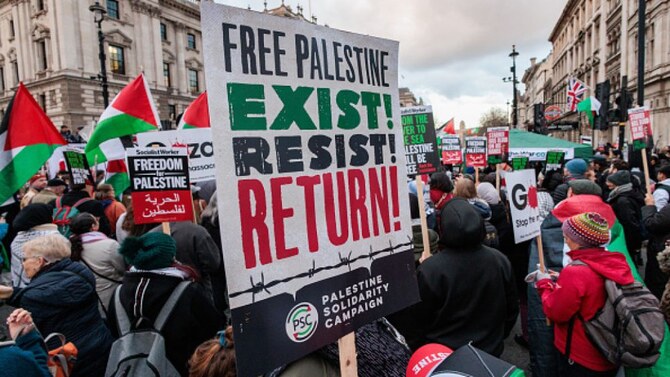
LONDON: Calls are growing for London’s Metropolitan Police to reverse their decision to ban a planned pro-Palestine demonstration that was set to take place on Saturday outside the BBC headquarters.
The march’s organizers, the Palestine Solidarity Campaign (PSC) and its coalition partners, issued a joint statement on Monday urging the police to reconsider their decision.
They also highlighted their commitment to proceeding with the protest, albeit along a revised route, following widespread backlash.
“PSC are calling on all those who support an immediate ceasefire and an end to Israel’s genocide in Gaza, as well as everyone who believes in the democratic right to protest, to join us in London at 12 p.m. on Jan. 18,” the group said.
“We will assemble in Whitehall, which will allow us to form up in massive numbers in an orderly fashion, and we will march toward the BBC.”
In a statement sent to Arab News on Monday evening, Met spokesperson Chris Humphreys said that authorities were aware of the proposed new route and would meet with PSC representatives on Tuesday to discuss the matter further.
“The Palestine Solidarity Campaign has announced a new route for its march this Saturday. This route is a reversal of the original one that had been advertised,” said Humphreys.
“It is not one we have agreed and it would breach the conditions that have been imposed under the Public Order Act.
“We imposed those conditions because we were satisfied, after carefully considering the evidence, that a demonstration forming up in the vicinity of a synagogue on a Saturday, when congregants would be attending Shabbat services, would cause serious disruption. Our assessment is that a demonstration ending and dispersing from the same place would have the same impact.”
The decision to ban the march, announced last week, came amid concerns about potential “serious disruption” to a nearby synagogue.
The police invoked the Public Order Act to prevent the rally — initially agreed upon in November — from gathering at the BBC’s headquarters.
The Metropolitan Police said that their decision followed consultations with local community and business representatives, including members of the synagogue’s congregation located “very close” to the rally’s proposed starting point.
The PSC has rejected claims that the march poses a threat to Jewish communities.
In a previous statement, the group said: “There has not been a single documented case of a threat or incident at a synagogue in relation to the national Palestine marches that have taken place over the last 15 months of the Gaza genocide.”
Ben Jamal, the PSC’s director, said on Monday: “Hundreds of thousands of people wish to continue to protest at our government’s ongoing complicity with Israel’s genocide against the Palestinian people.
“They also wish to protest at the complicity of the BBC, which has failed to report the facts of this genocide, as revealed in recent investigations. There are no legitimate grounds for the police to impede our proposal to march from Whitehall to the BBC, finishing with a rally outside its HQ. We call upon the Met Police to make clear they will drop any conditions which will deny the right to protest as planned.”
Over the weekend, hundreds of political, social and cultural figures voiced their support for the right to demonstrate in solidarity with Palestine.
A letter organized by a Jewish bloc that regularly takes part in Palestine marches was signed by more than 700 members of the Jewish community.
Among the signatories were Holocaust survivors and their descendants, who also penned a public letter supporting the rally.
The PSC said that they have written to the police requesting a meeting about the march.
The PSC have been contacted for comment.


