

China says fishing vessel hijacked off Somalia ‘freed’

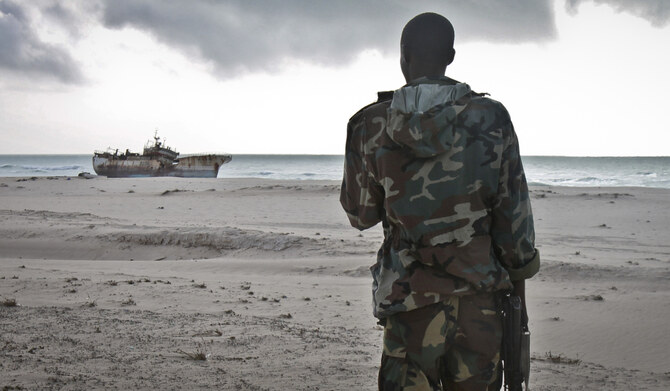
In this Sunday, Sept. 23, 2012 file photo, a Somali soldier looks out at a Taiwanese fishing vessel that washed up on shore after the pirates were paid a ransom and released the crew, in the once-bustling pirate den of Hobyo, Somalia. (AP)
Short Url
Updated 13 January 2025
Follow

China says fishing vessel hijacked off Somalia ‘freed’

  • Somalia has for years been blighted by piracy, which peaked in 2011, when the UN says more than 160 attacks were recorded off the Somali coast

MOGADISHU: A Chinese-owned fishing vessel hijacked off the Somali coast in November has been set free with its 18-member crew, the Chinese Embassy in Somalia said Monday.
The embassy said in a statement posted on X that the crew was rescued Monday following “the unremitting efforts of the Chinese government.” “The Chinese side strongly condemns this vicious action which threatened the safety of the crew and international navigation security, and will continue to firmly safeguard the lawful rights of Chinese citizens and enterprises overseas,” the statement said.

HIGHLIGHTS

• The ship and its crew were hijacked in late November and taken to Xaafuun district in the semi-autonomous state of Puntland.

• The pirates who took the ship later demanded a ransom of $10 million. It was not immediately clear if the money was paid.

The ship and its crew were hijacked in late November and taken to Xaafuun district in the semi-autonomous state of Puntland, a territory in Somalia’s northeast. The pirates who took the ship later demanded a ransom of $10 million.
It was not immediately clear if the money was paid.
“The Chinese side maintained close consultation and coordination” with federal authorities in Somalia as well as the regional government of Puntland in efforts to rescue the ship and its crew, the embassy statement said.
The hijacking underscored the persistent challenges of maritime security in Somalia’s waters. Somalia has for years been blighted by piracy, which peaked in 2011, when the UN says more than 160 attacks were recorded off the Somali coast.
Incidents have declined drastically since then, however, largely due to the presence of American and allied navies in international waters.


US backs Japan in dispute with China over radar incident

Updated 5 sec ago
Follow

US backs Japan in dispute with China over radar incident

  • US criticizes China for radar targeting Japanese aircraft
  • Incident follows Japan PM’s remarks on potential Chinese attack on Taiwan

WASHINGTON/TOKYO: The United States has for the first time criticized China for aiming radars at Japanese military aircraft during a training exercise last week, incidents that the Asian neighbors have given differing accounts of amid escalating tensions.
The run-in near Japan’s Okinawa islands comes after Japanese Prime Minister Sanae Takaichi triggered a dispute with Beijing last month with her remarks on how Tokyo might react to a hypothetical Chinese attack on Taiwan.
China claims democratically governed Taiwan and has not ruled out using force to take control of the island, which sits just over 100 km  from Japanese territory and is surrounded by sea lanes that Tokyo relies on.
“China’s actions are not conducive to regional peace and stability,” a State Department spokesperson said late Tuesday, referring to the radar incident.
“The US-Japan Alliance is stronger and more united than ever. Our commitment to our ally Japan is unwavering, and we are in close contact on this and other issues.”
China’s foreign ministry did not immediately respond to a request for comment.
Japan late on Tuesday scrambled jets to monitor Russian and Chinese air forces conducting joint patrols around the country.
MOST SERIOUS INCIDENT IN YEARS
The Chinese fighter jets aiming their radars at the Japanese planes on Saturday was the most serious run-in between the East Asian militaries in years.
Such moves are seen as a threatening step because it signals a potential attack and may force the targeted plane to take evasive action. Tokyo blasted the moves as “dangerous.”
Beijing, however, said that the Japanese aircraft had repeatedly approached and disrupted the Chinese navy as it was conducting previously announced carrier-based flight training east of the Miyako Strait.
Speaking to reporters in Taipei on Wednesday, Taiwan President Lai Ching-te said China’s drills were “very inappropriate behavior.”
“We also call upon China to demonstrate the responsibility befitting a major power. Peace is priceless; war has no winners. Peace must be fostered by all parties, and China shares this responsibility,” he said.
Relations between Asia’s two largest economies have soured sharply since Takaichi told parliament last month that a Chinese attack on Taiwan could amount to a “survival-threatening situation” and trigger a potential military response from Tokyo.
Beijing has demanded she retract the remarks, accused Tokyo of threatening it militarily and advised its citizens not to travel to Japan.
US Ambassador to Japan George Glass has publicly expressed support for Japan in several social media posts since the diplomatic dispute began, but President Donald Trump and other senior US officials have remained silent.
Trump, who plans to visit Beijing next year for trade talks, telephoned Takaichi last month, urging her not to escalate the dispute, people with knowledge of the matter told Reuters.