

Somalia and Ethiopia agree to restore diplomatic ties

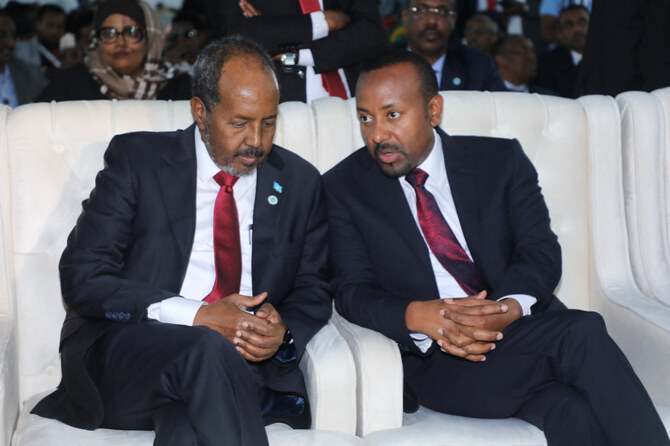
This photo taken on June 9, 2022, shows Hassan Sheikh Mohamud (L) speaking with Ethiopia's Prime Minister Abiy Ahmed during Hassan's inauguration ceremony as Somalia's 10th president in Mogadishu. (AFP)
Short Url
Updated 11 January 2025
Follow

Somalia and Ethiopia agree to restore diplomatic ties

  • Somalia's President Hassan and Ethiopia's PM Abiy Ahmed announced the agreement after a visit by Hassan to Addis Ababa
  • The two leaders also discussed deepening trade, and security cooperation against “extremist militant groups”

ADDIS ABABA/MOGADISHU: Somalia and Ethiopia announced Saturday they would restore full diplomatic relations following a visit by Somalia’s president to Addis Ababa to heal a year-long rift that threatened further instability in the Horn of Africa.
President Hassan Sheikh Mohamud and Ethiopian Prime Minister Abiy Ahmed “agreed to restore and enhance their bilateral relations through full diplomatic relations in their respective capitals,” they said in a joint statement.
Land-locked Ethiopia’s desire for access to the sea had deepened long-standing grievances between the two neighbors.
Somalia was outraged when Ethiopia signed a deal one year ago with its breakaway region of Somaliland, reportedly to recognize its independence in exchange for a port and military base on the Red Sea.
Ethiopia’s ambassador in Mogadishu was expelled last April and the countries broke off their diplomatic ties.
The row was defused by a peace deal last month, mediated by Turkiye and signed by both leaders.
During Mohamud’s visit to the Ethiopian capital Addis Ababa on Saturday they reiterated their commitment to the deal and its “spirit of friendship and solidarity,” in a joint statement.
They also discussed deepening trade, and security cooperation against “extremist militant groups.”

Many questions remain unresolved, however.
Although Turkish President Recep Tayyip Erdogan said last month’s deal would eventually give Ethiopia some form of sea access, it is not clear what form this would take.
The fate of Ethiopia’s deal with Somaliland is also uncertain.
Just hours before Saturday’s presidential visit, the continued tensions in the region were on display in Cairo when Somalia’s Foreign Minister Ahmed Moalim Fiqi met his Egyptian and Eritrean counterparts.
The three countries have lately found common ground in opposing Ethiopia’s ambitions and made a veiled reference to their rival.
“The Red Sea and its security is subject only to the will of the countries on its coast, and it is absolutely unacceptable for any country not bordering the Red Sea to have a presence, whether military, naval or otherwise,” said Egypt’s Foreign Minister Badr Abdelatty.
Egypt, Eritrea and Somalia forged a new regional alliance in October at a summit in the Eritrean capital Asmara, and the foreign ministers said Saturday that more would follow.
Shared concerns about Ethiopia have also pushed Egypt and Somalia into closer military ties.
Egyptian troops joined the African Union Support and Stabilization Mission in Somalia (AUSSOM), the updated international coalition to fight Somali Islamist insurgents that launched this month.


France’s Le Pen insists party acted in ‘good faith’ at EU fraud appeal

Updated 3 sec ago
Follow

France’s Le Pen insists party acted in ‘good faith’ at EU fraud appeal

  • Le Pen said on her second day of questioning that even if her party broke the law, it was unintentional
  • She also argued that the passage of time made it “extremely difficult” for her to prove her innocence

PARIS: French far-right leader Marine Le Pen told an appeals trial on Wednesday that her party acted in “good faith,” denying an effort to embezzle European Parliament funds as she fights to keep her 2027 presidential bid alive.
A French court last year barred Le Pen, a three-time presidential candidate from the far-right National Rally (RN), from running for office for five years over a fake jobs scam at the European institution.
It found her, along with 24 former European Parliament lawmakers, assistants and accountants as well as the party itself, guilty of operating a “system” from 2004 to 2016 using European Parliament funds to employ party staff in France.
Le Pen — who on Tuesday rejected the idea of an organized scheme — said on her second day of questioning that even if her party broke the law, it was unintentional.
“We were acting in complete good faith,” she said in the dock on Wednesday.
“We can undoubtedly be criticized,” the 57-year-old said, shifting instead the blame to the legislature’s alleged lack of information and oversight.
“The European Parliament’s administration was much more lenient than it is today,” she said.
Le Pen also argued that the passage of time made it “extremely difficult” for her to prove her innocence.
“I don’t know how to prove to you what I can’t prove to you, what I have to prove to you,” she told the court.
Eleven others and the party are also appealing in a trial to last until mid-February, with a decision expected this summer.

- Rules were ‘clear’ -

Le Pen was also handed a four-year prison sentence, with two years suspended, and fined 100,000 euros ($116,000) in the initial trial.
She now again risks the maximum sentence of 10 years in prison and a one-million-euro ($1.16 million) fine if the appeal fails.
Le Pen is hoping to be acquitted — or at least for a shorter election ban and no time under house arrest.
On Tuesday, Le Pen pushed back against the argument that there was an organized operation to funnel EU funds to the far-right party.
“The term ‘system’ bothers me because it gives the impression of manipulation,” she said.
EU Parliament official Didier Klethi last week said the legislature’s rules were “clear.”
EU lawmakers could employ assistants, who were allowed to engage in political activism, but this was forbidden “during working hours,” he said.
If the court upholds the first ruling, Le Pen will be prevented from running in the 2027 election, widely seen as her best chance to win the country’s top job.
She made it to the second round in the 2017 and 2022 presidential polls, before losing to Emmanuel Macron. But he cannot run this time after two consecutive terms in office.