End of Ukraine gas transit deal plunges Moldova’s pro-Russian region into crisis

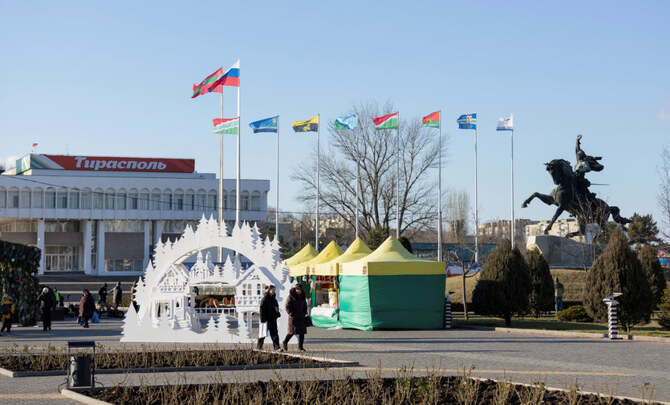
Flags fly near the monument to Russian commander Alexander Suvorov in a square in Tiraspol, Moldova's breakaway region of Transdniestria, on January 4, 2025. (REUTERS)
Short Url
Updated 05 January 2025
Follow

End of Ukraine gas transit deal plunges Moldova’s pro-Russian region into crisis

  • Kyiv refuses to renew the deal, leaving the breakaway region of Transdniestria without gas
  • With longer rolling blackouts, residents are left without heating, hot water

KYIV: The pro-Russian breakaway Moldovan region of Transdniestria, left without Russian gas supplies no longer transiting through neighboring Ukraine, faced longer periods of rolling power cuts on Saturday, local authorities said.
Flows of Russian gas via Ukraine to central and eastern Europe stopped on New Year’s Day after a transit deal expired between the warring countries and Kyiv refused to extend it.
Transdniestria, a mainly Russian-speaking enclave which has lived side-by-side with Moldova since breaking away from it in the last days of Soviet rule, received gas from Russian giant Gazprom through the pipeline crossing Ukraine.
The gas was used to operate a thermal plant which provided electricity locally and for much of Moldova under the control of the pro-European central government.
The region’s self-styled president, Vadim Krasnoselsky, writing on the Telegram messaging app, said rolling power cuts in various districts would be extended to four hours on Sunday.
Hour-long cuts were first imposed on Friday evening after heating and hot water supplies were curtailed. The cuts were then extended to three hours on Saturday.
“Yesterday’s introduction of rolling cuts was a test. And it confirmed that an hour-long break to keep the electrical supply system operating was insufficient,” Krasnoselsky wrote. “The power generated is not covering sharply rising demand.”
All industries except those producing food have been shut down. The official Telegram news channel of the region’s separatist authorities announced the official closure on Saturday of a steel mill and bakery in the town of Rybnitsa.
Regional officials announced new measures to help residents, especially the elderly, and warned that overnight temperatures would fall to -10 Celsius (+14 Fahrenheit). Residents were told not to put strain on the region’s mobile phone network.

Using firewood
The news channel warned against using heaters in disrepair after two residents died of carbon monoxide poisoning from a stove. Online pictures showed servicemen loading up trucks with firewood for distribution.
“Don’t put off gathering in firewood,” Krasnoselsky told residents. “It is better to ensure your supply in advance, especially since the weather is favorable so far.”
Moldova’s government blames Russia for the crisis and has called on Gazprom to ship gas through the Turkstream pipeline and then through Bulgaria and Romania.
Russia denies using gas as a weapon to coerce Moldova, and blames Kyiv for refusing to renew the gas transit deal.
The Transdniestria power cuts are a problem for Moldova particularly because the enclave is home to a power plant which provides most of the power for government-controlled areas of Moldova at a fixed and low price.
Prime Minister Dorin Recean said on Friday his country faced a security crisis after Transdniestria imposed the rolling blackouts, but he also said the Chisinau government had prepared alternative arrangements, with a mixture of domestic production and electricity imports from Romania.
Even before the halt of supplies via Ukraine, Gazprom had said it would suspend exports to Moldova on Jan. 1 because of what Russia says are unpaid Moldovan debts of $709 million. Moldova disputes that and put the figure at $8.6 million.



Survivors pick up pieces in flood-hit Indonesia as more rain predicted

Updated 3 sec ago
Follow

Survivors pick up pieces in flood-hit Indonesia as more rain predicted

TUKKA: Survivors in Indonesia were piecing back shattered lives Friday after devastating floods killed more than 1,500 people across four countries, with fears of fresh misery as more rain looms.
Indonesia has borne the brunt, with its toll rising to 837 dead and 545 missing, authorities said, many in Sumatra’s northern Aceh province where more than 800,000 people have been displaced. Sri Lanka has reported 486 deaths, Thailand 276 and Malaysia two.
Many survivors in Sumatra were counting the cost of the deluge that started last week, leading to destructive flash-flooding and landslides.
“Our house was covered by soil up to the ceiling,” said Rumita Laurasibuea. “Around the house, there were piles of wood.”
The 42-year-old government employee, now sheltering in a school, told AFP that recovering from the flood’s impact “could take more than a year.”
“This is a calamity we must face,” added Hendra Vramenia, 37, who fled his village of Kampung Dalam in southeastern Aceh.
“Possessions can be regained,” he told AFP, saying he remained worried that people in remote areas risk starvation.
Hendra said he would consider evacuating his family to his
“I will evacuate the children and family there first. Or I might also consider renting a house for the family,” he added.

- ‘Still worried’ -

Indonesia’s meteorological agency warned Aceh could see “very heavy rain” through Saturday, with North and West Sumatra also at risk.
Indonesian flood victims said fresh rain was likely to bring fresh misery.
“We are still worried... If the rain comes again, where can we go? Where can we evacuate?” asked Rumita.
In Sri Lanka, authorities said floodwaters had begun to recede, but residents face a mammoth clean-up.
In the central town of Gampola, residents worked to clear the mud and water damage.
“We are getting volunteers from other areas to help with this clean-up,” Muslim cleric Faleeldeen Qadiri told AFP at the Gate Jumma Mosque.
“It takes 10 men a whole day to clean one house,” said a volunteer, who gave his name as Rinas.
“No one can do this without help.”

- ‘Criminal prosecution’ -

Two separate weather systems dumped massive rainfall on all of Sri Lanka, Sumatra, parts of southern Thailand and northern Malaysia last week.
While across Asia seasonal monsoons bring rainfall that farmers depend on, climate change is making the phenomenon more erratic, unpredictable and deadly across the region.
But environmentalists and Indonesia’s government have pointed to the role forest loss played in the flash flooding and landslides that washed torrents of mud into villages and stranded residents of rooftops.
Indonesia is among the countries with the largest annual forest loss due to mining, plantations and fires, and has seen the clearance of large tracts of its lush rainforest in recent decades.
Jakarta on Wednesday said it was revoking environmental permits of several companies suspected of worsening the disaster’s impact.
Eight companies will be summoned on Monday in a probe, Environment Minister Hanif Faisol Nurofiq said.
Should evidence show corporate involvement in illegal logging or land clearing, which aggravated the disaster, “investigations could escalate to criminal prosecution,” Hanif said.
The scale of the disaster has made relief efforts challenging.
Indonesia’s government this week insisted it could handle the fallout, despite public outcry that not enough was being done.