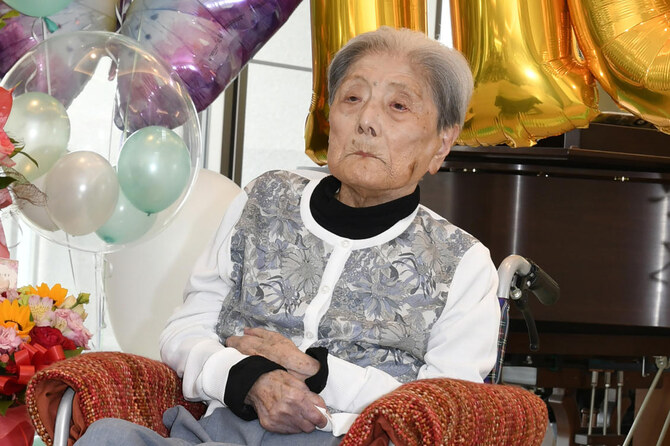
TOKYO: The world’s oldest person, Japanese woman Tomiko Itooka, has died aged 116, the city where she lived, Ashiya, announced on Saturday.
Itooka, who had four children and five grandchildren, died on December 29 at a nursing home where she resided since 2019, the southern city’s mayor said in a statement.
She was born on May 23, 1908 in the commercial hub of Osaka, near Ashiya – four months before the Ford Model T was launched in the United States.
Itooka was recognized as the oldest person in the world after the August 2024 death of Spain’s Maria Branyas Morera at age 117.
“Ms Itooka gave us courage and hope through her long life,” Ashiya’s 27-year-old mayor Ryosuke Takashima said in the statement.
“We thank her for it.”
Itooka, who was one of three siblings, lived through world wars and pandemics as well as technological breakthroughs.
As a student, she played volleyball.
In her older age, Itooka enjoyed bananas and Calpis, a milky soft drink popular in Japan, according to the mayor’s statement.
Women typically enjoy longevity in Japan, but the country is facing a worsening demographic crisis as its expanding elderly population leads to soaring medical and welfare costs, with a shrinking labor force to pay for it.
As of September, Japan counted more than 95,000 people who were 100 or older – 88 percent of whom were women.
Of the country’s 124 million people, nearly a third are 65 or older.

World’s oldest person dies at 116 in Japan
https://arab.news/pkuj8
World’s oldest person dies at 116 in Japan
- Tomiko Itooka was born on May 23, 1908 in the commercial hub of Osaka, near Ashiya
- As of September, Japan counted more than 95,000 people who were 100 or older
Arts festival’s decision to exclude Palestinian author spurs boycott
- A Macquarie University academic who researches Islamophobia and Palestine, Abdel-Fattah responded saying it was “a blatant and shameless act of anti-Palestinian racism and censorship,” with her lawyers issuing a letter to the festival
SYDENY: A top Australian arts festival has seen the withdrawal of dozens of writers in a backlash against its decision to bar an Australian Palestinian author after the Bondi Beach mass shooting, as moves to curb antisemitism spur free speech concerns.
The shooting which killed 15 people at a Jewish Hanukkah celebration at Sydney’s Bondi Beach on Dec. 14 sparked nationwide calls to tackle antisemitism. Police say the alleged gunmen were inspired by Daesh.
The Adelaide Festival board said last Thursday it would disinvite Randa Abdel-Fattah from February’s Writers Week in the state of South Australia because “it would not be culturally sensitive to continue to program her at this unprecedented time so soon after Bondi.”
FASTFACTS
• Abdel-Fattah responded, saying it was ‘a blatant and shameless act of anti-Palestinian racism and censorship.’
• Around 50 authors have since withdrawn from the festival in protest, leaving it in doubt, local media reported.
A Macquarie University academic who researches Islamophobia and Palestine, Abdel-Fattah responded saying it was “a blatant and shameless act of anti-Palestinian racism and censorship,” with her lawyers issuing a letter to the festival.
Around 50 authors have since withdrawn from the festival in protest, leaving it in doubt, local media reported.
Among the boycotting authors, Kathy Lette wrote on social media the decision to bar Abdel-Fattah “sends a divisive and plainly discriminatory message that platforming Australian Palestinians is ‘culturally insensitive.'”
The Adelaide Festival said in a statement on Monday that three board members and the chairperson had resigned. The festival’s executive director, Julian Hobba, said the arts body was “navigating a complex moment.”
a complex and unprecedented moment” after the “significant community response” to the board decision.
In the days after the Bondi Beach attack, Jewish community groups and the Israeli government criticized Prime Minister Anthony Albanese for failing to act on a rise in antisemitic attacks and criticized protest marches against Israel’s war in Gaza held since 2023.
Albanese said last week a Royal Commission will consider the events of the shooting as well as antisemitism and social cohesion in Australia. Albanese said on Monday he would recall parliament next week to pass tougher hate speech laws.
On Monday, New South Wales state premier Chris Minns announced new rules that would allow local councils to cut off power and water to illegally operating prayer halls.
Minns said the new rules were prompted by the difficulty in closing a prayer hall in Sydney linked to a cleric found by a court to have made statements intimidating Jewish Australians.
The mayor of the western Sydney suburb of Fairfield said the rules were ill-considered and councils should not be responsible for determining hate speech.
“Freedom of speech is something that should always be allowed, as long as it is done in a peaceful way,” Mayor Frank Carbone told Reuters.


