

World’s oldest known person dies aged 118: spokesman

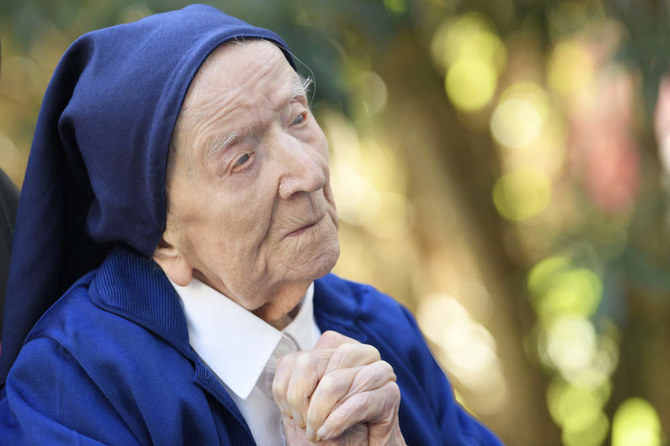
In this file photo taken on February 10, 2021, Sister Andre, Lucile Randon in the registry of birth, the eldest French and European citizen, prays in a wheelchair, on the eve of her 117th birthday, in an EHPAD (Housing Establishment for Dependant Elderly People) in Toulon, southern France, where she has been living since 2009. (AFP)
Short Url
Updated 18 January 2023
Follow

World’s oldest known person dies aged 118: spokesman

  • The sister was long feted as the oldest European, before the death of Japan’s Kane Tanaka aged 119 last year left her the longest-lived person on Earth

MARSEILLE: The world’s oldest known person, French nun Lucile Randon, has died aged 118, a spokesman told AFP on Tuesday.
Randon, known as Sister Andre, was born in southern France on February 11, 1904, when World War I was still a decade away.
She died in her sleep at her nursing home in Toulon, spokesman David Tavella said.
“There is great sadness but... it was her desire to join her beloved brother. For her, it’s a liberation,” Tavella, of the Sainte-Catherine-Laboure nursing home, told AFP.
The sister was long feted as the oldest European, before the death of Japan’s Kane Tanaka aged 119 last year left her the longest-lived person on Earth.
Guinness World Records officially acknowledged her status in April 2022.
Randon was born in the year New York opened its first subway and when the Tour de France had only been staged once.
She grew up in a Protestant family as the only girl among three brothers, living in the southern town of Ales.
One of her fondest memories was the return of two of her brothers at the end of World War I, she told AFP in an interview on her 116th birthday.
“It was rare, in families, there were usually two dead rather than two alive. They both came back,” she said.
She worked as a governess in Paris — a period she once called the happiest time of her life — for the children of wealthy families.
She converted to Catholicism and was baptised at the age of 26.
Driven by a desire to “go further,” she joined the Daughters of Charity order of nuns at the relatively late age of 41.
Sister Andre was then assigned to a hospital in Vichy, where she worked for 31 years.
In later life she moved to Toulon along the Mediterranean coast.
Her days in the nursing home were punctuated by prayer, mealtimes and visits from residents and hospice workers.
She also received a steady flow of letters, almost all of which she responded to.
In 2021 she survived catching Covid-19, which infected 81 residents of her nursing home.

Randon told reporters last year that her work and caring for others had kept her spry.
“People say that work kills, for me work kept me alive, I kept working until I was 108,” she told reporters in April last year in the tearoom of the home.
Although she was blind and relied on a wheelchair, she used to care for other elderly people much younger than herself.
“People should help each other and love each other instead of hating. If we shared all that, things would be a lot better,” she said at the same meeting with journalists.
But the Catholic nun had rejected requests for locks of hair or DNA samples, saying that “only the good Lord knows” the secret of her longevity.
It is likely that France’s new oldest person is now 112-year-old Marie-Rose Tessier, a woman from Vendee, longevity expert Laurent Toussaint told AFP.
But Toussaint warned that it was always possible an even older person had not yet made themselves known.
Jeanne Calment, who died in 1997 in Arles, southern France, at the age of 122 holds the record for the oldest confirmed age reached by any human.


As an uncertain 2026 begins, virtual journeys back to 2016 become a trend

Updated 30 January 2026
Follow

As an uncertain 2026 begins, virtual journeys back to 2016 become a trend

  • Over the past few weeks, millions have been sharing throwback photos to that time on social media, kicking off one of the first viral trends of the year

LONDON: The year is 2016. Somehow it feels carefree, driven by Internet culture. Everyone is wearing over-the-top makeup.
At least, that’s how Maren Nævdal, 27, remembers it — and has seen it on her social feeds in recent days.
For Njeri Allen, also 27, the year was defined by the artists topping the charts that year, from Beyonce to Drake to Rihanna’s last music releases. She also remembers the Snapchat stories and an unforgettable summer with her loved ones. “Everything felt new, different, interesting and fun,” Allen says.
Many people, particularly those in their 20s and 30s, are thinking about 2016 these days. Over the past few weeks, millions have been sharing throwback photos to that time on social media, kicking off one of the first viral trends of the year — the year 2026, that is.
With it have come the memes about how various factors — the sepia hues over Instagram photos, the dog filters on Snapchat and the music — made even 2016’s worst day feel like the best of times.
Part of the look-back trend’s popularity has come from the realization that 2016 was already a decade ago – a time when Nævdal says she felt like people were doing “fun, unserious things” before having to grow up.
But experts point to 2016 as a year when the world was on the edge of the social, political and technological developments that make up our lives today. Those same advances — such as developments under US President Donald Trump and the rise of AI — have increased a yearning for even the recent past, and made it easier to get there.
2016 marked a year of transition
Nostalgia is often driven by a generation coming of age — and its members realizing they miss what childhood and adolescence felt like. That’s certainly true here. But some of those indulging in the online journeys through time say something more is at play as well.
It has to do with the state of the world — then and now.
By the end of 2016, people would be looking ahead to moments like Trump’s first presidential term and repercussions of the United Kingdom leaving the EU after the Brexit referendum. A few years after that, the COVID-19 pandemic would send most of the world into lockdown and upend life for nearly two years.
Janelle Wilson, a professor of sociology at the University of Minnesota-Duluth, says the world was “on the cusp of things, but not fully thrown into the dark days that were to come.”
“The nostalgia being expressed now, for 2016, is due in large part to what has transpired since then,” she says, also referencing the rise of populism and increased polarization. “For there to be nostalgia for 2016 in the present,” she added, “I still think those kinds of transitions are significant.”
For Nævdal, 2016 “was before a lot of the things we’re dealing with now.” She loved seeing “how embarrassing everyone was, not just me,” in the photos people have shared.
“It felt more authentic in some ways,” she says. Today, Nævdal says, “the world is going downhill.”
Nina van Volkinburg, a professor of strategic fashion marketing at University of the Arts, London, says 2016 marked the beginning of “a new world order” and of “fractured trust in institutions and the establishment.” She says it also represented a time of possibility — and, on social media, “the maximalism of it all.”
This was represented in the bohemian fashion popularized in Coachella that year, the “cut crease” makeup Nævdal loved and the dance music Allen remembers.
“People were new to platforms and online trends, so were having fun with their identity,” van Volkinburg says. “There was authenticity around that.”
And 2016 was also the year of the “boss babe” and the popularity of millennial pink, van Volkinburg says, indications of young people coming into adulthood in a year that felt hopeful.
Allen remembers that as the summer she and her friends came of age as high school graduates. She says they all knew then that they would remember 2016 forever.
Ten years on, having moved again to Taiwan, she said “unprecedented things are happening” in the world. “Both of my homes are not safe,” she said of the US and Taiwan, “it’s easier to go back to a time that’s more comfortable and that you felt safe in.”
Feelings of nostalgia are speeding up
In the last few days, Nævdal decided to hide the social media apps on her phone. AI was a big part of that decision. “It freaks me out that you can’t tell what’s real anymore,” she said.
“When I’ve come off of social media, I feel that at least now I know the things I’m seeing are real,” she added, “which is quite terrifying.”
The revival of vinyl record collections, letter writing and a fresh focus on the aesthetics of yesterday point to nostalgia continuing to dominate trends and culture. Wilson says the feeling has increased as technology makes nostalgia more accessible.
“We can so readily access the past or, at least, versions of it,” she said. “We’re to the point where we can say, ‘Remember last week when we were doing XYZ? That was such a good time!’”
Both Nævdal and Allen described themselves as nostalgic people. Nævdal said she enjoys looking back to old photos – especially when they show up as “On This Day” updates on her phone, She sends them to friends and family when their photos come up.
Allen wished that she documented more of her 2016 and younger years overall, to reflect on how much she has evolved and experienced since.
“I didn’t know what life could be,” she said of that time. “I would love to be able to capture my thought process and my feelings, just to know how much I have grown.”