

Pakistani province vows to enforce writ in Karachi after police’s clash with sit-in protesters

Police personnel (front) disperse protesters (back) during a demonstration in Karachi on December 31, 2024, to condemn sectarian clashes in Pakistan’s Kurram district. (AFP)
Short Url
Updated 01 January 2025
Follow

Pakistani province vows to enforce writ in Karachi after police’s clash with sit-in protesters

  • Majlis Wahdat-e-Muslimeen party is leading sit-in protests in Karachi to protest violence in northwestern Kurram district 
  • Karachi police say eight cops wounded during Tuesday’s clashes, out of which three were injured due to protesters’ firing

KARACHI: The home minister of Pakistan’s southern Sindh province on Wednesday warned members of a religio-political party of stern action if they did not move their sit-in protests from Karachi’s busy locations to designated spots, a day after law enforcers clashed with the demonstrators in the port city. 
Karachi police and the paramilitary Rangers force cracked down on protesters belonging to the Majlis Wahdat-e-Muslimeen (MWM) party on Tuesday morning, using tear gas to disperse them from the city’s busy Numaish Chowrangi, Malir and other locations. Demonstrators pelted the law enforcers with stones in response and chanted slogans against them. 
The MWM has been leading sit-in protests at over 10 locations in Karachi since last week to protest violence in the northwestern Kurram district. With a population of around 600,000, Kurram has been plagued by tribal and sectarian violence for decades. A devastating ambush on a convoy of Shias on Nov. 21 in which gunmen killed 52 people, gave rise to sectarian clashes in the area that have since then claimed the lives of at least 136 people. 
Karachi police has charged protesters under the country’s anti-terror law, saying that over 150 protesters fired directly at police officers with the intention to kill during Tuesday’s clashes in the city’s Malir district. Two police constables, Zaeem Abbas and Ayaz Gul, were injured in the gunfire, as per the police complaint. All in all, police said eight cops were injured during the clashes out of which three were injured due to firing by protesters.  
“It is not possible for us to let the city fall victim to violence,” Sindh Home Minister Zia Ul Hassan Lanjar told reporters at a news conference. “It’s not possible for us to not protect the lives and property of citizens while sitting idle,” he added. 
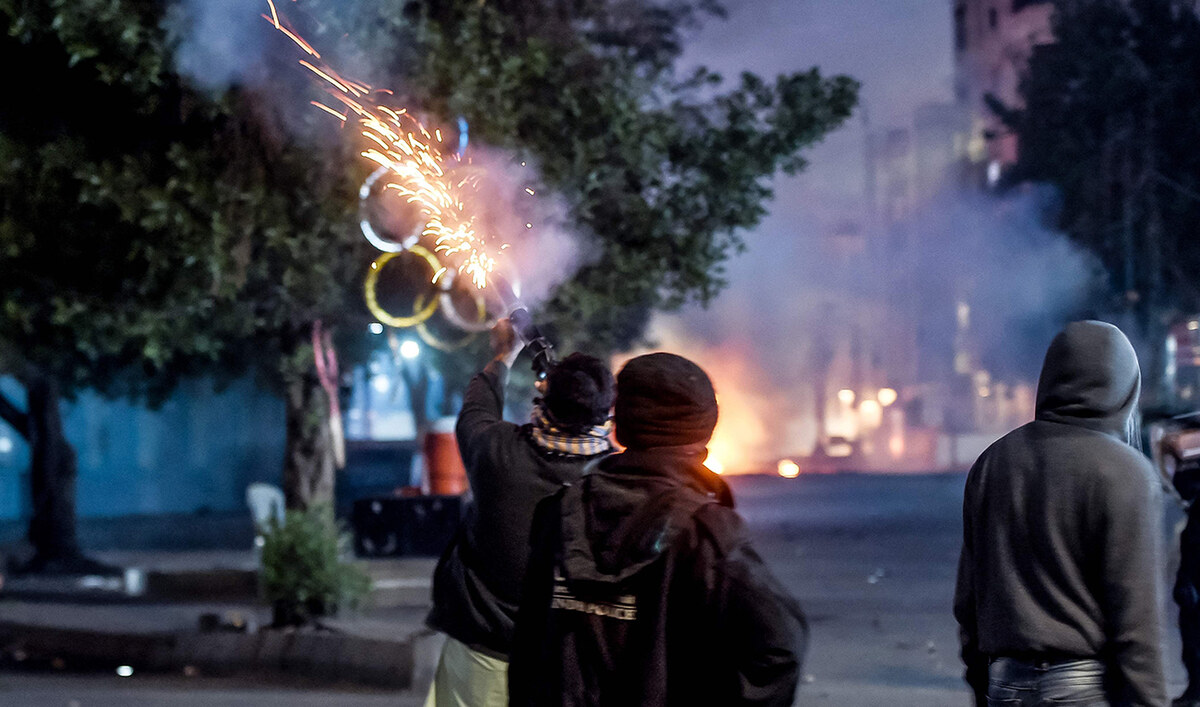


Police personnel fire tear gas shells to disperse protesters during a demonstration in Karachi on December 31, 2024, to condemn sectarian clashes in Pakistan’s Kurram district. (AFP)

He said the government was ready for talks with protesters but also warned that it would enforce its writ in the city. 
“Against any illegal actions, the government will stand firm, the police will do its job, the Rangers will do their job and law enforcement agencies will carry out their responsibilities,” the minister said. 
He said the Sindh government had extended protesters the offer to move their protests to designated spots across the city. 
“We will stand with you, but this is not the way for our main Saddar area to be closed, for Shahra-e-Faisal to be closed, for the Ancholi area to be closed, for the Malir area to be closed, and to turn the city into a battlefield,” he said, referring to Karachi’s areas where the MWM is holding protests.
 “You cannot do this. We will not compromise on this under any circumstances.”
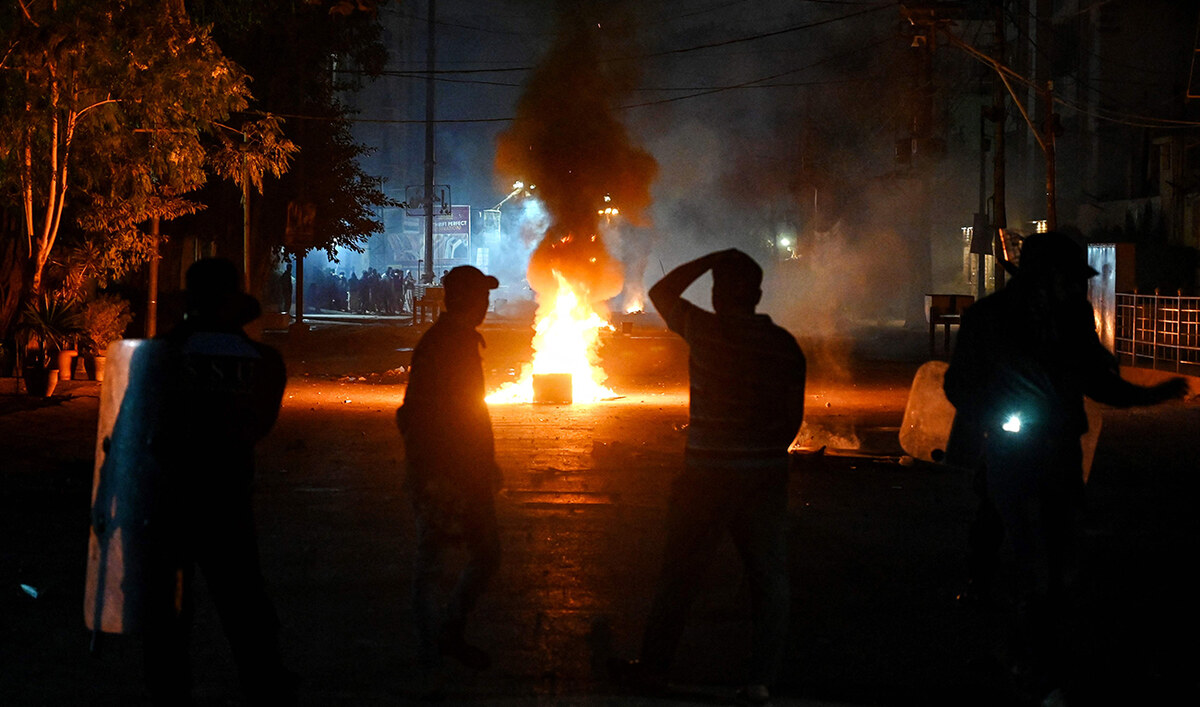


Police personnel (front) disperse protesters (back) during a demonstration in Karachi on December 31, 2024, to condemn sectarian clashes in Pakistan’s Kurram district. (AFP)

Reiterating his offer of negotiations, Lanjar said Karachi’s additional Inspector-general of police and the city’s commissioner will hold talks with MWM since Sindh’s senior ministers had already met representatives of the party. 
Meanwhile, senior MWM leader Allama Baqir Hussain Zaidi announced that the party’s protests in Karachi will continue. 
“The ongoing sit-ins will continue wherever they are being held and alternative routes will remain open,” Zaidi said in a video message. “The community is urged to participate in the sit-ins in an organized manner and to consider it both a personal and religious obligation to join tomorrow evening’s protest gathering.”
He announced that the group will hold a protest rally on Thursday at 4:00 p.m. at Numaish Chowrangi, stressing that it will be a peaceful one. 
A grand jirga — a traditional council of political and tribal elders — has been attempting to mediate between the rival factions in Kurram to enforce peace.


Pakistan highlights economic reforms at Davos, eyes cooperation in AI, IT and minerals

Updated 21 January 2026
Follow

Pakistan highlights economic reforms at Davos, eyes cooperation in AI, IT and minerals

  • Prime Minister Shehbaz Sharif speaks at breakfast event in Davos at sidelines of World Economic Forum summit
  • Pakistan, rich in gold, copper reserves, has sought cooperation with China, US, Gulf countries in its mineral sector

ISLAMABAD: Prime Minister Shehbaz Sharif highlighted Pakistan’s recent economic reforms during the sidelines of the ongoing World Economic Forum (WEF) summit in Davos on Wednesday, saying that his country was eyeing greater cooperation in mines and minerals, information technology, cryptocurrency and artificial intelligence with other states. 

The Pakistani prime minister was speaking at the Pakistan Pavilion in Davos on the sidelines of the WEF summit at a breakfast event. Sharif arrived in Switzerland on Tuesday to attend the 56th annual meeting of the WEF, which brings together global business leaders, policymakers and politicians to speak on social, economic and political challenges. 

Pakistan has recently undertaken several economic reforms, which include removing subsidies on energy and food, privatization of loss-making state-owned enterprises and expanding its tax base. Islamabad took the measures as part of reforms it agreed with the International Monetary Fund (IMF) in exchange for a financial bailout package. 

“We are now into mines and minerals business in a big way,” Sharif said at the event. “We have signed agreements with American companies and Chinese companies.”

Islamabad has sought to attract foreign investment in its critical minerals sector in recent months. In April 2025, Pakistan hosted an international minerals summit where top companies and government officials from the US, Saudi Arabia, China, Türkiye, the UK, Azerbaijan, and other nations attended.

Pakistan is rich in gold, copper and lithium reserves as well as other minerals, yet its mineral sector contributes only 3.2 percent to the countrys GDP and 0.1 percent to global exports, according to official figures.

Sharif said Pakistan has been blessed with infinite natural resources which are buried in its mountains in the northern Gilgit-Baltistan, Khyber Pakhtunkhwa, Azad Kashmir and southwestern Balochistan regions. 

“But we have now decided to go forward at lightning speed,” he said. “And we are also moving speedily in the field of crypto, AI, IT.”

He said the government’s fiscal and economic measures have reduced inflation from nearly 30 percent a few years ago to single-digit figures, adding that its tax-to-GDP ratio had also increased from 9 to 10.5 percent. 

The prime minister admitted Pakistan’s exports face different kinds of challenges collectively, saying the country’s social indicators needed to improve. 

“But the way forward is very clear: that Pakistan has to have an export-led growth,” he said. 

SHARIF MEETS IMF MANAGING DIRECTOR

Separately, Sharif met IMF Managing Director Kristalina Georgieva on improvements in Pakistan’s macroeconomic indicators, efforts toward stability and progress on institutional reforms, a statement from Sharif’s office said.

He emphasized Pakistan’s commitment to fiscal discipline, revenue mobilization and sustainable development, it added. 

The IMF managing director acknowledged and appreciated Pakistan’s reform efforts, the Prime Minister’s Office (PMO) said.

“Both sides exchanged views on the global economic outlook, challenges facing emerging economies, and the importance of multilateral cooperation in safeguarding economic stability,” the PMO said.