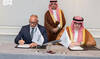
DAMASCUS: Syria’s de facto leader Ahmed Al-Sharaa met with senior Christian clerics on Tuesday, amid calls on the Islamist chief to guarantee minority rights after seizing power earlier this month.
“The leader of the new Syrian administration, Ahmed Al-Sharaa, meets a delegation from the Christian community in Damascus,” Syria’s General Command said in a statement on Telegram.
The statement included pictures of the meeting with Catholic, Orthodox and Anglican clerics.
Earlier Tuesday, French Foreign Minister Jean-Noel Barrot called for an inclusive political transition in Syria that guarantees the rights of the country’s diverse communities.
He expressed hope that “Syrians could take back control of their own destiny.”
But for this to happen, the country needs “a political transition in Syria that includes all communities in their diversity, that upholds the most basic rights and fundamental freedoms,” Barrot told AFPTV during a visit to Lebanon with Defense Minister Sebastien Lecornu.
Barrot and Lecornu also met Lebanon’s army chief Joseph Aoun and visited UN peacekeepers patrolling the southern border, where a fragile truce ended intense fighting between Israel and Hezbollah in late November.
Since seizing power, Syria’s new leadership has repeatedly tried to reassure minorities that they will not be harmed, although some incidents have sparked protests.
On December 25, thousands protested in several areas of Syria after a video circulated showing an attack on an Alawite shrine in the country’s north.
A day earlier, hundreds of demonstrators took to the streets in Christian areas of Damascus to protest the burning of a Christmas tree near Hama in central Syria.
Before the civil war erupted in 2011, Syria was home to about one million Christians, according to analyst Fabrice Balanche, who says their number has dwindled to about 300,000.
Earlier, a Syrian official told AFP that Sharaa held “positive” talks with delegates of the Kurdish-led Syrian Democratic Forces (SDF) on Monday.
The talks were Sharaa’s first with Kurdish commanders since his Islamist-led rebels overthrew longtime strongman Bashar Assad in early December and come as the SDF is locked in fighting with Turkish-backed factions in northern Syria.
The US-backed SDF spearheaded the military campaign that ousted Daesh group jihadists from their last territory in Syria in 2019.
But Turkiye, which has long had ties with Sharaa’s Hayat Tahrir Al-Sham group, accuses the main component of the SDF of links to the Kurdistan Workers’ Party (PKK), which has waged a four-decade insurgency against the Turkish state.
On Sunday, Sharaa told Al Arabiya television that Kurdish-led forces should be integrated into the new national army.
“Weapons must be in the hands of the state alone. Whoever is armed and qualified to join the defense ministry, we will welcome them,” he said.