

Turkish lawmakers back plan advancing PKK peace process

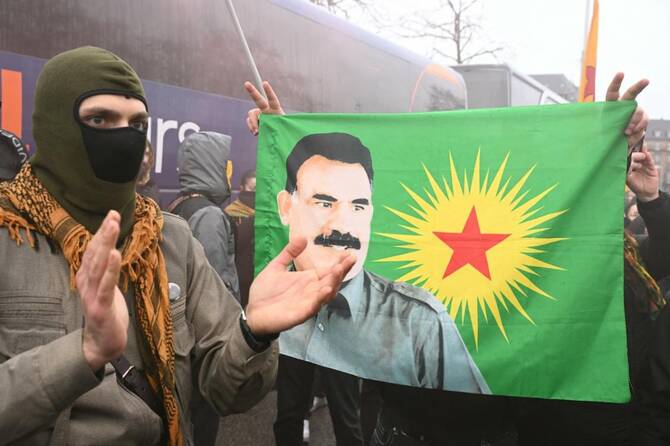
Protestors hold a flag bearing a portrait of jailed leader of the Kurdistan Workers' Party (PKK) Abdullah Ocalan during a demonstration of Kurdish people from all around Europe to mark the 27th anniversary of his arrest and to demand his liberation, in Strasbourg, Eastern France, on February 14, 2026. (FILE/AFP)
Short Url
Updated 18 February 2026
Follow

Turkish lawmakers back plan advancing PKK peace process

  • The vote shifts the peace process to the legislative theater
  • The roughly 60-page report proposes a roadmap for the parliament to enact laws

ANKARA: A Turkish parliamentary commission voted overwhelmingly on Wednesday to approve a report envisaging legal reforms alongside the militant Kurdistan Workers Party’s (PKK) disarmament, advancing a peace process meant to end decades of conflict.
The vote shifts the peace process to the legislative theater, as President Tayyip Erdogan, Turkiye’s leader of more than two decades, bids to end a conflict that has killed more than 40,000 people, sown deep discord at home and spread violence across borders into Iraq and Syria.
The PKK — designated a terrorist organization by Turkiye, the United States and European Union — halted attacks last year and said ⁠it would disarm ⁠and disband, calling on Ankara to take steps to let its members participate in politics.
The roughly 60-page report proposes a roadmap for the parliament to enact laws, including a conditional legal framework that urges the judiciary to review legislation and comply with European Court of Human Rights and Constitutional Court rulings.

PRO-KURDISH PARTY CALLS FOR RAPID IMPLEMENTATION
The pro-Kurdish DEM Party, which has been closely involved in the process and held several meetings with PKK leader ⁠Abdullah Ocalan in prison, objected to the report’s presentation of the Kurdish issue as a terrorism problem but generally welcomed the report and called for rapid implementation. “We believe legal regulations must be enacted quickly,” senior DEM lawmaker Gulistan Kilic Kocyigit told Reuters. Parts of the report offered “a very important roadmap for the advancement of this process,” she said. Erdogan signaled that the legislative process would begin straight away. “Now, discussions will begin in our parliament regarding the legal aspects of the process,” he said.
RECOMMENDS NO PERCEPTION OF AMNESTY
The report was approved by 47 of the commission’s 50 lawmakers. Its stated core objectives are a “terrorism-free Turkiye” and strengthening democracy, and it cites an agreement among political parties that reforms ⁠and disarmament should advance ⁠reciprocally and in parallel.
The section on legal reforms ties implementation to verified PKK disarmament, envisaging a separate and temporary legal framework and a special executive appointment to oversee implementation. “The law should aim to reintegrate individuals who reject weapons and violence into society,” the report said, even as legal regulations “should not create a perception of impunity and amnesty in society.” Amnesty for PKK members is unpopular among Turks, polls show.
A chapter on democratization proposals includes a recommendation to comply with ECHR and Constitutional Court rulings. It also calls for clearer anti-terrorism law definitions to exclude non-violent acts, and for expanded freedoms of expression, press and assembly. The PKK has symbolically burned some weapons and announced it was withdrawing any remaining fighters from Turkiye as a first step toward their legal reintegration into society, heeding a call from the movement’s leader Ocalan.


US makes plans to reopen embassy in Syria after 14 years

Updated 21 February 2026
Follow

US makes plans to reopen embassy in Syria after 14 years

  • The administration has been considering re-opening the embassy since last year
  • Trump told reporters on Friday that Al-Sharaa was “doing a phenomenal job” as president

WASHINGTON: The Trump administration has informed Congress that it intends to proceed with planning for a potential re-opening of the US Embassy in Damascus, Syria, which was shuttered in 2012 during the country’s civil war.
A notice to congressional committees earlier this month, which was obtained by The Associated Press, informed lawmakers of the State Department’s “intent to implement a phased approach to potentially resume embassy operations in Syria.”
The Feb. 10 notification said that spending on the plans would begin in 15 days, or next week, although there was no timeline offered for when they would be complete or when US personnel might return to Damascus on a full-time basis.
The administration has been considering re-opening the embassy since last year, shortly after longtime strongman Bashar Assad was ousted in December 2024, and it has been a priority for President Donald Trump’s ambassador to Turkiye and special envoy for Syria, Tom Barrack.
Barrack has pushed for a deep rapprochement with Syria and its new leadership under former rebel Ahmad Al-Sharaa and has successfully advocated for the lifting of US sanctions and a reintegration of Syria into the regional and international communities.
Trump told reporters on Friday that Al-Sharaa was “doing a phenomenal job” as president. “He’s a rough guy. He’s not a choir boy. A choir boy couldn’t do it,” Trump said. “But Syria’s coming together.”
Last May, Barrack visited Damascus and raised the US flag at the embassy compound, although the embassy was not yet re-opened.
The same day the congressional notification was sent, Barrack lauded Syria’s decision to participate in the coalition that is combating the Daesh militant group, even as the US military has withdrawn from a small, but important, base in the southeast and there remain significant issues between the government and the Kurdish minority.
“Regional solutions, shared responsibility. Syria’s participation in the D-Daesh Coalition meeting in Riyadh marks a new chapter in collective security,” Barrack said.
The embassy re-opening plans are classified and the State Department declined to comment on details beyond confirming that the congressional notification was sent.
However, the department has taken a similar “phased” approach in its plans to re-open the US Embassy in Caracas, Venezuela, following the US military operation that ousted former President Nicolás Maduro in January, with the deployment of temporary staffers who would live in and work out of interim facilities.