Syrian President Assad’s Baath Party clinches control of parliament

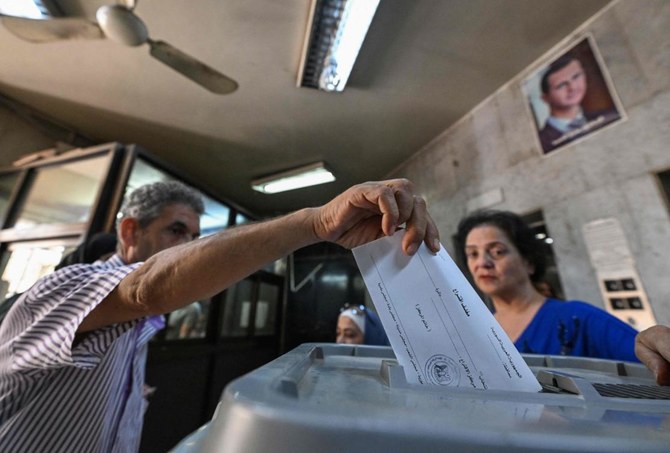
Syrians in government-held areas were voting on July 15 in their fourth parliamentary election since civil war erupted in 2011, a poll expected to keep President Bashar al-Assad's ruling Baath party in power. (File/AFP)
Short Url
Updated 18 July 2024
Follow

Syrian President Assad’s Baath Party clinches control of parliament

  • Elections for 250 parliamentary seats were held Monday at 8,151 centers in government-held areas of the country
  • The voting was repeated in several districts after election officials said there had been irregularities

DAMASCUS: The results of Syria’s parliamentary elections, announced Thursday, showed that President Bashar Assad’s Baath Party has won a majority of seats, as expected.
The elections for 250 parliamentary seats were held Monday at 8,151 centers in government-held areas of the country, but the voting was repeated in several districts — including Aleppo, Latakia, Hama and Daraa — after election officials said there had been irregularities, including voters casting ballots twice.
The heads of some electoral centers were referred to the judiciary for alleged electoral violations.
Altogether, 1,516 candidates were competing for the 250 seats. However, only 65 of those seats were seen as truly up for competition, as the Baath Party and allied parties presented a list of 185 candidates. Typically, all candidates who make it through the Baath Party primaries and appear on the final list win seats.
The results announced Thursday showed that all 185 candidates from the Baath Party and its allies won seats as expected, an increase from the 177 seats won by the coalition in 2020.
Turnout was 38 percent of the 19.3 million eligible voters, election officials said.
Unlike presidential elections, Syrians in the diaspora are not eligible to vote in parliamentary elections.
The head of the Supreme Judicial Committee for Elections, Jihad Murad, who announced the results, said they “reflected the broadest representation of the Syrian people in their various groups and sectors.”
The vote is the fourth since the country’s civil war began in March 2011.
With Assad facing term limits that would end his presidency in 2028, the next parliament is widely expected to try to pass a constitutional amendment to extend his term.
An amendment requires a three-quarters majority, or 188 votes, just over the number of seats held by the Bath Party and its allies. However, nominally independent candidates are also generally seen as loyal to the government.


Israeli police raid Christmas party in Haifa, arrest Palestinian man dressed as Santa

A person dressed as Santa Claus sells toys to people ahead of Christmas in Bethlehem, in the Israeli-occupied West Bank.
Updated 5 sec ago
Follow

Israeli police raid Christmas party in Haifa, arrest Palestinian man dressed as Santa

  • ‘Excessive force’ used in raid, says rights group for Palestinian citizens of Israel
  • Gaza marks first post-ceasefire Christmas as occupied West Bank faces holiday crackdown

LONDON: Police in Israel last week arrested a Palestinian man dressed as Santa Claus at a Christmas celebration in Haifa, The Guardian reported.

The Christmas event was closed on Sunday, after Israeli officers stormed the area and confiscated equipment, the Mossawa Center, a rights group for Palestinian citizens of Israel, said.

The Palestinian Santa Claus performer was arrested, as well as a DJ and street vendor.

In a video circulating on social media, police can be seen forcing the men to the ground and handcuffing them, as crowds of bystanders watch on.

The Palestinian man dressed as Santa Claus resisted arrest and assaulted an officer, Israeli police said in a statement.

But the police used excessive force during the raid, which was conducted without legal authority on the music hall venue, Mossawa said.

Palestinians across the occupied West Bank and Gaza are celebrating Christmas this week despite Israel’s imposition of restrictions on daily life there.

Celebrations for Dec. 25 were held in Bethlehem for the first time since the beginning of the war on Gaza.

Marching bands blew bagpipes in processions through the streets in the city of Jesus’ birth.

Churchgoers attended mass there at the Church of the Nativity and Palestinian children sang carols as the city hosted major celebrations.

Gaza’s small Christian community marked its first Christmas in the war-torn enclave since the signing of a fragile ceasefire between Israel and Hamas.

Amid the rubble strewn across Gaza, Christmas trees glitter brought sections of color to the territory, The Guardian reported.

Israel continued military operations and settler attacks took place despite the holiday.

In the town of Turmus Ayya outside Ramallah, Israeli settlers uprooted olive trees belonging to Palestinians, and near Hebron soldiers stormed the homes of residents and confiscated vehicles, according to the Palestinian news agency, WAFA.

Israel is carrying out mounting attacks against Christian sites in the occupied Palestinian territories.

A report in March documented 32 attacks on church properties and 45 assaults against Christians.

Pope Leo XIV, in his first Christmas address as pontiff, drew attention to the abysmal humanitarian situation in Gaza.

Hundreds of thousands of Palestinians there are living in tents amid fierce cold and rain, just as Jesus had been born in a stable, with God “pitching his fragile tent” among the peoples of the world, Leo said.

He added: “How, then, can we not think of the tents in Gaza, exposed for weeks to rain, wind and cold.”

The pope highlighted the plight of “the defenseless populations, tried by so many wars.”