Jailed PKK leader says ‘ready’ to support Turkiye peace drive

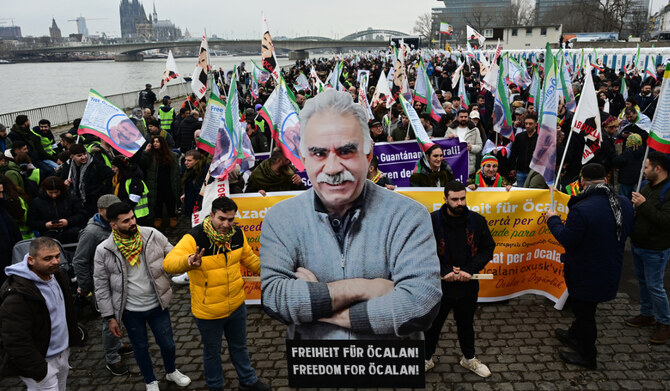
Supporters of the Kurdish community demonstrate with flags and banners on the occasion of the 25th anniversary of the arrest of Kurdistan Workers Party (PKK) leader Abdullah Ocalan on the banks of the Rhine river in Cologne, western Germany, on February 17, 2024. (AFP)
Short Url
Updated 29 December 2024
Follow

Jailed PKK leader says ‘ready’ to support Turkiye peace drive

  • The government’s approval of the visit comes two months after the head of Turkiye’s nationalist MHP party, Devlet Bahceli, extended Ocalan a shock olive branch, inviting him to parliament to renounce terror and disband his group, a move backed by Erdogan

ISTANBUL: Abdullah Ocalan, the jailed leader of the Kurdistan Workers’ Party (PKK), is “ready to make a call” to back a new initiative by the Turkish government to end decades of conflict, Turkiye’s pro-Kurd party said Sunday.
Two lawmakers from the DEM party made a rare visit to Ocalan on Saturday on his prison island, the first by the party in almost a decade, amid signs of easing tensions between the Turkish government and the PKK.
On Friday, President Recep Tayyip Erdogan’s government approved DEM’s request to visit the founder of the PKK, which is designated a terror group by Turkiye and its Western allies.
Ocalan has been serving a life sentence on the island of Imrali south of Istanbul since 1999.
The government’s approval of the visit comes two months after the head of Turkiye’s nationalist MHP party, Devlet Bahceli, extended Ocalan a shock olive branch, inviting him to parliament to renounce terror and disband his group, a move backed by Erdogan.
“I have the competence and determination to make a positive contribution to the new paradigm started by Mr.Bahceli and Mr.Erdogan,” Ocalan said, according to a DEM statement Sunday.
Ocalan said the visiting delegation would share his approach with both the state and political circles.
“In light of this, I am ready to take the necessary positive steps and make the call.”
DEM party co-chair Tuncer Bakirhan lauded Ocalan’s appeal as “historic opportunity to build a common future,” in a message on social media platform X.
“We are on the eve of a potential democratic transformation across Turkiye and the region. Now is the time for courage and foresight for an honorable peace,” he said.

The PKK has waged an insurgency against the Turkish state since 1984, claiming tens of thousands of lives.
A peace process between the PKK and the government collapsed in 2015, unleashing violence especially in the Kurdish-majority southeast.
The new initiative launched in October by Bahceli, who has been fiercely hostile to the PKK, sparked a public debate, with Erdogan hailing it as a “historic window of opportunity.”
But a deadly terror attack in October on a Turkish defense company in the capital Ankara, for which PKK militants claimed responsibility, put those hopes on hold.
Turkiye launched strikes on Kurdish militants in Iraq and Syria after the attack, which killed five people.
“Re-strengthening the Turkish-Kurdish brotherhood is not only a historical responsibility but also... an urgency for all peoples,” Ocalan said, according to the DEM statement.
He said all the efforts would “take the country to the level it deserves” and become a “very valuable guide for a democratic transformation.”
“It’s time for peace, democracy and brotherhood in Turkiye and the region.”
The new outreach by both sides comes as Islamist rebels consolidate their control in neighboring Syria after toppling its strongman president Bashar Assad.
Turkiye hopes Syria’s new leaders will address the issue of Kurdish forces in the country, which Ankara sees as a terror group affiliated to the PKK.
Foreign Minister Hakan Fidan told his US counterpart Antony Blinken in a phone call on Saturday that Kurdish fighters “cannot be allowed to take shelter in Syria,” according to the ministry spokesman.
According to the DEM statement, Ocalan said developments in Syria had shown that outside interference would only complicate the problem, and a solution could no longer be postponed.


Israel accused of move expanding Jerusalem borders for first time since 1967

Updated 4 sec ago
Follow

Israel accused of move expanding Jerusalem borders for first time since 1967

  • Planned development is formally a westward expansion of the Geva Binyamin, or Adam, settlement situated north-east of Jerusalem in the West Bank
  • Some 200,000 Israelis live in Israeli-annexed east Jerusalem, while more than 500,000 others live in West Bank settlements and outposts
JERUSALEM: Israeli NGOs have raised the alarm over a settlement plan signed by the government which they say would mark the first expansion of Jerusalem’s borders into the occupied West Bank since 1967.
Israel has occupied east Jerusalem since 1967 and later annexed it in a move not recognized by the international community.
Palestinians view east Jerusalem as the capital of their future state.
The proposal, published in early February but reported by Israeli media only on Monday, comes as international outrage mounts over creeping measures aimed at strengthening Israeli control over the West Bank.
Critics say these actions by the Israeli authorities are aimed at the de facto annexation of the Palestinian territory.
The planned development, announced by Israel’s Ministry of Construction and Housing, is formally a westward expansion of the Geva Binyamin, or Adam, settlement situated north-east of Jerusalem in the West Bank.
In a statement, the ministry said the development agreement included the construction of around 2,780 housing units for the settlement, with an investment of roughly 120 million Israeli shekels (around $38.7 million).
But the area to be developed lies on the Jerusalem side of the separation barrier built by Israel in the early 2000s, while Geva Binyamin sits on the West Bank side of the barrier, and the two are separated by a road.
In a statement, Israeli settlement watchdog Peace Now said there would be no “territorial or functional connection” between the area to be developed and the settlement.
“The new neighborhood will be integral to the city of Jerusalem,” Lior Amihai, Peace Now’s executive director, told AFP.
“What is unique about that one is that it will be connected directly to Jerusalem, but it will be beyond the annexed municipal border. So it will be in complete West Bank territory, but just adjacent to Jerusalem,” he said.

‘Living there as Jerusalemites’

The move comes days after Israel’s government approved a process to register land in the West Bank as “state property,” drawing widespread international condemnation and fears among critics that it would accelerate annexation of the Palestinian territory.
Days earlier, Israel’s security cabinet approved a series of measures to tighten control over areas of the West Bank administered by the Palestinian Authority under the Oslo accords.
Those measures, which also sparked international backlash, include allowing Jewish Israelis to buy West Bank land directly and allowing Israeli authorities to administer certain religious sites in areas under the Palestinian Authority’s control.
Amihai said that the current government — one of the most right-wing in Israel’s history — was “systematically working to annex the occupied territories and to prevent Palestinian statehood.”
The case of Jerusalem, he said, was particularly symbolic.
“Every change to Jerusalem is sensitive to both the Israeli public, but also to the Palestinians,” he told AFP.
Aviv Tatarsky, a researcher at Ir Amim, an Israeli NGO focusing on Jerusalem within the context of the Israeli-Palestinian conflict, said the latest planned development amounted to a de facto expansion of the city of Jerusalem.
“If it is built, and people live there, the people who will live there, they will be living there as Jerusalemites,” he told AFP.
“In all practical terms, it’s basically not the settlement that will be expanded, but Jerusalem.”

‘Facts on the ground’

The development agreement was signed by Israel’s Construction and Housing Ministry, the Finance Ministry and the Binyamin Regional Council, which represents settlements north of Ramallah in the central West Bank.
It has yet to be reviewed by the Civil Administration’s Higher Planning Committee, in a process which could take several months or years.
Tatarsky said that international pressure had so far made it difficult for recent Israeli governments to make formal declarations on annexation.
“It’s much easier to create facts on the ground, which, altogether... actually add up to annexation,” the researcher said.
The West Bank, occupied since 1967, would form the largest part of any future Palestinian state but is seen by many on the religious right as Israeli land.
Some 200,000 Israelis live in Israeli-annexed east Jerusalem, while more than 500,000 others live in West Bank settlements and outposts, which are illegal under international law.
Around three million Palestinians live in the territory.
The current Israeli government has fast-tracked settlement expansion, approving a record 52 settlements in 2025.