Security for Kurds ‘essential’ for a secure Syria: German FM

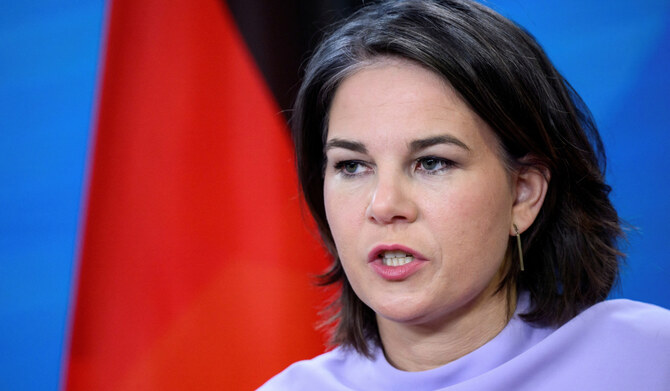
German Foreign Minister Annalena Baerbock and her Croatian counterpart Gordan Grlic Radman hold news conference in Berlin, Germany, March 24, 2022. (REUTERS)
Short Url
Updated 21 December 2024
Follow

Security for Kurds ‘essential’ for a secure Syria: German FM

  • “The view that the PKK/YPG represents the Kurds in Syria is wrong,” the source quoted him as saying, stressing Turkiye would never allow such “terrorist organizations to abuse the situation in Syria”

ANKARA: Security for the Kurdish people is critical for Syria to have a secure future, German Foreign Minister Annalena Baerbock told her Turkish counterpart in Ankara on Friday.
“Security, especially for Kurds, is essential for a free and secure future for Syria,” she told journalists after meeting Turkish Foreign Minister Hakan Fidan, warning of the dangers of any “escalation” with Kurdish forces in Syria.
Earlier Friday, Baerbock raised the alarm over fresh violence in northern Syria, where Turkish troops and Ankara-backed fighters have been battling the Syrian Defense Forces (SDF), a Kurdish-led group supported by the US.
Ankara sees the SDF as an extension of its domestic nemesis, the Kurdistan Workers’ Party (PKK) which has led a decades-long insurgency on Turkish soil, with President Recep Tayyip Erdogan insisting Friday it was “time to neutralize the existing terror organizations in Syria.”
Her comments came as concerns grew over a possible Turkish assault on the Kurdish-held border town of Kobani, also known as Ain Al-Arab, after pro-Turkish fighters seized Manbij and Tal Rifaat, two other key Kurdish-held towns.
As Islamist-led rebels pressed their lightning that toppled Bashar Assad, Turkish-backed fighters began a parallel operation against Kurdish-led forces in the north, sparking clashes that left hundreds dead in just a few days.
“Thousands of Kurds from Manbij and other places are on the run in Syria or are afraid of fresh violence,” the German minister said.
“I made it very, very clear today that our common security interests must not be jeopardized by an escalation with the Kurds in Syria.”

But she expressed understanding for Ankara’s “legitimate” security concerns, saying “northeast Syria must not pose a threat to Turkiye” while also warning that Islamic State (IS) group jihadists must not be allowed to regain a foothold in Syria.
“No one would be helped if the real winner of a conflict with the Kurds turned out to be the terrorists of IS: that would be a security threat for Syria, Turkiye and also for us in Europe.”
According to a foreign ministry source, Fidan told her the PKK and the YPG — the main force within the SDF — did not represent the Kurdish people.
“The view that the PKK/YPG represents the Kurds in Syria is wrong,” the source quoted him as saying, stressing Turkiye would never allow such “terrorist organizations to abuse the situation in Syria.”
“We expect all our allies to respect Turkiye’s security concerns,” he added.
Baerbock also said Berlin would judge Syria’s new Islamist-led HTS rulers on the basis of their actions amid concerns over the group’s Al-Qaeda origins.
“A radical Islamist order will only lead to new fragmentation, new oppression and therefore new violence,” she said.
“We will judge the new rulers by their actions.”


Battered by Gaza war, Israel’s tech sector in recovery mode

Updated 21 February 2026
Follow

Battered by Gaza war, Israel’s tech sector in recovery mode

  • “High-tech companies had to overcome massive staffing cuts, because 15 to 20 percent of employees, and sometimes more, were called up” to the front as reservists, IIA director Dror Bin told

JERUSALEM: Israel’s vital tech sector, dragged down by the war in Gaza, is showing early signs of recovery, buoyed by a surge in defense innovation and fresh investment momentum.
Cutting-edge technologies represent 17 percent of the country’s GDP, 11.5 percent of jobs and 57 percent of exports, according to the latest available data from the Israel Innovation Authority (IIA), published in September 2025.
But like the rest of the economy, the sector was not spared the knock-on effects of the war, which began in October 2023 and led to staffing shortages and skittishness from would-be backers.
Now, with a ceasefire largely holding in Gaza since October, Israel’s appeal is gradually returning, as illustrated in mid-December, when US chip giant Nvidia announced it would create a massive research and development center in the north that could host up to 10,000 employees.
“Investors are coming to Israel nonstop,” Prime Minister Benjamin Netanyahu said at the time.
After the war, the recovery can’t come soon enough.
“High-tech companies had to overcome massive staffing cuts, because 15 to 20 percent of employees, and sometimes more, were called up” to the front as reservists, IIA director Dror Bin told AFP.
To make matters worse, in late 2023 and 2024, “air traffic, a crucial element of this globalized sector, was suspended, and foreign investors froze everything while waiting to see what would happen,” he added.
The war also sparked a brain drain in Israel.
Between October 2023 and July 2024, about 8,300 employees in advanced technologies left the country for a year or more, according to an IIA report published in April 2025.
The figure represents around 2.1 percent of the sector’s workforce.
The report did not specify how many employees left Israel to work for foreign companies versus Israeli firms based abroad, or how many have since returned to Israel.

- Rise in defense startups -

In 2023, the tech sector far outpaced GDP growth, increasing by 13.7 percent compared to 1.8 percent for GDP.
But the sector’s output stagnated in 2024 and 2025, according to IIA figures.
Industry professionals now believe the industry is turning a corner.
Israeli high-tech companies raised $15.6 billion in private funding in 2025, up from $12.2 billion in 2024, according to preliminary figures published in December by Startup Nation Central (SNC), a non-profit organization that promotes Israeli innovation.
Deep tech — innovation based on major scientific or engineering advances such as artificial intelligence, biotech and quantum computing — returned in 2025 to its pre-2021 levels, according to the IIA.
The year 2021 is considered a historic peak for Israeli tech.
The past two years have also seen a surge in Israeli defense technologies, with the military engaged on several fronts from Lebanon and Syria to Iran, Yemen, Gaza and the occupied West Bank.
Between July 2024 and April 2025, the number of startups in the defense sector nearly doubled, from 160 to 312, according to SNC.
Of the more than 300 emerging companies collaborating with the research and development department of Israel’s defense ministry, “over 130 joined our operations during the war,” Director General Amir Baram said in December.
Until then, the ministry had primarily sourced from Israel’s large defense firms, said Menahem Landau, head of Caveret Ventures, a defense tech investment company.
But he said the war pushed the ministry “to accept products that were not necessarily fully finished and tested, coming from startups.”
“Defense-related technologies have replaced cybersecurity as the most in-demand high-tech sector,” the reserve lieutenant colonel explained.
“Not only in Israel but worldwide, due to the war between Russia and Ukraine and tensions with China.”