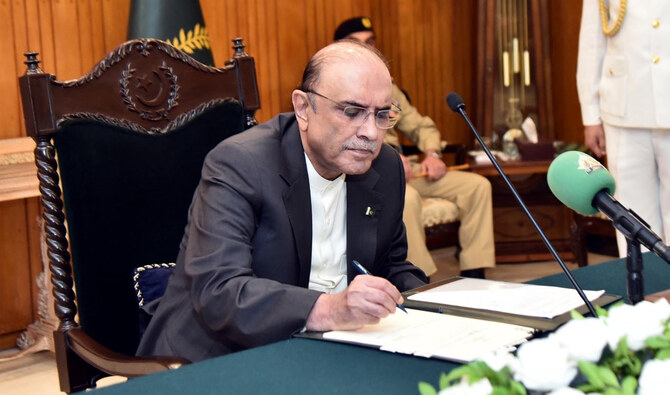
ISLAMABAD: Pakistan President Asif Ali Zardari on Sunday signed into law a bill relating to the registration of madrasas (religious seminaries) in the country, following months of delay despite its passage from parliament.
The Societies Registration (Amendment) Bill, 2024 was passed by both houses of Pakistan parliament in October this year, but it was caught in limbo after President Zardari cautioned parliamentarians to consider international obligations before altering existing procedures to register religious seminaries.
The main sticking point was that the new bill amended the existing procedure for registering madrasas with the education ministry and says the institutions should be affiliated with the industries ministry instead.
“The Societies Registration (Amendment) Bill, 2024 is assented to, as advised by the prime minister,” read a notification signed by President Zardari.
Although the notification was dated Dec. 27, but it was issued to media on Sunday, Dec. 29.
Every religious seminary existing before the commencement of the Societies Registration (Amendment) Act, 2024, if not already registered, shall get itself registered under the Act within six months from the commencement of the Societies Registration (Amendment) Act, 2024, according to the new law.
A seminary established after the promulgation of the new law will get itself registered under the Act within one year of its establishment.
The passage of the bill was widely reported to have been one of the conditions on which the Jamiat Ulema-e-Islam (JUI) religious party supported the coalition government of Prime Minister Shehbaz Sharif and helped it secure two-third majority required in parliament to pass the 26th Constitutional Amendment in October.
The JUI religious party, which rigorously campaigned for the bill in recent months, welcomed Sunday’s development and said it would continue to play its role in “protecting religious seminaries.”
“Religious schools are the fortress of Islam and the guardians of Pakistan’s ideological geography,” it said in a statement.
“Unity of [religious] scholars is important for the protection of religious institutions.”


![]()

Pakistan president signs madrasa registration bill into law after months of delay
Short Url
https://arab.news/6z6wp
Pakistan president signs madrasa registration bill into law after months of delay
- The development comes two days Pakistan’s federal cabinet approved tweaks to the Societies Registration Act, 1860
- Every seminary existing before commencement of new law will be required to get itself registered in 6 months it says
Latest updates


© 2026 SAUDI RESEARCH & PUBLISHING COMPANY, All Rights Reserved And subject to Terms of Use Agreement.