Pakistan’s cabinet approves policy guidelines for trade in carbon market

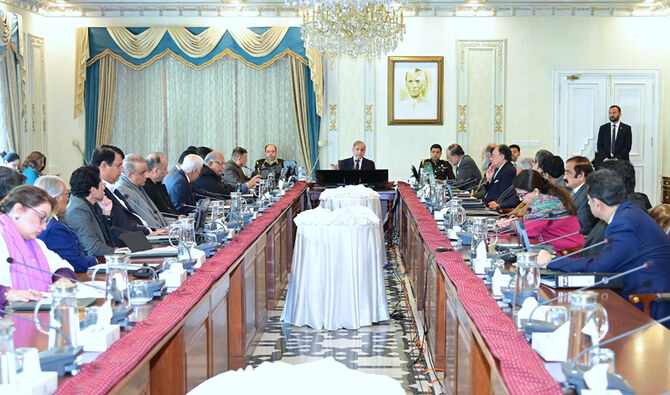
Pakistan’s Prime Minister Shehbaz Sharif (center) chairs a federal cabinet meeting in Islamabad, Pakistan, on December 27, 2024. (PID)
Short Url
Updated 28 December 2024
Follow

Pakistan’s cabinet approves policy guidelines for trade in carbon market

  • The new guidelines will establish regulatory framework for governing both voluntary and compliance carbon market activities
  • These markets are carbon pricing mechanisms that enable governments, non-state actors to trade greenhouse gas emission credits

ISLAMABAD: Pakistan’s federal cabinet on Friday approved policy guidelines for trade in carbon markets that help channel financial resources to reduce carbon emissions and mitigate their contribution to climate change.
Carbon markets are carbon pricing mechanisms enabling governments and non-state actors to trade greenhouse gas emission credits. There are two types of carbon markets: compliance and voluntary. In compliance markets such as national or regional emissions trading schemes, participants act in response to an obligation established by a regulatory body.
In voluntary carbon markets, participants are under no formal obligation to achieve a specific target. Instead, non-state actors such as companies, cities or regions seek to voluntarily offset their emissions, for example, to achieve mitigation targets such as climate neutral, net zero emissions.
The new guidelines aim to establish a clear regulatory framework for governing both voluntary and compliance carbon market activities in Pakistan, following international requirements and good practices.
“The federal cabinet approved policy guidelines for trading in the carbon market on the recommendation of the Ministry of Climate Change and Climate Coordination,” Prime Minister Shehbaz Sharif’s office said in a statement after the meeting.
Pakistan’s Ministry of Climate Change marked Nov. 16 as the Pakistan Pavillion’s “Carbon Market Day” and organized a high-level event on carbon markets at the UN COP29 climate summit to cement Pakistan’s commitment to participation in the new global carbon market.
Nearly 200 governments agreed on the framework that sets up a centralized global mechanism with clear rules and procedures for countries and companies involved in carbon credit transactions.
Pakistan’s policy guidelines aim to foster investments in energy, agriculture and forestry sectors, according to state media. Through these carbon markets, businesses will be encouraged to adopt eco-friendly technologies and reduce greenhouse gas emissions.
Under Article 6 of the Paris Agreement Crediting Mechanism (PACM), developing countries can host emissions reduction and removal projects and trade the resulting carbon credits internationally as a means to generate new revenue streams and unlock investment in ambitious climate action.
Pakistan’s “Carbon Market Policy Guidelines” outline a cohesive strategy and authorization criteria, which prioritizes investment in resilience and climate change adaptation, and works closely with provincial governments, the UN Environment Program says on its website.
“While these guidelines offer cultural and geographical nuance for each province’s differential needs, they set stringent quality control criteria, thus ensuring high-quality project development with substantial co-benefits. Finally, countries will experience a competitive and cost-efficient framework that emphasizes fairness in benefit distribution,” the document says.
A number of project opportunities have already been identified on the basis of which the government of Pakistan intends to initiate dialogues on Article 6 collaboration, according to the UN.


Karachi plaza fire death toll reaches 28 as search continues for missing

Updated 6 sec ago
Follow

Karachi plaza fire death toll reaches 28 as search continues for missing

  • Demolition of burned building on hold until all victims accounted for, official says
  • Authorities shut adjacent mall, order fire safety compliance across Karachi city

KARACHI: Pakistani authorities on Wednesday said 28 bodies had been recovered from a shopping plaza devastated by a massive fire in Karachi last weekend, with dozens of people still unaccounted for, as officials warned the structure could not be demolished until search operations were completed.

The blaze broke out late Saturday at Gul Plaza, a multi-story commercial building in Karachi’s congested Saddar district, and burned for more than 24 hours before being brought under control. The fire gutted over 1,200 shops, triggered partial structural collapse and forced rescuers to navigate extreme heat, debris and instability inside the building.

Speaking to reporters on Wednesday, Deputy Commissioner of Karachi South Javed Nabi Khoso said rescue teams were continuing phased search and debris-removal operations under strict safety protocols, adding that demolition would only be permitted once all missing persons were traced.

“Until even one missing person is accounted for, the building cannot be demolished,” Khoso said “So far, 28 bodies have been recovered, of which 11 have been identified, while 17 remain unidentified. DNA samples have been taken from families and the bodies, and the identification process is ongoing.”

Khoso said authorities had initially received reports of 85 missing persons, of whom 39 had since been located, leaving 28 people still unaccounted for as search operations continued. He said heavy machinery had been deployed to remove large installations such as chillers to reduce load on the structure and allow safer access to critical areas.

“We are focusing on the floors where bodies were found, and then moving toward controlled debris removal,” he said, adding that extreme internal temperatures and structural damage were limiting how long rescue teams could remain inside the building.

Medical officials said the condition of many victims’ remains had made immediate identification impossible.

Police Surgeon Dr. Summaiya Syed said forensic teams were working to confirm identities through DNA analysis.

“As of now, we can confirm 20 deaths, including six identified and 14 unidentified,” she said earlier, noting that samples from 48 families had been collected to assist with identification, while processing of additional remains was continuing.

Officials have cautioned that figures could change as recovery operations progress.

SAFETY RISKS SPREAD TO ADJACENT BUILDINGS

The scale of the fire has raised broader safety concerns across Karachi’s commercial districts. Authorities said Rimpa Plaza, an adjacent shopping complex, had been declared unsafe after being damaged by falling debris during the blaze and was partially closed pending structural assessments.

Separately, the Sindh Building Control Authority (SBCA) has issued notices to building owners and developers across the city, giving them three days to address fire safety deficiencies highlighted in recent audit reports or face legal action under provincial laws.

In a letter to the Association of Builders and Developers (ABAD), the SBCA said enforcement would be stepped up following the Gul Plaza disaster, citing long-standing failures in fire exits, alarms, wiring and emergency access in commercial buildings.

Deadly fires are a recurring problem in Karachi, a city of more than 20 million people, where overcrowding, illegal construction, narrow access points and weak enforcement of safety regulations have repeatedly resulted in mass casualties and economic losses.

In November 2023, a shopping mall fire killed 10 people, while one of Pakistan’s deadliest industrial disasters occurred in 2012, when a blaze at a garment factory claimed at least 260 lives.

Provincial officials say inspections and enforcement will be intensified in the coming days, but safety advocates warn that lasting change will depend on sustained oversight beyond emergency directives.