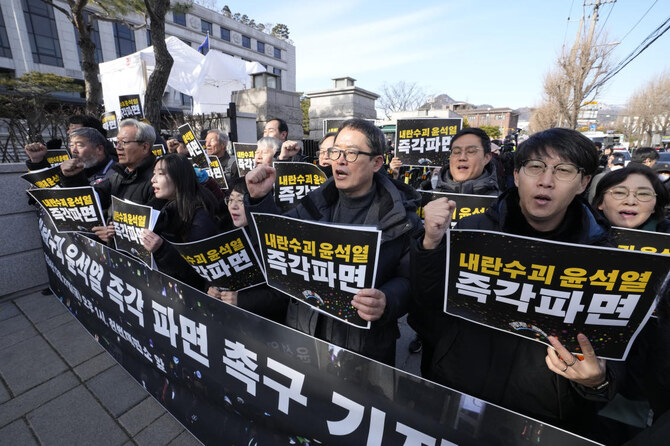
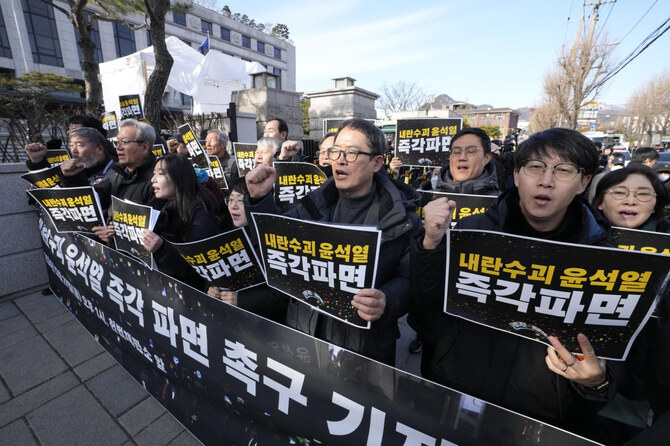
SEOUL: South Korea’s parliament impeached acting President Han Duck-soo on Friday over a short-lived martial law, plunging the country deeper into political chaos, as the Constitutional Court said it would swiftly trial suspended President Yoon Suk Yeol.
The impeachment of Han, who has been acting president since Yoon was impeached on Dec. 14 for declaring martial law on Dec. 3, has thrown South Korea’s once-vibrant democratic success story into uncharted territory.
The motion led by opposition parties passed with 192 of the 300 votes amid rowdy scenes by ruling People Power Party members who surrounded the speaker’s podium chanting the vote was invalid and parliament had committed “tyranny.”
Ahead of the parliamentary session, opposition leader Lee Jae-myung said his Democratic Party, which has majority control of parliament, will go ahead with the plan to impeach the acting president, accusing Han of “acting for insurrection.”
“The only way to normalize the country is to swiftly root out all the insurrection forces,” Lee said in a fiery speech, adding the party was acting on the public order to eradicate those who have put the country at risk.
There has been overwhelming public support for Yoon’s removal, according to opinion polls conducted after his martial law attempt.
The plan for a vote to impeach Han was unveiled on Thursday by the main opposition Democratic Party after he declined to immediately appoint three justices to fill vacancies at the Constitutional Court, saying it would exceed his acting role.
Until just before voting began, it was unclear how many votes were needed to impeach Han as acting leader. The threshold for a prime minister is a simple majority, while a two-thirds majority is needed for a president.
Speaker Woo Won-shik declared a simple majority would constitute parliamentary approval.
Han said in a statement after the vote that he would step aside to avoid more chaos and will await a Constitutional Court ruling on his impeachment.
By law Finance Minister Choi Sang-mok will assume the acting presidency.
Choi earlier pleaded with parliament to withdraw the plan to impeach Han, saying it would do serious damage to the country’s economy.
The South Korean won retreated to 1,475.4 per dollar, down 0.53 percent at 0707 GMT ahead of the parliamentary vote.
The vote to determine Han’s fate comes on the same day the Constitutional Court held its first hearing in a case reviewing whether to overturn the impeachment and reinstate Yoon or remove him permanently from office. It has 180 days to reach a decision.