

Why 2024 was a pivotal year for AI adoption and innovation in Saudi Arabia

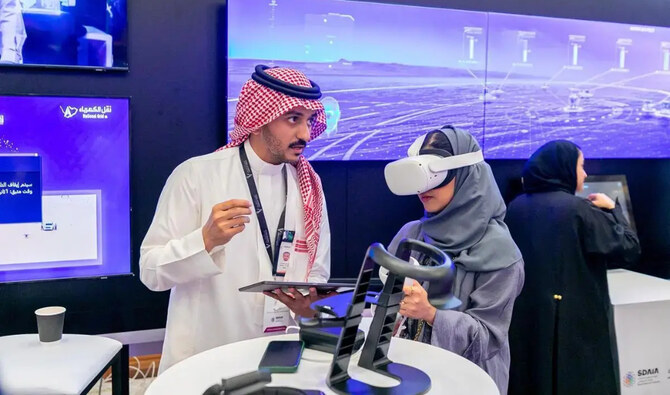
The report provided a comprehensive overview of the Kingdom’s progress in AI. (SPA)
Short Url
Updated 26 December 2024
Follow

Why 2024 was a pivotal year for AI adoption and innovation in Saudi Arabia

  • AI events and initiatives throughout the year have cemented the Kingdom’s place as a regional tech leader
  • Thanks to new investments, Saudi Arabia now ranks 14th globally and 1st in the Arab world in the Global AI Index

RIYADH: Saudi Arabia has enjoyed a fruitful year of events and initiatives intended to advance the adoption of artificial intelligence, propelling the Kingdom to the 14th position in the Global AI Index and 1st in the Arab world.

Recently, Saudi Arabia was also ranked third globally in the Organization for Economic Co-operation and Development’s AI Policy Observatory, behind the US and the UK. But how did the Kingdom rise to such heights?

The “State of AI in Saudi Arabia” report, unveiled by Abdullah bin Sharaf Al-Ghamdi, the president of the Saudi Data and Artificial Intelligence Authority, detailed the Kingdom’s advancements from 2019-23 during the Global AI Summit held in Riyadh in September.

The report provided a comprehensive overview of the Kingdom’s progress in AI, focusing on seven key pillars: regulations and policies, investment, infrastructure, data, talent development, research and innovation, and adoption.

It also highlighted the Saudi Data and AI Authority’s central role in driving the Kingdom’s digital transformation. According to SDAIA’s forecasts, AI is expected to contribute SR58.8 trillion ($15.6 trillion) to the global economy by 2030 and create 98 million jobs by 2025.

Mohammed Al-Qarni, an academic and consultant on AI for business, believes the rapid pace of the Kingdom’s AI adoption has come at “a critical time.”


MOZN office in Riyadh. (Abdulrahman bin Shalhoub)

“It is now or never,” Al-Qarni told Arab News. “Saudi Arabia’s Vision 2030 ambition to be a globally competitive nation means that we must proactively utilize the latest technology to our advantage.

“Think of AI as a means to diversify the economy, another Vision 2030 ambition, or to develop globally competitive citizens.

“How rapidly we advance in AI adoption will significantly impact these ambitions. That being said, I think there is a long way to go. As AI is still developing, we must be agile to shape its future, whether in governance and ethics, technical development, or its impact on human lives.”

Al-Qarni said the most impressive advancement in 2024 was the Riyadh Declaration, a document announced during the 19th session of the Internet Governance Forum, hosted by Saudi Arabia and organized by the UN.

According to the Saudi Press Agency, the declaration focuses on AI with its inclusive, innovative, and impactful dimensions and emphasizes the need for using AI technologies to enable digital access, enhance digital knowledge, address global challenges, and unlock economic value.

Opinion

This section contains relevant reference points, placed in (Opinion field)

“It asserts Saudi global leadership in AI and focuses on AI’s inclusive, innovative, and transformative potential,” said Al-Qarni.

“The Declaration highlights the importance of leveraging AI technologies to expand digital access, enhance digital literacy, tackle global challenges, and unlock significant economic value worldwide.”

He added: “Nations that embrace AI will win, and those who let fear of AI get the best of them will lose.


Smart Citizens actively embrace AI-powered technologies in luxury apartments and homes. (Supplied)

“Globally, the next few years will offer as much opportunity as risk. Saudi Arabia has shown that it would be in the first camp. I expect more investment in human capital and technology. I also expect regulations to mature over the next few years, and I hope those regulations will more effectively support AI innovation and adoption.”

The past 12 months have seen a flurry of AI investment activity. The Kingdom recently launched a $100 billion AI initiative, named “Project Transcendence,” to position itself as a global tech hub.

The project, led by the Public Investment Fund in collaboration with Google, aims to support local tech startups, create jobs, and collaborate with technology firms globally.

From fashion to sports, AI is already being utilized in almost every sector imaginable. The boxing rematch between Oleksandr Usyk and Tyson Fury in Riyadh on Dec. 21 featured an experimental fourth judge powered by AI, designed to help eliminate bias and human error in scoring.

Technology that supports good sportsmanship has also extended to the digital realm. FACEIT, a platform that uses Minerva, employs specialized AI technology to understand in-game actions and other non-text chat behaviors to improve multiplayer gaming experiences.

DID YOU KNOW?

• The Riyadh Declaration focused on AI’s transformative potential, enhancing digital access, literacy, and addressing global challenges.

• Project Transcendence is a $100 billion initiative led by Saudi Arabia and Google to support startups and create jobs.

• Saudi achievements in the health sector include the world’s first fully robotic heart transplant at King Faisal Specialist Hospital in Riyadh.

• Generative AI research at KAUST aims to pioneer innovation and address global challenges through training and upskilling.


Saudi Arabia’s health-tech sector is also undergoing a major transformation driven by AI, promising significant economic and operational benefits. A McKinsey & Co. analysis forecasts that by 2030, AI could unlock $15 to $27 billion in economic value for the Kingdom’s medical sector.

The Saudi health sector has made significant strides thanks to AI, such as the world’s first fully robotic heart transplant performed on a 16-year-old patient suffering from end-stage heart failure at King Faisal Specialist Hospital and Research Center in Riyadh.

A medical team led by Dr. Feras Khaliel, head of cardiac surgery and director of the Robotics and Minimally Invasive Surgery Program at KFSHRC, performed the operation after practicing the procedure virtually.


These solutions have already shown results with a 40 percent decrease in false alarms. (Supplied)

Saudi Arabia’s King Abdullah University of Science and Technology has also joined the global AI race by accelerating generative AI research through models aligned with the Kingdom’s Research Development and Innovation Authority.

Its Center of Excellence on Generative AI (GenAI Coe) intends to become the premier hub for pioneering generative AI technology to address the most pressing challenges faced by the Kingdom and the world.

The GenAI CoE also intends to focus on making a positive impact through GenAI training and upskilling programs for KAUST researchers, partners, and the general public. Through these training outreach initiatives, the CoE hopes to address the shortage of GenAI talent in Saudi Arabia.

As the Kingdom enters 2025, it is well-positioned to continue its meteoric rise as an AI leader.


AI, automation creating new jobs and displacing traditional roles: Saudi HR minister

Updated 15 sec ago
Follow

AI, automation creating new jobs and displacing traditional roles: Saudi HR minister

  • Ahmad Al-Rajhi: Expect significant growth in tech-centric jobs like AI specialists and data analysts, while roles such as data entry and administrative assistants may decline
  • Al-Rajhi: Rising living costs and economic slowdowns will shape which skills are most valued, like resilience, flexibility and creative thinking

RIYADH: Artificial intelligence, robotics and automation are creating new opportunities while displacing traditional roles, Saudi Arabia’s Minister of Human Resources and Social Development Ahmad Al-Rajhi said in his opening remarks at a conference in Riyadh on Monday.

Al-Rajhi was speaking during the opening of the third Global Labor Market Conference, which is being held under the theme “Future in Progress” and brings together decision-makers, thought leaders and experts from around the world.

“Expect significant growth in tech-centric jobs like AI specialists and data analysts, while roles such as data entry and administrative assistants may decline,” he said.

Al-Rajhi added that the green transition is driving demand for renewable energy engineers and environmental specialists.

“We will see a surge in green jobs as industries adapt to climate goals,” he said.

The minister also pointed to broader economic and geopolitical pressures shaping labor markets globally, including rising living costs and slowing growth.

“Rising living costs and economic slowdowns will shape which skills are most valued, like resilience, flexibility and creative thinking,” he said.

Al-Rajhi added that demographic shifts, including aging populations in some regions and expanding working-age populations in others, will continue to influence labor supply and demand, increasing the need for healthcare, training and inclusive job creation.

Turning to the global youth employment challenge, he said international trends highlight the urgency of coordinated action.

“More than 262 million young people worldwide are not in employment, education or training in many regions, and job creation is not keeping pace with population growth, while other countries are facing the pressure of aging workforces and rising dependency ratios,” Al-Rajhi said, citing international estimates.

He added that rapid technological change is outpacing education and training systems, making continuous upskilling essential across both advanced and emerging economies.

“These pressures differ by region, but they are too complex for countries to address in isolation,” he said.

Highlighting Saudi Arabia’s domestic workforce transformation, Al-Rajhi said more than 2.5 million Saudis have joined the private sector since 2020, describing young men and women as a growing national asset driving new fields and skills development.

“These indicators, among others, show an economy movement for people who are investing in themselves, learning, competing and shaping the future with confidence,” he said.

During the event, Saudi Minister of Industry and Mineral Resources Bandar Al-Khorayef announced the launch of an occupations and skills framework for the mining and industrial sectors, aimed at clarifying job roles and workforce requirements.

He said the framework will cover more than 500 occupations and outline the skills, job descriptions and titles needed across the sectors, helping private companies, educators and training providers to align workforce development with industry demand.

“This is an important framework to allow different players in the ecosystem, from private sector who will actually need (those) kinds of jobs, but it will allow, I think, most importantly, training and the training ecosystem,” Al-Khorayef said

Saudi Minister of Tourism Ahmed Al-Khateeb added global travel is expected to continue rising over the next decade, driving demand for tourism workers as the Kingdom expands new destinations and cities.

He said the global tourism sector is expected to create 91 million jobs by 2035, while facing a projected shortfall of 43 million workers.

“(This is) good news for the job market in Saudi Arabia. We’re projecting to create an additional 400,000 jobs to 600,000 jobs in the next five to six years, just to fill the new destinations, the new cities that we are building today.”

Al-Khateeb added that tourism does not require highly specialized skills in the same way as sectors such as engineering or medicine, but instead builds soft skills that can deliver positive outcomes.

He said that employment in the tourism sector has risen sharply since the Kingdom launched its tourism strategy in 2019, contributing to job creation and lower unemployment, and underscoring the importance of training and workforce development.

“When we launched tourism back in 2019, we used to have 750,000 people working in the sector. Last year, we surpassed 1 million,” he said.

He added that tourism has become one of the most impactful sectors for reducing unemployment and creating jobs, with an emphasis on ensuring that workers entering the industry are well trained.

Saudi Minister of Transport and Logistics Services Saleh Al-Jasser said infrastructure investment plays a key role in driving economic growth, development and job creation, citing its strong multiplier effect across sectors.

Al-Jasser also cited a recent World Bank statement at the World Economic Forum in Davos on the scale of the labor market challenge ahead.

“There would be 1.2 billion (entering) the labor market in the next 10 years … but only 400 million jobs will be opening up,” he said.

He added that the growing global focus on job creation will be decisive in determining whether development succeeds or falls short in the years ahead.

The event will run from Jan. 26–27 and will focus on six key pillars: trade changes and employment; informal economies; the new global skills landscape; the real impact of artificial intelligence on jobs and productivity; building resilient labor markets in times of crisis; and improving job quality, with particular attention to youth as the foundation of the future economy.