RIYADH: In today’s hyper-connected world, mobile apps have become the gateway to almost every service and business interaction. But as businesses race to deliver convenience, they inadvertently expose themselves — and their users — to growing cyber threats.
With security breaches rising at an alarming rate, mobile apps are often the weakest link. Developers face a two-fold challenge — balancing security without sacrificing speed or innovation.
This pressing issue was the catalyst for Appknox, a mobile app security platform established in Bangalore, India, and now making inroads in Saudi Arabia, which was designed to make securing apps faster, smarter, and more efficient.
“Mobile apps are no longer just tools — they’re business-critical systems,” Subho Halder, CEO of Appknox, told Arab News. “Yet securing them has remained cumbersome, complex, and, often, reactive.”
At its core, Appknox simplifies security testing by integrating into the development pipeline, helping businesses identify and fix vulnerabilities early in the software development lifecycle.
By removing friction and leveraging advanced technology like AI and machine learning, Appknox bridges the gap between speed and security — two critical elements for businesses operating in the digital economy.
The demand for mobile apps has exploded, but so too have cyberattacks targeting them. For developers, traditional security solutions have long been a source of frustration.
Tools relying on source code access raise privacy concerns, while outdated systems generate high false positives, leaving teams chasing ghosts rather than fixing real problems. The result? Security becomes an afterthought — patched hastily or worse, ignored entirely.
“Developers want to ship quickly, but every delay costs businesses money,” said Halder. “The problem is that skipping security leaves apps vulnerable to breaches that are far more expensive to fix later.”
For businesses operating in highly regulated industries like fintech, banking, or government, the stakes are even higher. Regulations such as those enforced by the Saudi Central Bank, for instance, require stringent compliance with data protection standards.
Failing to meet those standards not only risks fines but can erode user trust — a death knell in industries where reliability is everything.
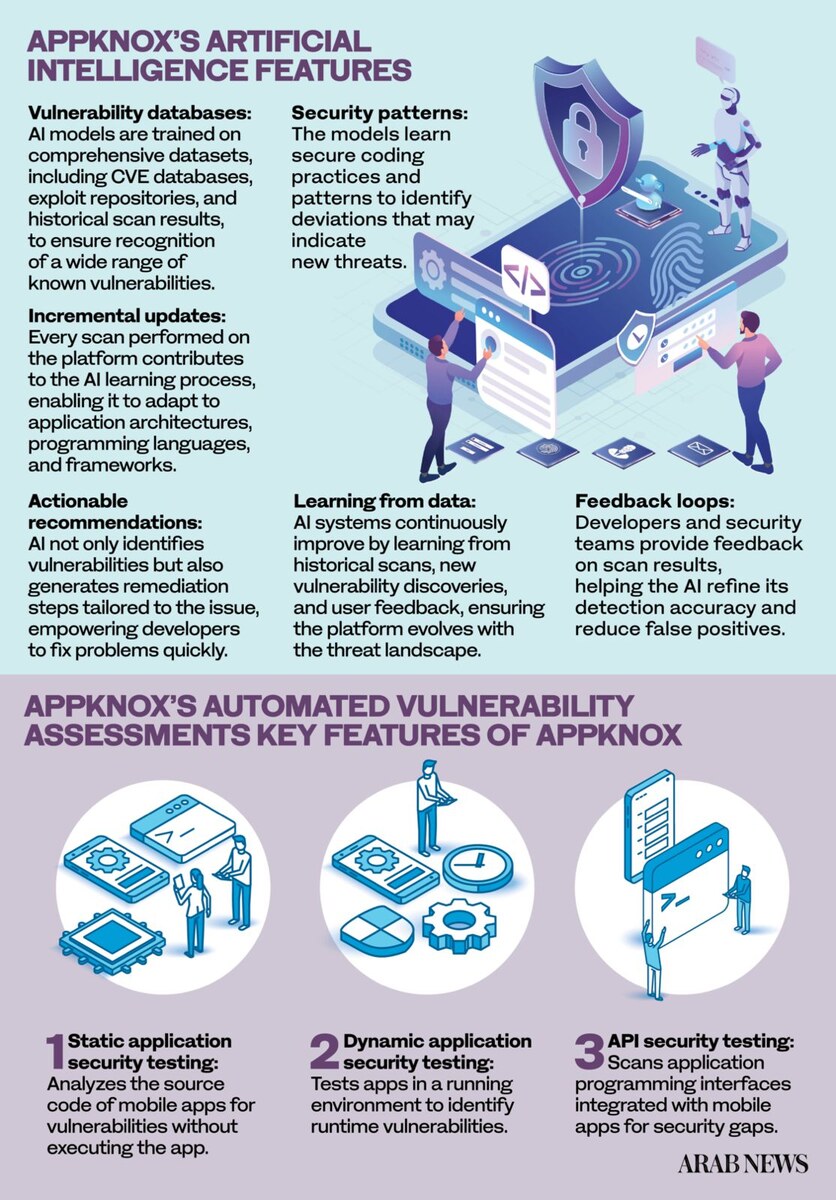
What makes Appknox stand out is its ability to tackle these challenges without complicating the developer workflow. It uses a binary-based scanning approach, meaning the platform does not require access to the app’s source code.
Instead, it scans compiled binaries to uncover runtime vulnerabilities, ensuring confidentiality while delivering deeper, more actionable insights.
The platform combines static analysis, dynamic analysis, and application programming interface testing, giving developers a unified view of their security posture.
Appknox’s launch in Saudi Arabia comes at a time when the Kingdom is undergoing a dramatic digital transformation. Under Vision 2030, sectors like fintech, open banking, and e-commerce are expanding rapidly. But with this growth comes increased vulnerability.
“The digital infrastructure being built in Saudi Arabia is world-class,” said Halder. “But world-class innovation demands world-class security.”
Opinion
This section contains relevant reference points, placed in (Opinion field)
For fintech players in particular, API security has become a priority as the Kingdom embraces open banking initiatives. APIs, while critical for enabling seamless financial transactions, are also prime targets for cyberattacks.
One of the most significant breakthroughs Appknox brings to mobile security is its ability to cut through the noise.
High false positives — a common complaint in traditional tools — are minimized using AI-driven analysis. The platform’s machine learning models are trained on vast datasets of vulnerabilities, ensuring smarter detection that focuses on real, exploitable risks.
But Halder stresses that AI alone is not enough. To ensure accuracy, Appknox combines automation with human validation. “Automation gets you speed, but human experts provide context,” he said. “It’s this balance that gives teams confidence to act on the results.”
Moreover, the AI behind Appknox continuously evolves. Every scan, every vulnerability patched, and every piece of user feedback helps improve detection accuracy over time. This adaptability is critical as new threats, such as zero-day vulnerabilities, emerge at an increasing rate.

The impact of Appknox’s solutions is already being felt across industries. In one notable case, a large Middle Eastern enterprise managing over 50 mobile applications struggled with delayed vulnerability remediation and fragmented oversight.
With Appknox, they streamlined their security processes through automated scanning, real-time monitoring, and a centralized security dashboard.
“The result was transformative,” said Halder. “They cut remediation times significantly and moved from a reactive approach to proactive security. That’s the kind of impact businesses need to stay competitive.”
As cyber threats evolve, Halder believes security tools must become predictive rather than reactive. AI will play a central role in this shift, enabling platforms like Appknox to anticipate vulnerabilities before they are exploited.
In markets like Saudi Arabia, where digital transformation is reshaping the economy, this kind of innovation is not optional — it is essential. Businesses need to secure their apps not just to comply with regulations, but to earn and maintain user trust.
“Mobile apps are the face of your business,” said Halder. “If they’re not secure, neither is your reputation. Our mission is simple: to make sure security is never the reason a business can’t grow.”