

Global Labor Market Conference sees 31 deals to provide training, job opportunities in Saudi Arabia

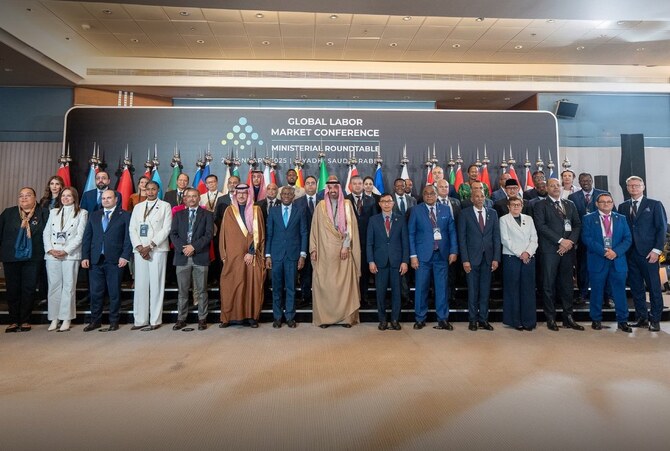
The Global Labor Market Conference is taking place in Riyadh from Jan. 29-30. X@Global_LMC
Short Url
Updated 31 January 2025
Follow

Global Labor Market Conference sees 31 deals to provide training, job opportunities in Saudi Arabia

  • Saudi Logistics Academy signed four agreements to strengthen the Kingdom’s position as a global logistics hub
  • GLMC signed a new three-year partnership agreement with the World Bank

RIYADH: Saudi Arabia signed 31 deals at the Global Labor Market Conference to expand training, leadership development, and job opportunities for graduates and individuals with disabilities through specialized skills and education.

Taking place in Riyadh from Jan. 29-30, the agreements and memoranda of understanding also include a variety of development initiatives, educational projects, and knowledge exchanges aimed at empowering different segments of society, the Saudi Press Agency reported.

The agreements come as the Kingdom seeks to bring more people into the workforce, having recently revised its unemployment rate target to 5 percent by the end of the decade, down from the previous goal of 7 percent, as part of Vision 2030’s ambitions.

The Saudi Logistics Academy signed four agreements to strengthen the Kingdom’s position as a global logistics hub.

The first MoU was with the International Federation of Freight Forwarders Associations and seeks to bolster collaboration in developing skills and vocational training in the field of freight and logistics services. Under the terms of the agreement, both sides committed to exchanging information and expertise to support the nation’s logistics transformation.

The academy inked a second MoU with the Spanish ACEX Association to establish a collaborative framework to enhance human resources in road maintenance and operation. This partnership focuses on providing specialized training programs and promoting the exchange of best practices to achieve mutual objectives.

The third agreement, signed with Saudi MEDLOG Limited, focuses on training and certifying 18 individuals for entry-level positions within the company. This initiative aims to enhance the skills of the national workforce to meet the demands of the job market.

The academy also partnered with the Mediterranean Shipping Co. to train and certify six candidates for roles within the firm as part of the entry-level diploma program.

GLMC signed a new three-year partnership agreement with the World Bank, directed at shaping labor systems and formulating policies that meet the future needs of the job market while addressing it's evolving challenges.

The collaboration reinforces combined endeavors, specifically in training policymakers on a global scale and conducting research to offer inventive perspectives that assist governments and organizations in adjusting to the swift transformations influencing labor market needs, job trends, and labor policies.

Both entities aspire to nurture a fresh cohort of policymakers through the deal, fortifying the conference’s position as an impartial research institution committed to forging effective labor market strategies.

Policymakers will be chosen from nations falling within the mandate of the World Bank to craft a holistic and enduring global labor market framework.

As part of the collaboration, the GLMC Labor Market Academy was launched in partnership with Takamol Holding.

The academy offers a three-year development program covering all aspects of the labor market to train international experts responsible for future policy formulation and to create an innovative platform for cross-country learning, particularly for low- and middle-income nations.

The partnership also includes the inauguration of a policy lab, which is a dedicated platform for in-depth discussions on specific policies, tools, and programs that propel labor market outcomes and workforce skills.

During the second edition of the GLMC, two policy labs will be introduced, playing a crucial role in addressing youth employment challenges, focusing on active labor market programs to raise employment opportunities and sector skills councils to bridge the gap between employees’ skills and job responsibilities.

The GLMC-World Bank collaboration aims to promote an inclusive and diverse global labor market, ensuring that all countries, especially emerging economies, can benefit from collaborative research and advanced policy development.

On the sidelines of the GLMC, the Ministry of Tourism signed several memorandums of cooperation as part of its efforts to develop the capabilities of national workers in the tourism sector and improve employee quality.

An agreement inked with the Marriott Hotel Group in Riyadh aims to create job opportunities for several Saudi workers. It also focuses on training and developing the workforce to enhance professional performance and increase operational efficiency in the tourism sector.

The MoU between the Ministry of Tourism and hotel management firm Adeera aims to train and qualify Saudi nationals working in the sector, as well as prepare job seekers to fill available industry positions.

The memorandum of cooperation signed between the Ministry of Tourism and Takamul Business Services Co. seeks to further elevate the capabilities of workers, exchange experiences, achieve quality and occupational safety standards, as well as improve services.

Saudi Arabia is emerging as a global leader in addressing labor market challenges, skill development, and workforce requalification, according to an analysis released by GLMC in December.

The inaugural report, issued by the conference hosted by the Kingdom’s Ministry of Human Resources and Social Development, emphasized the government’s initiatives to bridge the gap between academic qualifications and market demands. 

These efforts include enhancing education and training programs and preparing young job seekers for the rapidly evolving global labor landscape.


Telfaz11 aims to invest $135m to support film production 

Updated 4 sec ago
Follow

Telfaz11 aims to invest $135m to support film production 

JEDDAH: In just seven years, Saudi Arabia’s cinema industry has transformed from a near-dormant sector into a rapidly growing entertainment market, marked by a significant increase in the number of screens and film production. 

In 2025 alone, cinemas in Saudi Arabia screened 538 films, generating revenues exceeding SR920.8 million ($245.4 million) and selling around 18.8 million tickets. This performance reflects a growing audience base and rising demand for local cinematic content, underscoring the accelerating growth of the domestic film market. 

Telfaz11 investments in the film sector 

Amid this growth, local content companies continue to increase their investments to build a sustainable film industry. Telfaz11 is one of the leading companies in this effort, having invested over SR110 million since 2022 in film production and the development of cinema projects. 

Speaking to Al-Eqtisadiah, CEO Alaa Fadan said that the company has an ambitious plan to inject more than SR500 million over the next five years to support film production and expand the scope of its projects. 

Record-breaking box-office films 

Fadan noted that Telfaz11 has produced the three highest-grossing films in Saudi cinema history, generating over SR97 million in total. These include “Sattar,” which earned around SR39 million; “Night Courier,” or “Mandoob,” with approximately SR28 million; and “Al-Zarfa,” which brought in about SR30 million. 

These figures highlight the success of local cinematic projects and their ability to attract audiences while generating strong revenue. 

Industry still in building phase 

Fadan explained that the progress achieved over the past seven years represents rapid advancement compared with other emerging film industries worldwide. However, he stressed that the sector is still in a building phase and has not yet reached full maturity. 

He said that Saudi Arabia now possesses key foundational elements such as widespread cinema screens, local production companies, a new generation of filmmakers, and audiences increasingly accustomed to watching Saudi films. 

Nonetheless, he added, developing a fully integrated industry requires years of accumulated experience, continuous production, and a robust system for financing, distribution, and training. 

Talent and specialized workforce challenges 

Fadan believes the real challenge does not lie in a single element of the industry, but in the integration of the entire cinematic ecosystem, emphasizing that Saudi talent in writing, directing, and acting is now evident, yet expanding production requires increasing the number of qualified professionals. 

For example, he stressed, the market needs more screenwriters capable of developing commercially appealing stories for audiences. 

On the technical side, local teams have shown significant development, although some reliance on international expertise in advanced specializations continues, which is normal in the early stages of any industry. 

Importance of marketing and distribution 

Fadan emphasized that marketing and distribution are crucial elements in a film’s success, as a film’s performance now depends not only on its artistic quality but also on its ability to reach audiences and be promoted strategically, both locally and internationally. 

He noted that Telfaz11’s prior experience in digital content creation before entering cinema gave the company a key advantage, allowing it to build a direct relationship with audiences online through hundreds of clips and projects that helped establish a broad fan base. 

This connection, he added, enabled the company to understand Saudi viewers’ tastes and create anticipation around new releases. 

Therefore, Fadan said, marketing is not viewed as a post-production step but as an integral part of project development from the outset, including building a clear film identity, designing creative communication campaigns, and leveraging digital platforms to reach audiences effectively. 

Equation for successful commercial film 

According to Fadan, the success of a commercial film depends on three main elements: a strong and engaging story, a deep understanding of audience interests, and an effective marketing and distribution strategy. 

At the same time, the biggest challenge in production remains balancing risk and return, especially for high-budget commercial films that require significant investments and carefully planned production decisions. 

Supporting local talent and creative economy 

Since entering film production, Telfaz11 has invested SR110 million between 2022 and 2025 in various cinematic projects. 

More than 10,000 local professionals have participated in the company’s work across different projects. The company also established several writing rooms that have trained over 30 emerging writers from the new generation. 

In addition, Telfaz11 has collaborated with more than 100 local suppliers and companies in production, logistics, equipment, and design, supporting the creative economy and enhancing the participation of local businesses in the sector. 

Cultural initiatives to strengthen cinema community 

The company also launched the Cinema Valley initiative, an independent pop-up cinema experience designed to create a cultural community around films and encourage audiences to interact directly with movies and their creators. 

Future plans and ongoing production 

Looking ahead, the company is currently developing over 40 project ideas at various stages, some of which have already entered the writing phase in preparation for production over the next two years. 

The company aims to release its works across multiple platforms, including cinemas and digital streaming services, with a plan to produce roughly three projects annually. The first of these in 2026 is the series “Alkhallat+.” 

New phase for Saudi cinema 

With these investments and rapid growth, Saudi cinema is entering a new phase, potentially evolving from a promising market into a fully integrated industry in the coming years, supported by increasing production, developing talent, and a growing local audience base.