

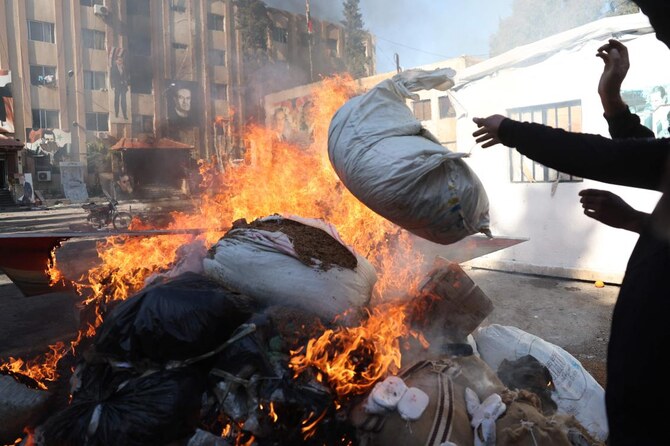

DAMASCUS: Syria’s new authorities torched a large stockpile of drugs on Wednesday, two security officials told AFP, including one million pills of captagon, whose industrial-scale production flourished under ousted president Bashar Assad.
Captagon is a banned amphetamine-like stimulant that became Syria’s largest export during the country’s more than 13-year civil war, effectively turning it into a narco state under Assad.
“We found a large quantity of captagon, around one million pills,” said a balaclava-wearing member of the security forces, who asked to be identified only by his first name, Osama, and whose khaki uniform bore a “public security” patch.
An AFP journalist saw forces pour fuel over and set fire to a cache of cannabis, the painkiller tramadol, and around 50 bags of pink and yellow captagon pills in a security compound formerly belonging to Assad’s forces in the capital’s Kafr Sousa district.
Captagon has flooded the black market across the region in recent years, with oil-rich Saudi Arabia a major destination.
“The security forces of the new government discovered a drug warehouse as they were inspecting the security quarter,” said another member of the security forces, who identified himself as Hamza.
Authorities destroyed the stocks of alcohol, cannabis, captagon and hashish in order to “protect Syrian society” and “cut off smuggling routes used by Assad family businesses,” he added.
Syria’s new Islamist rulers have yet to spell out their policy on alcohol, which has long been widely available in the country.
Since an Islamist-led rebel alliance toppled Assad on December 8 after a lightning offensive, Syria’s new authorities have said massive quantities of captagon have been found in former government sites around the country, including security branches.
AFP journalists in Syria have seen fighters from Islamist group Hayat Tahrir Al-Sham (HTS) set fire to what they said were stashes of captagon found at facilities once operated by Assad’s forces.
Security force member Hamza confirmed Wednesday that “this is not the first initiative of its kind — the security services, in a number of locations, have found other warehouses... and drug manufacturing sites and destroyed them in the appropriate manner.”
Maher Assad, a military commander and the brother of Bashar Assad, is widely accused of being the power behind the lucrative captagon trade.
Experts believe Syria’s former leader used the threat of drug-fueled unrest to put pressure on Arab governments.
A Saudi delegation met Syria’s new leader Ahmed Al-Sharaa in Damascus on Sunday, a source close to the government told AFP, to discuss the “Syria situation and captagon.”
Jordan in recent years has also cracked down on the smuggling of weapons and drugs including captagon along its 375-kilometer (230-mile) border with Syria.


