ISLAMABAD: Former prime minister Imran Khan’s Pakistan Tehreek-e-Insaf (PTI) party announced on Thursday it wanted to conclude its negotiations with the government by Jan. 31, 2025, reiterating that it wanted a judicial commission to probe violent nationwide protests that broke out in May 2023.
The PTI and the government opened formal negotiations on Monday to ease political tensions in the country. Both sides moved to reduce tensions after Khan threatened a civil dissidence movement and amid growing concerns he may face trial by a military court for allegedly inciting attacks on sensitive security installations during the May 9, 2023 protests.
The PTI has put forward two demands: the release of political prisoners and the establishment of judicial commissions to investigate protests on May 9 last year and Nov. 26 in Islamabad this year, which the government says involved his party supporters, accusing them of attacking military installations and government buildings.
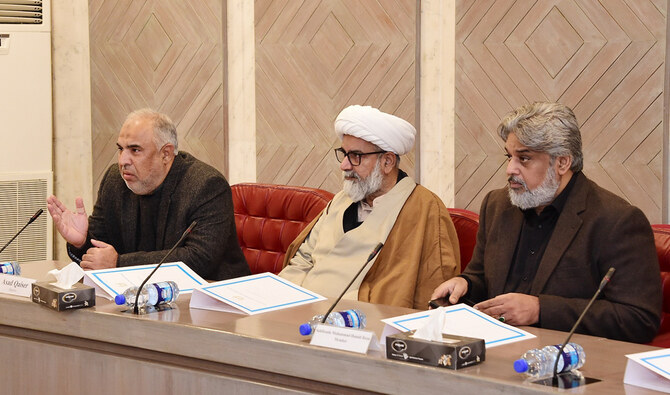
Members of the PTI’s negotiation team, Omar Ayub and Sahibzada Muhammad Hamid Raza, spoke to the media after meeting Khan in the Adiala prison in Rawalpindi. The negotiating committee apprised Khan regarding Monday’s talks with the government.
“The cutoff timeframe for negotiations is the end of January,” Raza told reporters outside Adiala prison. “By Jan. 31, we want to take these negotiations to their logical conclusion.”
Raza reiterated the PTI’s demands for the formation of judicial commissions for the May 9, 2023 and Nov. 26 protests.
“Our stance on the Nov. 26 (Islamabad protest) is quite clear: As of today, according to our data, 13 of our supporters were martyred, 64 suffered bullet injuries and the number of our missing supporters is between 150 to 200,” he said.
He said Khan will not accept any “deal” by the government for his release from prison. “Imran Khan will after facing all his cases in court, come out through the courts,” Raza said.
The next round of talks between the government and the PTI is scheduled to be held on Jan. 2.
Khan’s ouster in a parliamentary vote of no-confidence in 2022 has plunged the country into a long-term political crisis, particularly since the PTI founder was jailed in August last year on corruption and other charges and remains behind bars.
His party and supporters regularly hold protests calling for his release, with many of the demonstrations turning violent, including the one on Nov. 26 in which the government says four troops were killed and the PTI says 13 of its supporters died.
The negotiations on Monday were held days after Pakistan’s military announced prison sentences for 25 people involved in the May 9 protests.
The military announced on Thursday it had sentenced 60 more civilians, among them Khan’s nephew and two retired army officers, to prison sentences ranging from two to 10 years, for the May 9 protests.
Khan’s party has pointed out that the sentencing is contrary to the International Covenant on Civil & Political Rights, to which Pakistan is a party.


![]()

Imran Khan’s party says wants to conclude negotiations with Pakistan government by Jan. 31
Short Url
https://arab.news/wdtf3
Imran Khan’s party says wants to conclude negotiations with Pakistan government by Jan. 31
- Khan’s PTI, Pakistan’s government kicked off talks to ease political tensions on Monday
- PTI says Khan will not accept any “deal” with the government for his release from prison


Latest updates





© 2026 SAUDI RESEARCH & PUBLISHING COMPANY, All Rights Reserved And subject to Terms of Use Agreement.