PRAYAGRAJ, India: Beside India’s holy rivers, a makeshift city is being built for a Hindu religious festival expected to be so vast it will be seen from space, the largest gathering in history.
Line after line of pontoon bridges span the rivers at Prayagraj, as Indian authorities prepare for 400 million pilgrims – more than the combined population of the United States and Canada – during the six-week-long Kumbh Mela.
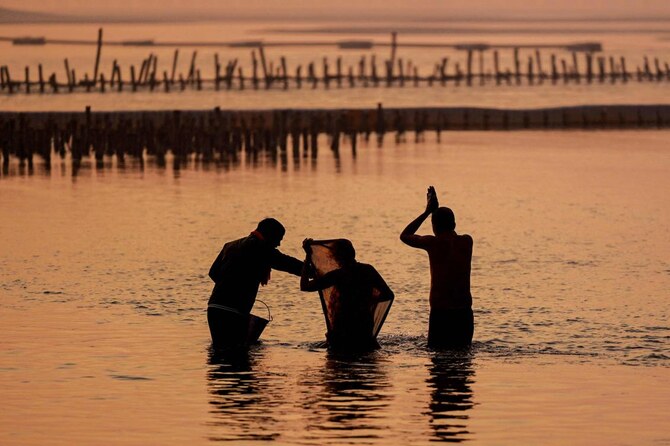
The millennia-old sacred show of religious piety and ritual bathing is held once every 12 years at the site where the holy Ganges, Yamuna and the mythical Saraswati rivers meet.
But this edition from January 13 to February 26 is expected to be a mega draw, as it is set to coincide with a special alignment of the planets.
Beads of sweat glisten on laborer Babu Chand’s forehead as he digs a trench for seemingly endless electrical cables, one of an army of workers toiling day and night at a venue sprawling over 4,000 hectares (15 square miles).
“So many devotees are going to come,” 48-year-old Chand said, who says he is working for a noble cause for the mela, or fair.
“I feel I am contributing my bit – what I am doing seems like a pious act.”
A humongous tent city, two-thirds the area of Manhattan, is being built on the floodplains of Prayagraj, formerly called Allahabad, in the northern state of Uttar Pradesh.
“Some 350 to 400 million devotees are going to visit the mela, so you can imagine the scale of preparations,” said Vivek Chaturvedi, the spokesman for the festival.
Preparing for the Kumbh is like setting up a new country, requiring roads, lighting, housing and sewerage.
“What makes this event unique is its magnitude and the fact that no invitations are sent to anybody... Everyone comes on their own, driven by pure faith,” Chaturvedi said.
“Nowhere in the world will you see a gathering of this size, not even one-tenth of it.”
Around 1.8 million Muslims take part in the annual Hajj pilgrimage to Makkah in Saudi Arabia.
The Kumbh numbers, according to Chaturvedi, are mind-boggling.
Some 150,000 toilets have been built, 68,000 LED lighting poles have been erected, and community kitchens can feed up to 50,000 people at the same time.
Alongside religious preparations, Prayagraj has undergone a major infrastructure overhaul, and huge posters of Prime Minister Narendra Modi and state Chief Minister Yogi Adityanath dot the city.
Both are from the ruling Hindu-nationalist Bharatiya Janata Party (BJP), with politics and religion deeply intertwined.
The Kumbh Mela is an ancient celebration, with its origins rooted in Hindu mythology.
Hindus believe that taking a dip in Sangam, the confluence of the rivers, will cleanse them of their sins and help them attain “moksha,” setting them free from the cycle of birth and death.
According to legends, deities and demons fought over a pitcher – or “kumbh” – containing the nectar of immortality.
During the battle, four drops fell to Earth.
One drop landed in Prayagraj.
The others fell at Haridwar, Nashik and Ujjain – the three other cities where the rotating Kumbh Mela is held on other years.
But the one in Prayagraj – held every 12 years – is the largest.
Organizing authorities are calling it the great, or “Maha” Kumbh Mela.
The last Kumbh Mela at Prayagraj in 2019 saw 240 million devotees, according to authorities – but that was the smaller “Ardh” or half festival, spaced in between the main event.
“When you talk about the Kumbh, you have to talk about astronomy,” said historian Heramb Chaturvedi, 69.
“Jupiter transits one zodiac sign in a single year,” he added. “Therefore, when it completes 12 zodiac signs, then it is Kumbh.”
Core to celebrations is giving alms to the “wise and learned, the poor and the needy,” he said.
Some pilgrims have already arrived, including naked naga sadhus – wandering monks who have walked for weeks from the remote mountains and forests where they are usually devoted to meditation.
They will lead the dawn charge into the chilly river waters on the six most auspicious bathing dates, starting with the first on January 13.
“I have come here to give my blessings to the public,” 90-year-old naga sadhu Digambar Ramesh Giri, naked with dread-locked hair in a bun, said.
“Whatever you long for in your heart you get at Kumbh.”


![]()

India readies for 400 million pilgrims at mammoth Kumbh Mela festival
Short Url
https://arab.news/rrxg2
India readies for 400 million pilgrims at mammoth Kumbh Mela festival
- The millennia-old sacred show of religious piety and ritual bathing is held once every 12 years at the site where the holy Ganges, Yamuna and the mythical Saraswati rivers meet


Latest updates


© 2026 SAUDI RESEARCH & PUBLISHING COMPANY, All Rights Reserved And subject to Terms of Use Agreement.