

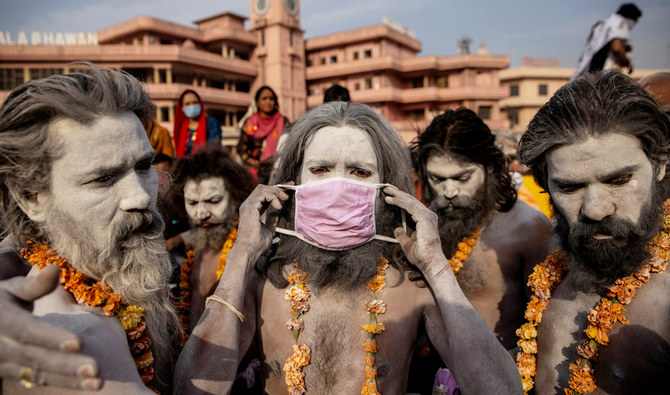

NEW DELHI: India’s move to cancel a massive Hindu festival with an expected footfall of over 20 million people was the “right decision,” civil society members and health experts said on Sunday amid an impending third wave of the coronavirus disease (COVID-19) outbreak, which has claimed more than 400,000 lives across the country.
Independent agencies and media reports, however, claim the actual figure is “at least 10 times higher” than the numbers reflected in official data.
On Saturday, the Bharatiya Janata Party (BJP) government in India’s largest state of Uttar Pradesh called off the “Kanwar Yatra,” a festival for Hindu deity Shiva, amid a steady spike in daily COVID-19 infections. Nearly 42,000 new cases were reported from across India on Sunday.
“On the appeal of the Uttar Pradesh government, the Kanwar Sanghs (the organization of Shiva devotees) has canceled the Kanwar Yatra (festival) this year,” Navneet Sehgal, Uttar Pradesh’s informational secretary, said in a statement on Saturday.
Uttar Pradesh was forced to revise its stand after the Supreme Court on Friday called upon the state to reconsider hosting the “symbolic festival.”
“The right to life is paramount. All other sentiments, even religious, are subservient to these most basic fundamental rights,” the apex court said on Friday before asking the state government to file a response by Monday.
Experts applauded the move, urging authorities to “keep learning and use science in decision making,” especially during a pandemic.
“Public health science is very clear. No matter which gathering, it can spread the virus, especially when there is potential threat of transmission of the virus in the emerging third wave,” Dr. Chandrakant Lahariya, an epidemiologist and public health expert based in the national capital New Delhi, told Arab News.
“This is an important development and a very right decision,” he added.
FASTFACTS
• ‘The right to life is paramount. All other sentiments, even religious, are subservient to these most basic fundamental rights,’ says the apex court.
• Experts applauded the move, urging authorities to ‘keep learning and use science in decision making,’ especially during a pandemic.
The 15-day annual festival draws close to 30 million from different parts of the country to the holy city of Haridwar in Uttar Pradesh’s neighboring state of Uttarakhand, where devotees collect water from the River Ganges, considered sacred by Hindus. The pilgrims then return home and use the water as an offering at local shrines for Shiva.
The anxiety surrounding the festival became all the more pronounced following reports that the Kumbh Mela — a massive Hindu festival attended by over 4 million people between March and April in Haridwar — was a “super spreader” amid the second wave of the outbreak.
“Pilgrims who came to the Kumbh contributed to the disease in other parts of the country,” Dr. Lahariya said, adding: “The number of the pilgrims attending the Kanwar Yatra could be three to four times more than those attending the Kumbh. It definitely has a higher risk of spreading the virus.”
Dr. Lahariya added that to “arrest the virus,” authorities needed to undertake all measures to limit the disease.
“When vaccination coverage is low, and the COVID-19 appropriate behavior is suboptimal, the festival or mass gathering can spread the virus fast,” he added.
The South Asian nation of 1.39 billion people has ordered 660 million vaccine doses for August-December, its largest procurement, local media reported on Friday, amid a severe vaccine shortage, with many inoculation centers shut and people waiting for long hours to get a shot.
Health and government officials were unavailable for comment when contacted by Arab News on Sunday.
However, Dr. Loveleen Mangla, a pulmonologist based in Uttar Pradesh’s industrial hub of Noida, said he “felt a sense of relief” at the cancelation of the festival.
“There are many things that can be delayed, be it religious or any other gatherings in view of the prevailing outbreak,” Dr. Mangla told Arab News, adding that “after the experience of Kumbh Mela, we should be more careful.”
“It’s a collective responsibility of all — be it politicians or people to do everything possible to stop the spread of the virus and follow COVID-19-appropriate behavior,” he added.
But while Uttarakhand made a “wise choice” by canceling the Kanwar Yatra festival last week, said Anoop Nautiyal, a social worker, he added that it had paid “a heavy price” for hosting the Kumbh Mela.
“All energies should now be focused on strengthening our infrastructure and human resources to minimize the impact of the imminent and inevitable third wave of the pandemic,” Nautiyal, the founder of the Social Development for Communities, an NGO based in Dehradun, told Arab News.
Uttar Pradesh goes to the polls early next year, and the ruling BJP “cannot afford to lose” the largest state of the country that elects 80 out of 543 lawmakers to the lower house of Parliament.
“More than not learning from mistakes, it’s a question of political compulsions that are dominating the public health concerns. After the Supreme Court’s intervention, the Uttar Pradesh government does not have any option but to pull back,” Nautiyal said.
Some analysts, however, were apprehensive whether the government would be “serious in implementing its order.”
“Though better sense prevailed this time and they canceled the festival, I have my apprehensions even today,” Surya Pratap Singh, a former bureaucrat and social advocate based in Uttar Pradesh’s capital, Lucknow, told Arab News.
“No doubt the government has banned the festival, but the people will go out, and the regime will say they cannot control it. My experience says what the BJP government says or does; there is a lot of difference between the two,” he said.


