

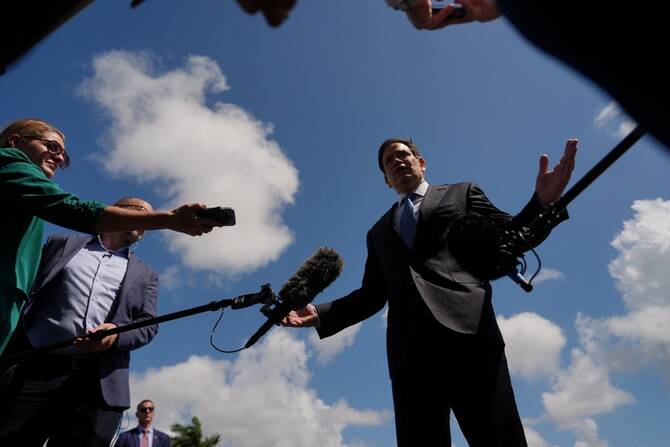

HELSINGBORG, Sweden: US Secretary of State Marco Rubio will meet NATO allies on Friday for the first time since President Donald Trump called the alliance into question due to divisions over the Iran war and Washington announced plans to pull 5,000 troops from Europe. Before leaving for a meeting of NATO foreign ministers in Sweden, Rubio said Trump was “very disappointed” in alliance members who had not allowed the US to use bases on their territory for the war, singling out Spain in particular.
“You have countries like Spain denying us the use of these bases — well then why are you in NATO? That’s a very fair question,” Rubio told reporters in Miami. “In fairness, other countries in NATO have been very helpful. But we need to discuss that.”
Trump has fiercely criticized NATO members for not doing more to help the US-Israeli military campaign. He has said he is considering withdrawing from the alliance and questioned whether Washington was bound to honor its mutual defense pact.
NATO officials have stressed the US did not ask the 32-member alliance to take part in the Iran war, but many members have honored commitments to allow US forces to use their airspace and bases on their territory.
European concerns about Trump’s attitude toward NATO were also exacerbated this year by Trump’s push to acquire Greenland, a territory of fellow NATO member Denmark.
Europeans say they are ready to help with Hormuz
At the gathering in the Swedish town of Helsingborg, European ministers are expected to try to placate the US by stressing they are ready to help with freedom of navigation in the Strait of Hormuz when conditions permit and to take more responsibility for European security. Iran has restricted traffic through the strait during the war.
European fears about the US president’s commitment to NATO have been heightened by the decision to withdraw 5,000 troops from Europe, which US officials linked to German Chancellor Friedrich Merz’s criticism of Trump’s Iran war strategy.
Washington’s allies have also been confused and unsettled by the way the decision was communicated. US officials first said the troops would be withdrawn from Germany but later said they would delay the deployment of a brigade to Poland. The United States has also said a planned deployment of long-range Tomahawk missiles to Germany will no longer go ahead. In addition, it plans to tell NATO allies it will shrink the pool of military capabilities the US makes available to the alliance in a crisis, three sources familiar with the matter told Reuters. NATO’s top commander, US Air Force General Alexus Grynkewich, sought this week to reassure European allies about the recent decisions, saying further drawdowns would stretch over years to give allies time to develop capabilities to replace them.
“As the European pillar of the alliance gets stronger, this allows the US to reduce its presence in Europe and limit itself to providing only those critical capabilities that allies cannot yet provide,” he told reporters at NATO headquarters on Tuesday.


