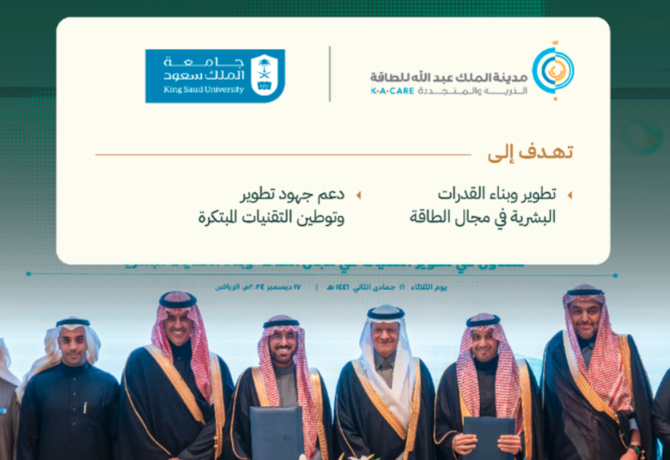

RIYADH: Saudi Arabia’s King Abdullah City for Atomic and Renewable Energy has signed new agreements to advance innovation, localize solutions, and empower women.
The first memorandum of understanding, inked with King Saud University, will focus on developing and localizing innovative technologies in the energy sector, the Saudi Press Agency reported.
The agreement also emphasizes building human capacity through training programs and the exchange of expertise, with a particular focus on technical and advisory services.
This partnership supports Saudi Arabia’s Vision 2030, which aims to increase the Kingdom’s use of renewable energy and promote sustainability.
It also aligns with Saudi Arabia’s goal of 50 percent of its electricity coming from renewable sources by the end of the decade.
In addition to these technological advancements, the MoU includes the development of educational programs and scholarships to help meet the growing demand for skilled professionals in the energy sector.
The agreement also includes joint research initiatives in renewable energy, atomic energy, hydrogen technologies, and artificial intelligence applications within the energy field. This will provide valuable opportunities for students and researchers to contribute to the Kingdom’s energy transformation, the SPA report added.
KACARE also signed a second MoU with the Saudi Women and Energy Association, further reinforcing the Kingdom’s commitment to empowering female workers in the sector.
This agreement focuses on launching comprehensive initiatives and programs aimed at supporting women to become leaders and innovators in energy. It includes training and development opportunities, such as the WE Spark program, which is dedicated to training women in renewable energy.
This program is in partnership with King Abdullah University of Science and Technology and seeks to equip women with the skills necessary to excel in a rapidly evolving industry.
The MoU also includes conducting studies to assess women’s participation in the energy sector. The research will identify key challenges and propose solutions to enhance women’s roles, ensuring equal opportunities in the workplace and supporting their development into leadership positions.
In a further effort to empower women in the energy industry, KACARE signed another MoU with Princess Nourah University. This agreement aims to enhance female competencies in renewable energy through tailored training programs for female students pursuing engineering degrees.
It also seeks to improve the capabilities of faculty members in providing specialized programs in solar energy, as well as upgrading infrastructure to support hydrogen production plants and solar photovoltaic energy projects.