GENEVA: The United Nations said Tuesday it expects around one million people to return to Syria in the first half of 2025, following the collapse of president Bashar Assad’s rule.
Assad fled Syria just over a week ago, as his forces abandoned tanks and other equipment in the face of a lightning offensive spearheaded by Hayat Tahrir Al-Sham (HTS), ending five decades of repressive rule by Assad’s family.
The rule was marked by the mass jailing and killing of suspected dissidents, and nearly 14 years of civil war that left more than 500,000 people and forced half of the population to flee their homes.
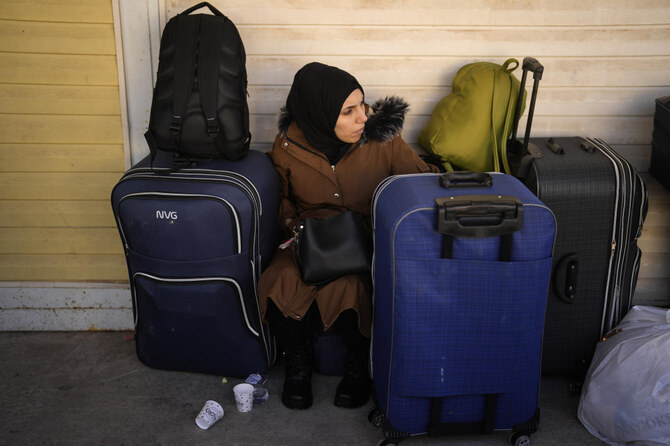
The ousting of Assad sparked celebrations around Syria and beyond, and has prompted many to begin returning to their war-ravaged country.
“We have forecasted that we hope to see somewhere in the order of one million Syrians returning between January and June of next year,” Rema Jamous Imseis, the Middle East and North Africa director for the UN refugee agency UNHCR, told reporters in Geneva.
She said the recent developments had brought “a tremendous amount of hope... for the largest displacement crisis we have on planet Earth to finally be resolved.”
But she stressed that “we also have to recognize that a change in the regime doesn’t mean that there is an end to the humanitarian crisis already there.”
Pointing to “immense challenges,” she called on countries that have been hosting the millions of Syrian refugees to refrain from hastily sending them back.
“No one should be forcibly returned to Syria and that the right of Syrians to maintain access to asylum must be preserved,” Imseis said.
Almost immediately after Assad’s fall, a number of European countries said they would freeze pending asylum requests from Syrians, while far-right parties have been pressing for the deportation of refugees back to Syria.
“What we’re saying to governments that have suspended asylum proceedings is... please continue to respect the right to access territory, to lodge an asylum claim,” Jamous Imseis said.
“People simply cannot after 14 years of displacement, pack a bag overnight and return to a country that has been devastated by conflict,” she said.
“Give us and Syrian refugees time to assess whether it’s safe to go back... It’s simply too early to see how safe it’s going to be.”
At the same time as many people are returning to Syria, Jamous Imseis pointed out that more than a million people had become newly displaced in Syria in the past three weeks, “mostly women and children.”
She highlighted that there was also a need to reevaluate who was at risk in the radically-changed Syria.
“Risk profiles which existed prior to December 8 may no longer need that same level of protection, or do not have that same threat or fear of violations against their rights, whereas now with this regime change, we have other vulnerable groups that have emerged in that process,” she said.


![]()

UN says one million Syrians may return in first half of 2025
Short Url
https://arab.news/66pyz
UN says one million Syrians may return in first half of 2025
- Pointing to “immense challenges,” Imseis called on countries that have been hosting the millions of Syrian refugees to refrain from hastily sending them back


Latest updates


© 2026 SAUDI RESEARCH & PUBLISHING COMPANY, All Rights Reserved And subject to Terms of Use Agreement.