

Canada deputy PM quits in tariff rift with Trudeau

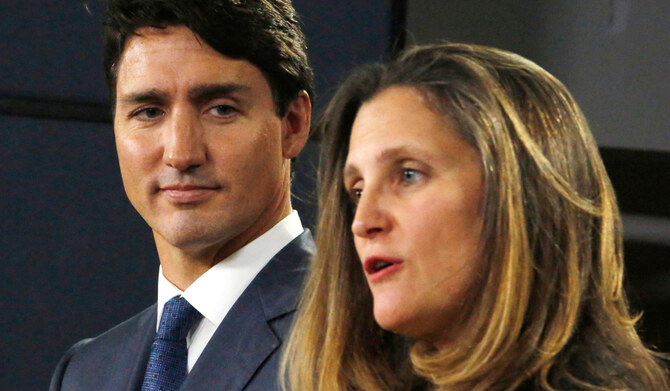
Canada's Prime Minister Justin Trudeau (L) and Minister of Foreign Affairs Chrystia Freeland (R) speak at a press conference to announce the new trade pact with Canada, the United States, and Mexico in Ottawa, October 1, 2018. (AFP)
Short Url
Updated 17 December 2024
Follow

Canada deputy PM quits in tariff rift with Trudeau

  • Trudeau flew to Florida last month to dine with Trump at Mar-a-Lago and try to head off the tariff threat, but nothing yet indicates Trump is changing his position

OTTAWA: Canada's Deputy Prime Minister Chrystia Freeland quit Monday in a surprise move after disagreeing with Justin Trudeau over US President-elect Donald Trump's tariff threats.
The resignation of Freeland, 56, who also stepped down as finance minister, marked the first open dissent against Prime Minister Trudeau from within his cabinet, and may threaten his hold on power.
Liberal leader Trudeau lags 20 points in polls behind his main rival, Conservative Pierre Poilievre, who has tried three times since September to topple the government and force a snap election.
"Our country today faces a grave challenge," Freeland said in her resignation letter to Trudeau, pointing to Trump's planned 25 percent tariffs on Canadian imports.
"For the past number of weeks, you and I have found ourselves at odds about the best path forward for Canada."
First elected to parliament in 2013, the former journalist joined Trudeau's cabinet two years later when the Liberals swept to power, holding key posts including trade and foreign minister, and leading free trade negotiations with the EU and the United States.
Most recently, Freeland had been tasked with helping lead Canada's response to the incoming Trump administration. As the first woman to hold the nation's purse strings, she had also been tipped as a possible successor to Trudeau.
Canada's main trading partner is the United States, with 75 percent of its exports each year going to its southern neighbor.
Trudeau flew to Florida last month to dine with Trump at Mar-a-Lago and try to head off the tariff threat, but nothing yet indicates Trump is changing his position.
In her resignation letter, Freeland said Trudeau wanted to shuffle her to another job, to which she replied: "I have concluded that the only honest and viable path is for me to resign from the cabinet."
She said the country needed to take Trump's tariffs threats "extremely seriously."
Warning that it could lead to a "tariff war" with the United States, she said Ottawa must keep its "fiscal powder dry."
"That means eschewing costly political gimmicks, which we can ill afford," she said, in an apparent rebuke of a recent sales tax holiday that critics said was costly and aimed at bolstering the ruling Liberals' sagging political fortunes.

Dalhousie University professor Lori Turnbull called Freeland's exit "a total disaster."
"It really shows that there is a crisis of confidence in Trudeau," she said. "And makes it much harder for Trudeau to continue as prime minister."
Until now, the cabinet has rallied around Trudeau as he faced pockets of dissent from backbench MPs, noted Genevieve Tellier, a professor at the University of Ottawa.
But Freeland's rejection of his economic policies poses "a big problem," she said, and shows his team is not as united behind him as some thought.
One by one, ministers trickled out of a cabinet meeting Monday past a gauntlet or reporters shouting questions. Some shouted back that they had "confidence in the prime minister," but most, looking solemn, said nothing.
Freeland's departure came just hours before she was scheduled to provide an update on the nation's finances, amid reports the government would blow past Freeland's deficit projections last spring.
"We simply cannot go on like this," Poilievre said. "The government is spiraling out of control... at the very worst time."
Housing Minister Sean Fraser, who also announced Monday he was quitting federal politics, described Freeland as "professional and supportive."
One of her closest friends and allies in cabinet, Anita Anand, told reporters: "This news has hit me really hard."
Freeland said she would run for reelection in the country's next parliamentary polls. A vote is scheduled to be held in October 2025 at the latest, but most analysts believe it will come sooner.
Trudeau has indicated that he plans to lead the Liberals into the next election.
Some local media suggested he might step down after Freeland's exit, but his office flatly rejected the reports as "absolutely not accurate."


El Paso flights resume after US anti-drone system prompts sudden shutdown

Updated 3 sec ago
Follow

El Paso flights resume after US anti-drone system prompts sudden shutdown

  • Aviation officials lifts restrictions after sudden overnight halt
  • FAA, US Army in dispute ‌over laser anti-drone system
WASHINGTON: A secret military laser-based anti-drone system prompted the Trump administration to ban air traffic for more than seven hours in and out of the Texas border city of El Paso after US aviation officials raised drastic concerns about the safety of commercial air traffic.
The sudden closure of the nation’s 71st busiest airport by the Federal Aviation Administration stranded air travelers and disrupted medical evacuation flights overnight. The FAA initially said the closure would last 10 days for “special security reasons,” in what would have been an unprecedented action involving a single airport. Government and airline officials, speaking on condition of anonymity, said the FAA closed the airspace due to concerns that an Army laser-based counter-drone system could pose risks to air traffic. The two agencies had planned to discuss the issue at a February 20 meeting but the Army opted to proceed without FAA approval, sources said, which prompted the FAA to halt flights.
The Army’s laser was a direct-energy weapon called LOCUST and is manufactured by AeroVironment, a Virginia-based ‌drone and counter-drone defense ‌firm, two people briefed on the matter said. The company and the Pentagon did not ‌immediately ⁠respond to requests ⁠for comment.
The FAA lifted its restrictions after the Army agreed to more safety tests before using the system, which is housed at Fort Bliss, next to El Paso International Airport.
The White House was surprised by the El Paso airspace closure, according to two sources speaking on condition of anonymity, touching off a scramble among law enforcement agencies to figure out what happened.
The FAA lifted the restrictions shortly after the situation was discussed in the office of White House chief of staff Susie Wiles, the sources said. US Transportation Secretary Sean Duffy, who oversees the FAA, said the closure had been prompted by a drone incursion by a Mexican drug cartel. However, a drone sighting near an airport would typically ⁠lead to a brief pause on traffic, not an extended closure, and the Pentagon says there ‌are more than 1,000 such incidents each month along the US-Mexico border.
FAA Administrator ‌Bryan Bedford met senators on Wednesday and told them there could have been better coordination about the move but did not answer detailed questions about ‌why the agency initially planned a 10-day halt to flights, lawmakers said. Senate Commerce Committee chair Ted Cruz, a Texas Republican, and Senator ‌Ben Ray Lujan, a New Mexico Democrat, both called for a classified briefing to get more answers. “The details of what exactly occurred over El Paso are unclear,” Cruz said.
The move had stranded numerous aircraft from Southwest Airlines, United Airlines and American Airlines at the airport, which handles about 4 million passengers annually.
El Paso Mayor Renard Johnson said the FAA did not reach out to the airport, the police chief or other local officials before ‌shutting down the airspace.
“I want to be very, very clear that this should have never happened,” he said at a news conference.
The US official in charge of airport security, Transportation Security ⁠Administration Acting Administrator Ha Nguyen McNeill, ⁠also told Congress that she had not been notified.
“That’s a problem,” said Republican Representative Tony Gonzales of Texas, who said there are daily drone incursions along the US-Mexico border.
Airlines caught off guard
Airlines were also caught off-guard by the early Wednesday announcement. Southwest Airlines said the effects should be minimal for its 23 daily departures scheduled.
“FAA has not exactly acquitted itself credibly, objectively, or professionally,” said Bob Mann, an airline industry consultant. “The question should be, do we get an explanation?”
Trump has repeatedly threatened to deploy US military force against Mexican drug cartels, which have used drones to carry out surveillance and attacks on civilian and government infrastructure, according to US and Mexican security sources.
Mexican President Claudia Sheinbaum said at her daily news conference that her administration would try to find out what exactly happened but had no information about drone traffic along the border.
Tensions between the US and regional leaders have ramped up since the Trump administration mounted a large-scale military buildup in the southern Caribbean, attacked Venezuela and seized its president, Nicolas Maduro, in a military operation. The FAA curbed flights throughout the Caribbean after the attack, forcing the cancelation of hundreds of flights.