

UN must put justice for torture victims in Libya ahead of election plans, Security Council told

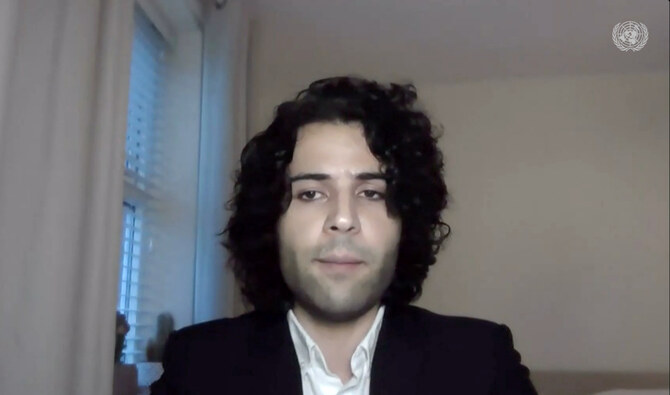
Ali Omar, director of Libya Crimes Watch. (Screenshot/UN)
Short Url
Updated 17 December 2024
Follow

UN must put justice for torture victims in Libya ahead of election plans, Security Council told

  • Libyan human rights activist Ali Omar warns that any political process will be undermined if victims of torture, arbitrary detention and other crimes are denied justice
  • He presents alarming report documenting more than 280 ‘grave’ violations of human rights in the country this year alone

NEW YORK CITY: A leading Libyan human rights activist called on the UN Security Council to prioritize accountability for human rights violations in the country over the planning of elections.

Addressing council members on Monday, Ali Omar, the director of Libya Crimes Watch, warned that any future political process would be undermined by the absence of justice for the victims of torture, arbitrary detention and other crimes.

He presented an alarming report that documented more than 280 “grave” violations of human rights in Libya this year, “perpetrated by both eastern and western authorities” in the country.

He said: “These figures are not mere statistics but reflect harrowing stories and real tragedies of victims, including the most vulnerable groups such as women and migrants, as well as activists, journalists, lawyers and others.

“These violations include torture in prisons, arbitrary arrests, enforced disappearances and extrajudicial killings. Such practices not only destroy the lives of individuals and their families but also sow fear throughout society and undermine any hope for peace.

“These heinous crimes are not isolated acts, but systematic and recurrent, carried out and overseen by all sides in the conflict, including the Libyan Armed Forces, the Government of National Unity, and other military groups.”

Omar, who lives in exile, urged the Security Council to shift its focus from planning an electoral process for Libya to the urgent need to hold accountable those responsible for rights abuses in the country.

“The persistence of these violations poses a serious threat to social peace and stability in Libya,” he said.

“How can a country where individuals accused of war crimes and crimes against humanity hold the senior positions of power, how can such a country organize fair and transparent elections?”

Omar, himself a former prisoner of conscience, added: “Prisons and unofficial detention centers represent a dangerous and ongoing phenomenon. In these places, human dignity is stripped away and individuals are treated as mere numbers without value.”

He highlighted as particular concerns the ongoing repression of civil society, the arbitrary detention of activists, and the deaths of prisoners in suspicious circumstances. He told how three detainees — a woman and two followers of Sufi orders, a religious minority long subjected to persecution — died under torture at an unofficial detention center in Benghazi in November 2023.

“This culture of impunity perpetuates violence and political instability,” Omar said.

He also spoke about the chilling effects of repressive government legislation, including anti-cybercrime and anti-terrorism laws that were used to justify the arrests of more than 50 activists in eastern and western Libya in 2023 alone.

Omar highlighted the cases of 16 people, including four children, who were arrested for demonstrating peacefully in support of the former Libyan regime following the catastrophic collapse of two dams in Derna in September 2023 following a storm. The disaster claimed at least 6,000 lives. Demonstrators were arrested for protesting against the corruption and governmental negligence they believe contributed to the disaster, and demanding that those responsible be held accountable.

Calling for urgent reforms in Libya, Omar urged the Security Council to establish an independent international mechanism to investigate violations of human rights and hold the perpetrators accountable.

He also called for the UN Support Mission in Libya to be granted a stronger mandate to address issues related to human rights, including the protection of vulnerable communities and an end to arbitrary detentions.

“Libyan civil society and human rights defenders in exile are asking for one thing: accountability,” Omar said. “Without it, no political process, no election, will be credible.”

Libya continues to grapple with deep political divisions and ongoing violence, despite years of international efforts to mediate peace and facilitate democratic elections.

The nation has been in turmoil since the Arab Spring protests in 2011 that led to the overthrow and killing of Muammar Qaddafi, who had ruled for 42 years. It is split between two rival governments backed by armed militias and international patrons. In the west of the country, Prime Minister Abdul Hamid Dbeibah heads the internationally recognized Government of National Unity. In the east, Prime Minister Ossama Hamad heads the Government of National Stability, backed by military commander Khalifa Haftar’s Libyan National Army.

Given this fractured governmental structure and competing military factions, many fear the continuing failure to address human rights violations can only prolong the instability and prevent the formation of a legitimate, unified government.

Omar urged council members to “look into the eyes of the victims” and take decisive action to prevent further atrocities.


Sudan’s prime minister takes his peace plan to the UN, but US urges humanitarian truce now

Updated 23 December 2025
Follow

Sudan’s prime minister takes his peace plan to the UN, but US urges humanitarian truce now

  • Sudan’s prime minister is proposing a wide-ranging peace initiative to end a nearly 1,000-day war with a rival paramilitary force
  • It seems unlikely the RSF would support the proposal, which would essentially give government forces a victory and take away their military power

UNITED NATIONS: Sudan’s prime minister on Monday proposed a wide-ranging peace initiative to end a nearly 1,000-day war with a rival paramilitary force, but the United States urged both sides to accept the Trump administration’s call for an immediate humanitarian truce.
Kamil Idris, who heads Sudan’s transitional civilian government, told the Security Council his plan calls for a ceasefire monitored by the United Nations, African Union and Arab League, and the withdrawal of paramilitary forces from all areas they occupy, their placement in supervised camps and their disarmament.
Sudan plunged into chaos in April 2023 when a power struggle between the military and the powerful paramilitary Rapid Support Forces exploded into open fighting, with widespread mass killings and rapes, and ethnically motivated violence. This has amounted to war crimes and crimes against humanity, according to the UN and international rights groups.
It seemed highly unlikely the RSF would support the prime minister’s proposal, which would essentially give government forces a victory and take away their military power.
In an indirect reference to the truce supported by the US and key mediators Saudi Arabia, Egypt and the United Arab Emirates, known as the Quad, Idris stressed to the UN Security Council that the government’s proposal is “homemade — not imposed on us.”
In early November, the Rapid Support Forces agreed to a humanitarian truce. At that time, a Sudanese military official told The Associated Press the army welcomed the Quad’s proposal but would only agree to a truce when the RSF completely withdraws from civilian areas and gives up their weapons — key provisions in the plan Idris put forward on Monday.
Idris said unless the paramilitary forces were confined to camps, a truce had “no chance for success.” He challenged the 15 members of the Security Council to back his proposal.
“This initiative can mark the moment when Sudan steps back from the edge and the international community — You! You! — stood on the right side of history,” the Sudanese prime minister said. He said the council should “be remembered not as a witness to collapse, but as a partner in recovery.”
US deputy ambassador Jeffrey Bartos, who spoke to the council before Idris, said the Trump administration has offered a humanitarian truce as a way forward and “We urge both belligerents to accept this plan without preconditions immediately.”
Bartos said the Trump administration strongly condemns the horrific violence across Darfur and the Kordofan region — and the atrocities committed by both the Sudanese Armed Forces and the Rapid Support Forces, who must be held accountable.
UAE Ambassador Mohamed Abushahab, a member of the Quad, said there is an immediate opportunity to implement the humanitarian truce and get aid to Sudanese civilians in desperate need.
“Lessons of history and present realities make it clear that unilateral efforts by either of the warring parties are not sustainable and will only prolong the war,” he warned.
Abushahab said a humanitarian truce must be followed by a permanent ceasefire “and a pathway toward civilian rule independent of the warring parties.”
UN Assistant Secretary-General for political affairs Khaled Khiari reflected escalating council concerns about the Sudan war, which has been fueled by the continuing supply of increasingly sophisticated weapons.
He criticized unnamed countries that refuse to stop supplying weapons, and both government and paramilitary forces for remaining unwilling to compromise or de-escalate.
“While they were able to stop fighting to preserve oil revenues, they have so far failed to do the same to protect their population,” Khiari said. “The backers of both sides must use their influence to help stop the slaughter, not to cause further devastation.”
The devastating war in Sudan has killed more than 40,000 people according to UN figures, but aid groups say the true number could be many times higher. The conflict has created the world’s largest humanitarian crisis, with over 14 million people displaced, disease outbreaks and famine spreading in parts of the country.