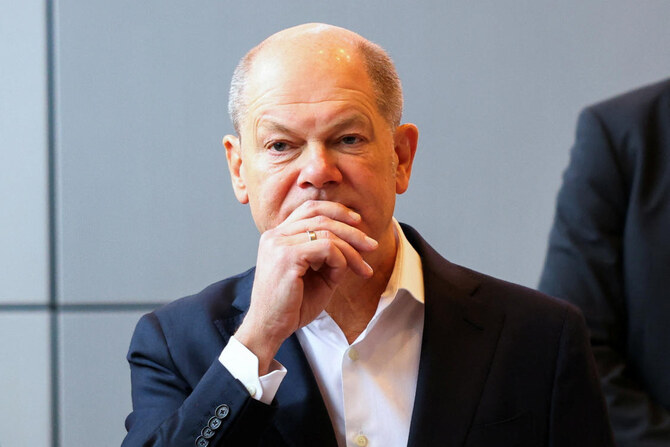
BERLIN: Chancellor Olaf Scholz will call on Germany’s parliament on Monday to declare it has no confidence in him, taking the first formal step toward securing early elections following his government’s collapse.
The departure last month of the neoliberal Free Democrats from the three-way coalition left Scholz’s Social Democrats and the Greens governing without a parliamentary majority just when Germany faces its deepest economic crisis in a generation.
Rules drawn up to prevent the series of short-lived and unstable governments that played an important role in helping the Nazis rise to power in the 1930s mean that the path to new elections is long and largely controlled by the chancellor.
“If legislators follow the path I am recommending, I will suggest to the President that he dissolve parliament,” Scholz told reporters on Wednesday after requesting the motion.
President Frank-Walter Steinmeier has said he will act accordingly after Monday’s vote and agreed with parliamentary parties on Feb. 23 as the date for early elections.
Assuming the no-confidence vote passes, Scholz and his ministers will remain in office in an acting capacity until a new government is formed, which could take months if coalition negotiations prove lengthy.
Scholz has outlined a list of measures that could pass with opposition support during that period, including 11 billion euros ($11.55 billion) of tax cuts and an increase in child benefits already agreed on by former coalition partners.
Measures to better protect the Constitutional Court from the machinations of a future populist or anti-democratic government, to cut energy prices and to extend a popular subsidised transport ticket are also under discussion.
The outcome of the vote is not certain, with Scholz’s SPD likely to vote that they have confidence in their Chancellor, while opposition conservatives, far ahead in the polls, and the Free Democrats expected not to.
The far-right Alternative for Germany, with whom all other parties refuse to work, could surprise legislators by voting that they do have confidence in Scholz.
If both the SPD and the Greens also back Scholz, that would leave him in the awkward position of remaining in office with the support of a party that he rejects as anti-democratic. In that case, most observers expect he would resign, which itself would trigger elections.
To avoid that scenario, many legislators expect the Greens to abstain from the vote.


![]()

German Chancellor Scholz to ask parliament to clear way for new elections
Short Url
https://arab.news/nbxyy
German Chancellor Scholz to ask parliament to clear way for new elections
- Lost confidence vote opens path to snap elections
- Scholz hopes to be acting chancellor until new government formed


Latest updates




© 2026 SAUDI RESEARCH & PUBLISHING COMPANY, All Rights Reserved And subject to Terms of Use Agreement.