

Syrians return to ruined homes in city that became Hezbollah hub

1 / 4
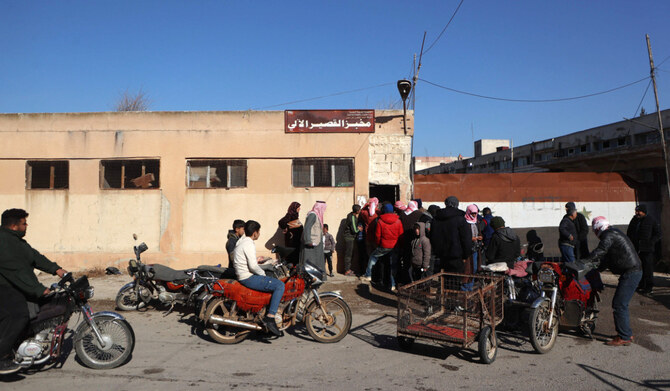
Syrians queue to buy bread from a bakery in the town of in Qusayr in Syria's central Homs province on December 14, 2024. (AFP)
2 / 4
This aerial view shows a building reportedly used by Lebanon's Hezbollah group, in the town of in Qusayr in Syria's central Homs province on December 15, 2024. (AFP)
3 / 4
Syrians queue to buy bread from a bakery in the town of in Qusayr in Syria's central Homs province on December 14, 2024. (AFP)
4 / 4
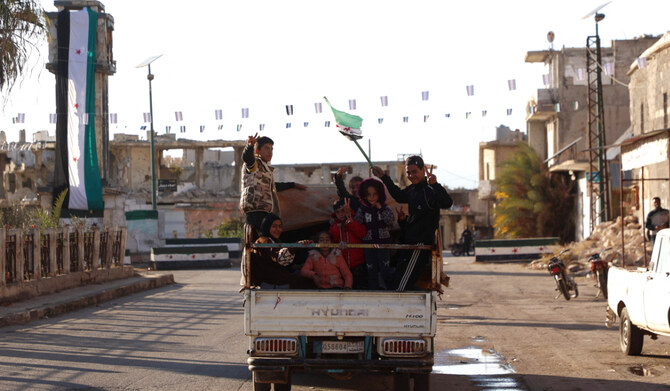
Syrians sit in the back of a truck as it drives in the town of in Qusayr in Syria's central Homs province on December 14, 2024. (AFP)
Short Url
Updated 16 December 2024
Follow

Syrians return to ruined homes in city that became Hezbollah hub

  • Qusayr had been used by rebels as a transit point for weapons and fighters from Lebanon, and was strategically vital for the Syrian government because it is close to a major road linking Damascus to the coast

AL-QUSAYR, Syria: Residents of Qusayr in central Syria are finally returning home after the departure of Hezbollah fighters, who helped Bashar Assad’s forces seize the city a decade ago and left with his fall.
Many of the houses are now in ruins, after years under the control of the Lebanese armed group, a key Assad ally which had set up a military base and training camp there.
“Most areas in the city of Qusayr were off-limits to us,” said 22-year-old resident Ali Khleif.
“Even the local residents who owned shops and establishments there were prohibited from entering.”
Syria’s military retook Qusayr, near the Lebanese border, in June 2013 after a blistering assault led by Hezbollah fighters.
Qusayr had been used by rebels as a transit point for weapons and fighters from Lebanon, and was strategically vital for the Syrian government because it is close to a major road linking Damascus to the coast.
Hezbollah used the buildings “as warehouses for weapons and ammunition,” said Khleif.
“After the liberation, the residents returned to their shops and land” and have reclaimed them, he said.
“We will begin rebuilding them.”
Hezbollah acknowledged in 2013 that it was fighting in Syria in support of Damascus, two years after war erupted when Assad brutally repressed a pro-democracy uprising.
Now in Qusayr, former Hezbollah posts have been ransacked.
Images of the group’s former chief Hassan Nasrallah, who was killed in September in a huge Israeli strike on Beirut’s southern suburbs, have been slashed up and destroyed.
The 2013 battle for Qusayr forced thousands to flee, including many Lebanese residents of the area, which maintains close ties to Lebanon’s Bekaa Valley across the border.
Hezbollah fighters abandoned the area with the fall of Assad last week, after Islamist-led rebels pressed a lightning offensive, taking the capital on December 8.
Lawyer Ayman Soweid, 30, said that “during Hezbollah’s occupation of Qusayr, our city was regarded as a land bridge for transporting weapons, specifically from Syria and Iran, via Iraq, passing through us to Lebanon.”
Israeli strikes have also repeatedly hit the Qusayr area.
Israel, which has carried out hundreds of strikes in Syria since 2011, mainly targeting the army and Iran-backed groups including Hezbollah, has rarely commented on individual raids but has repeatedly said it would not allow Iran to expand its presence in the country.
Elsewhere in Qusayr, Samar Harfouch, 38, was surveying piles of rubble.
She said she had returned on Saturday only to find her home destroyed.
“This is my home, and these are the homes of my husband’s brothers — three homes,” she told AFP, also indicating more relatives’ homes nearby.
“All destroyed,” she said.
“Twelve homes reduced to rubble.”


Activists plan new, bigger flotilla to try to bring aid to Gaza

Updated 9 sec ago
Follow

Activists plan new, bigger flotilla to try to bring aid to Gaza

  • Activists previously detained by Israel plan new flotilla
  • Israeli officials denounce such missions as stunts
JOHANNESBURG: Activists behind a flotilla intercepted at sea last year by Israel while trying to bring aid to Gaza will try again this year, expecting more than twice as many boats carrying up to 1,000 medics, they said on Thursday.
The Israeli military halted the roughly 40 boats in the Global Sumud Flotilla last October as ‌they attempted ‌to reach blockaded Gaza, arresting Swedish ‌activist ⁠Greta Thunberg and more ‌than 450 other participants.
Organizers, who gathered on Wednesday at the foundation of late South African leader Nelson Mandela in Johannesburg, said they hope to bring 100 boats for their next attempt.
“It is a cause ... for those that want to rise and stand for justice and dignity for all,” Mandela’s ⁠grandson Mandla Mandela, who was among activists detained last time, told the ‌gathering. “We want to mobilize the ... global ‍community to join forces with us.”
Israeli ‍officials repeatedly denounced last year’s mission, and previous smaller-scale ‍attempts to reach Gaza by sea, as publicity stunts.
Israel, which controls all access to the Gaza Strip, denies withholding supplies for its more than 2 million residents. Palestinians and international aid bodies say supplies reaching the territory are still insufficient, despite a ceasefire reached in October which included guarantees of ⁠increased aid.
Following the ceasefire, Israeli forces now control more than 53 percent of the Gaza Strip where they have ordered residents out. Nearly the entire population is crowded into a narrow strip along the coast, mostly living in makeshift tents and damaged buildings.
If the flotilla is blocked again, the activists said it would still be worth it to highlight Gaza’s plight.
“We may not have reached Gaza physically (but) we have reached ... the people in Gaza,” said one of the activists, Susan Abdallah. “They ‌know that we care, that we will not stop at anything until we actually break the siege.”