Hoping for religious harmony, Christians in a Syrian town attend Mass

1 / 3
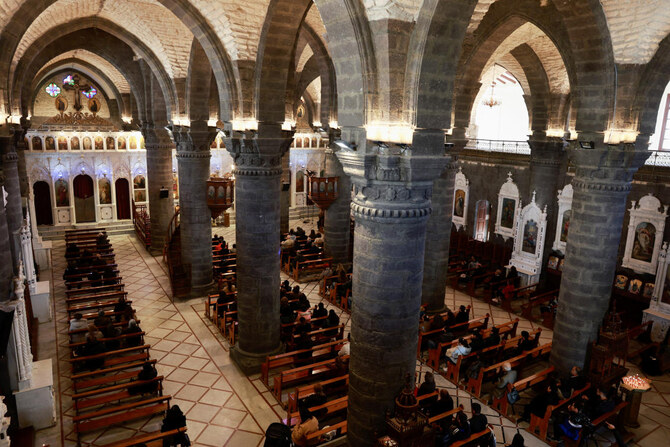
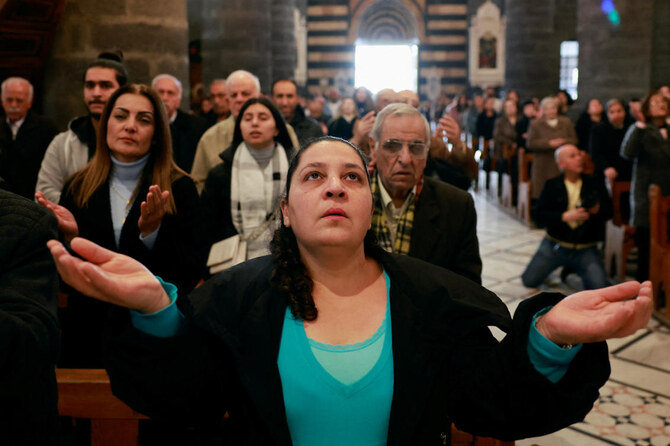
Christians attend the first Sunday mass after the fighters of the ruling Syrian body took control of the city, at Zaitoun Church in Damascus, Syria, December 15, 2024. (Reuters)
2 / 3
A priest takes part in the first Sunday mass after the fighters of the ruling Syrian body took control of the city, at Zaitoun Church in Damascus, Syria, December 15, 2024. (Reuters)
3 / 3
Christians attend the first Sunday mass after the fighters of the ruling Syrian body took control of the city, at Zaitoun Church in Damascus, Syria, December 15, 2024. (Reuters)
Short Url
Updated 16 December 2024
Follow

Hoping for religious harmony, Christians in a Syrian town attend Mass

  • Syria’s population includes historic ethnic and religious minority communities including Christians, Armenians, Kurds and Shiite Muslims

LATAKIA: In Syria’s northwestern port town of Latakia, Christian worshippers attending Mass on Sunday at St. George Greek Orthodox Cathedral were hopeful that the country’s new largely Sunni Muslim leadership would respect their religion.
Like other Christians around the country, they were attending the first Mass since militants overthrew President Bashar Assad a week ago.
Last Sunday, Church authorities warned people to stay away from worship amid the upheaval as militants — led by former al Qeada offshoot Hayat Tahrir Al-Sham — swept into Damascus and ended 50 years of brutal rule by the Assad family.
Athanasios Fahed, the Metropolitan of Latakia and its dependencies for the Greek Orthodox Church, led Sunday’s service in Latakia and the cathedral filled with people in brisk morning weather.
“Last Sunday, we were surprised just like all Syrian people, of the change that happened. Of course, we had many fears, especially for those who are called minorities,” Fahed told Reuters, although he added he did not consider Christians minorities since they were “part of this country.”
“But of course, a lot of questions rose because obviously there was chaos in the street due to the fall of the state and its security, military, official and civil institutions,” Fahed said.
Fahed said that while many Christians were displaced to other regions under Assad’s rule, the coastal regions such as areas around Latakia were unaffected. Latakia was a stronghold of Assad’s rule.
Syria’s population includes historic ethnic and religious minority communities including Christians, Armenians, Kurds and Shiite Muslims, who like many other Syrian Muslims had feared during the 13-year civil war that any future Islamist rule would imperil their way of life.
Lina Akhras, a parish council secretary at the church, said Christians had been “comfortable” under Assad in terms of their freedom of belief.
“It happened all of a sudden, we didn’t know what to expect. So in order to protect everybody, we stopped (worship) until we saw how it will develop,” she told Reuters.
“Thank God, we received a lot of assurances and we saw that members of the (HTS) committee reached out to our priest... God willing we will return to our previous lives and live in our beautiful Syria,” she told Reuters.
“Your religion is yours, but our country is for all of us.”


Lebanese finance minister denies any plans for a Kushner-run economic zone in the south

Updated 45 min 44 sec ago
Follow

Lebanese finance minister denies any plans for a Kushner-run economic zone in the south

  • Proposal was made by US Envoy Morgan Ortagus but was ‘killed on the spot’
  • Priority is to regain control of state in all aspects, Yassine Jaber tells Arab News

DAVOS: Lebanon’s finance minister dismissed any plans of turning Lebanon’s battered southern region into an economic zone, telling Arab News on the sidelines of the World Economic Forum’s meeting in Davos that the proposal had died “on the spot.”

Yassine Jaber explained that US Envoy to Lebanon Morgan Ortagus had proposed the idea last december for the region, which has faced daily airstrikes by Israel, and it was immediately dismissed.

Jaber’s comments, made to Arab News on the sidelines of the World Economic Forum in Davos, were in response to reports which appeared in Lebanese media in December which suggested that parts of southern Lebanon would be turned into an economic zone, managed by a plan proposed by Jared Kushner, US President Donald Trump’s son in law.

Meanwhile, Jaber also dismissed information which had surfaced in Davos over the past two days of a bilateral meeting between Lebanese ministers, US Middle East Envoy Steve Witkoff and Kushner.

Jaber said that the meeting on Tuesday was a gathering of “all Arab ministers of finance and foreign affairs, where they (Witkoff and Kushner) came in for a small while, and explained to the audience the idea about deciding the board of peace for Gaza.”

He stressed that it did not develop beyond that.

When asked about attracting investment and boosting the economy, Jaber said: “The reality now is that we need to reach the situation where there is stability that will allow the Lebanese army, so the (Israeli) aggression has to stop.”

Over the past few years, Lebanon has witnessed one catastrophe after another: one of the world’s worst economic meltdowns, the largest non-nuclear explosion in its capital’s port, a paralyzed parliament and a war with Israel.

A formal mechanism was put in place between Lebanon and Israel to maintain a ceasefire and the plan to disarm Hezbollah in areas below the Litani river.

But, the minister said, Israel’s next step is not always so predictable.

“They’re actually putting pressure on the whole region. So, a lot of effort is being put on that issue,” he added.

“There are still attacks in the south of the country also, so stability is a top necessity that will really succeed in pushing the economy forward and making the reforms beneficial,” he said.

Lawmakers had also enacted reforms to overhaul the banking sector, curb the cash economy and abolish bank secrecy, alongside a bank resolution framework.

Jaber also stressed that the government had recently passed a “gap law” intended to help depositors recover funds and restore the banking system’s functionality.

“One of the priorities we have is really to deal with all the losses of the war, basically reconstruction … and we have started to get loans for reconstructing the destroyed infrastructure in the attacked areas.”

As Hezbollah was battered during the war, Lebanon had a political breakthrough as the army’s general, Joseph Aoun, was inaugurated as president. His chosen prime minister was the former president of the International Court of Justice, Nawaf Salam.

This year marks the first time a solid delegation from the country makes its way to Davos, with Salam being joined by Jaber, Economy and Trade Minister Amr Bisat, and Telecoms Minister Charles Al-Hage.

“Our priority is to really regain the role of the state in all aspects, and specifically in rebuilding the institutions,” Jaber said.