LUANDA: Talks due Sunday between the leaders of Rwanda and the Democratic Republic of Congo to end conflict in the eastern DRC were called off after negotiations deadlocked, officials said.
Since 2021 a Rwanda-backed rebel militia has seized swathes of the eastern DRC, displacing thousands and triggering a humanitarian crisis.
There had been high hopes that the summit hosted by Angola’s President Joao Lourenco – the African Union mediator to end the conflict – would end with a deal to end the conflict.
But around midday Sunday the head of the Angolan presidency’s media office said it would not go ahead.
“Contrary to what we expected, the summit will no longer be held today,” media officer Mario Jorge told journalists.
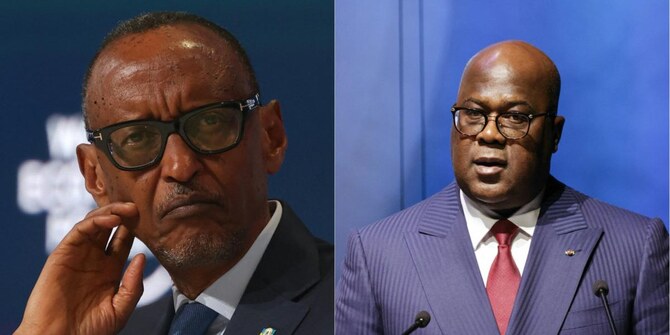
Lourenco was meeting with DRC leader Felix Tshisekedi and without Rwandan President Paul Kagame, he said.
The Congolese presidency said that negotiations had hit deadlock over a Rwandan demand that the DRC hold direct dialogue with the Kigali-backed and largely ethnic Tutsi M23 rebels who have since 2021 seized swathes of the eastern DRC.
“There is a stalemate because the Rwandans have set as a precondition for the signing of an agreement that the DRC hold a direct dialogue with the M23,” Giscard Kusema, the Congolese presidency spokesman present in Luanda, said.
Rwanda’s Foreign Minister Olivier Nduhungirehe said Friday that his country wanted “a firm commitment from the DRC to resume direct talks with the M23 within a well-defined framework and timeframe.”
The Congolese government says, however, that the M23 only exists because of Rwandan military support.
“If Kigali is in good faith in the negotiations and on its promise to withdraw... its troops from Congolese soil, the conflict will end with the M23, and at the same time it will stop with Rwanda,” a Congolese government source said.
Kagame and Tshisekedi last saw each other in October in Paris but did not speak, though they have maintained dialogue through the mediation of Luanda.
In early August, Angola mediated a fragile truce that stabilized the situation at the front line, but both sides continued to exchange fire and clashes have intensified since late October.
Home to a string of rival armed groups, the mineral-rich eastern DRC has been plagued by internal and cross-border violence for the past three decades.
“Our country continues to face persistent rebellions, including the aggression by the Rwandan army and the M23 terrorists,” Tshisekedi said in parliament Wednesday, calling the militants and Rwanda “enemies of the Republic.”
The capital of DRC’s North Kivu province Goma, home to about one million people and another million displaced by war, is now nearly surrounded by M23 rebels and the Rwandan army.
Early in November, the two central African neighbors launched a committee to monitor ceasefire violations, led by Angola and including representatives from both the DRC and Rwanda.
Kinshasa and Kigali a few weeks later approved a document setting out the terms by which Rwandan troops will disengage from Congolese territory.
A previous draft dated in August listed the dismantling of the FDLR militia, created by ethnic Hutus involved in the Rwandan genocide in 1994, as a precondition for Rwanda’s withdrawal.
Often portrayed by Kigali as a threat to its security, the Democratic Forces for the Liberation of Rwanda (FDLR) is one of various disparate militias fighting alongside the Congolese army against the M23.
The August draft was rejected by the DRC, which demanded that the withdrawal occur at the same time as the FDLR’s dismantling.
The final strategic document, seen by AFP, planned for a period of 90 days to “conclude the neutralization of the FDLR and the lifting of Rwanda’s defensive measures.”


![]()

DR Congo, Rwanda peace talks canceled
Short Url
https://arab.news/y4ybv
DR Congo, Rwanda peace talks canceled
- Since 2021 a Rwanda-backed rebel militia has seized swathes of the eastern the Democratic Republic of Congo
- The Congolese government says that the M23 rebels only exist because of Rwandan military support


Latest updates


© 2026 SAUDI RESEARCH & PUBLISHING COMPANY, All Rights Reserved And subject to Terms of Use Agreement.