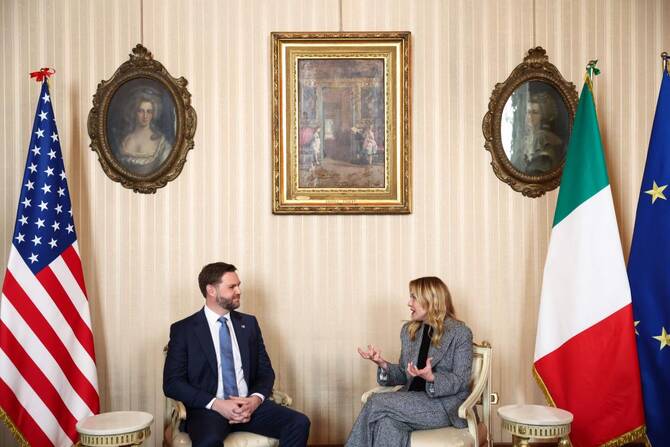
MILAN: US Vice President JD Vance and Italy’s Giorgia Meloni, a fellow conservative, hailed their “shared values” on Friday ahead of the Olympics as hundreds protested against the US in Milan.
Prime Minister Meloni, one of the European leaders closest to President Donald Trump, said sport and religion were “values that keep together Italy and the US, Europe and the US, Western civilization.”
Vance praised Meloni for Italy’s organization of the Olympics and also welcomed “coming together around shared values.”
Meloni and Vance — a fervent Catholic who converted in 2019 — last met in Rome following the election last year of Pope Leo XIV, the first American pontiff.
There has been anger in Italy ahead of the Games over the presence of some agents from the US immigration enforcement agency ICE as part of security for the US delegation.
ICE operations in a number of US cities have triggered large-scale protests, and the recent killings of two demonstrators have caused outrage.
Hundreds of students from high schools and universities in Milan gathered in front of the Politecnico di Milano to protest against ICE.
“This is all unacceptable for us,” Leonardo Schiavi, a protester, told AFP, referring to Vance’s visit and the presence of ICE agents.
Giacomo Calvi said he was protesting the American “anti-immigration police which are carrying out all kinds of violence in the United States.”
The Italian government has said the ICE agents will not have any operational role on its soil.
The agents will be from ICE’s Homeland Security Investigations Unit, which is a different division from the one accused of violence in the US.

Meloni, Vance hail ‘shared values’ amid pre-Olympic protests
https://arab.news/7n9zn
Meloni, Vance hail ‘shared values’ amid pre-Olympic protests
- Meloni said sport and religion were “values that keep together Italy and the US, Europe and the US, Western civilization“
- There has been anger in Italy ahead of the Games over the presence of some ICE agents
Afghan barbers under pressure as morality police take on short beards
KABUL: Barbers in Afghanistan risk detention for trimming men’s beards too short, they told AFP, as the Taliban authorities enforce their strict interpretation of Islamic law with increasing zeal.
Last month, the Ministry for the Propagation of Virtue and Prevention of Vice said it was now “obligatory” to grow beards longer than a fist, doubling down on an earlier order.
Minister Khalid Hanafi said it was the government’s “responsibility to guide the nation to have an appearance according to sharia,” or Islamic law.
Officials tasked with promoting virtue “are obliged to implement the Islamic system,” he said.
With ministry officials patrolling city streets to ensure the rule is followed, the men interviewed by AFP all spoke on condition of anonymity due to security concerns.
In the southeastern province of Ghazni, a 30-year-old barber said he was detained for three nights after officials found out that one of his employees had given a client a Western-style haircut.
“First, I was held in a cold hall. Later, after I insisted on being released, they transferred me to a cold (shipping) container,” he said.
He was eventually released without charge and continues to work, but usually hides with his clients when the patrols pass by.
“The thing is that no one can argue or question” the ministry officials, the barber said.
“Everyone fears them.”
He added that in some cases where both a barber and clients were detained, “the clients have been let out, but they kept the barber” in custody.
Last year, three barbers in Kunar province were jailed for three to five months for breaching the ministry’s rules, according to a UN report.
‘Personal space’
Alongside the uptick in enforcement, the religious affairs ministry has also issued stricter orders.
In an eight-page guide to imams issued in November, prayer leaders were told to describe shaving beards as a “major sin” in their sermons.
The religious affairs ministry’s arguments against trimming state that by shaving their beards, men were “trying to look like women.”
The orders have also reached universities — where only men study because women have been banned.
A 22-year-old Kabul University student said lecturers “have warned us... that if we don’t have a proper Islamic appearance, which includes beards and head covering, they will deduct our marks.”
In the capital Kabul, a 25-year-old barber lamented that “there are a lot of restrictions” which go against his young clients’ preference for closer shaves.
“Barbers are private businesses, beards and heads are something personal, they should be able to cut the way they want,” he said.
Hanafi, the virtue propagation minister, has dismissed such arguments, saying last month that telling men “to grow a beard according to sharia” cannot be considered “invading the personal space.”
Business slump
In Afghanistan, the majority are practicing Muslims, but before the Taliban authorities returned to power in 2021, residents of major cities could choose their own appearance.
In areas where Taliban fighters were battling US-backed forces, men would grow beards either out of fear or by choice.
As fewer and fewer men opt for a close shave, the 25-year-old Kabul barber said he was already losing business.
Many civil servants, for example, “used to sort their hair a couple of times a week, but now, most of them have grown beards, they don’t show up even in a month,” he said.
A 50-year-old barber in Kabul said morality patrols “visit and check every day.”
In one incident this month, the barber said that an officer came into the shop and asked: “Why did you cut the hair like this?“
“After trying to explain that he is a child, he told us: ‘No, do Islamic hair, not English hair’.”


