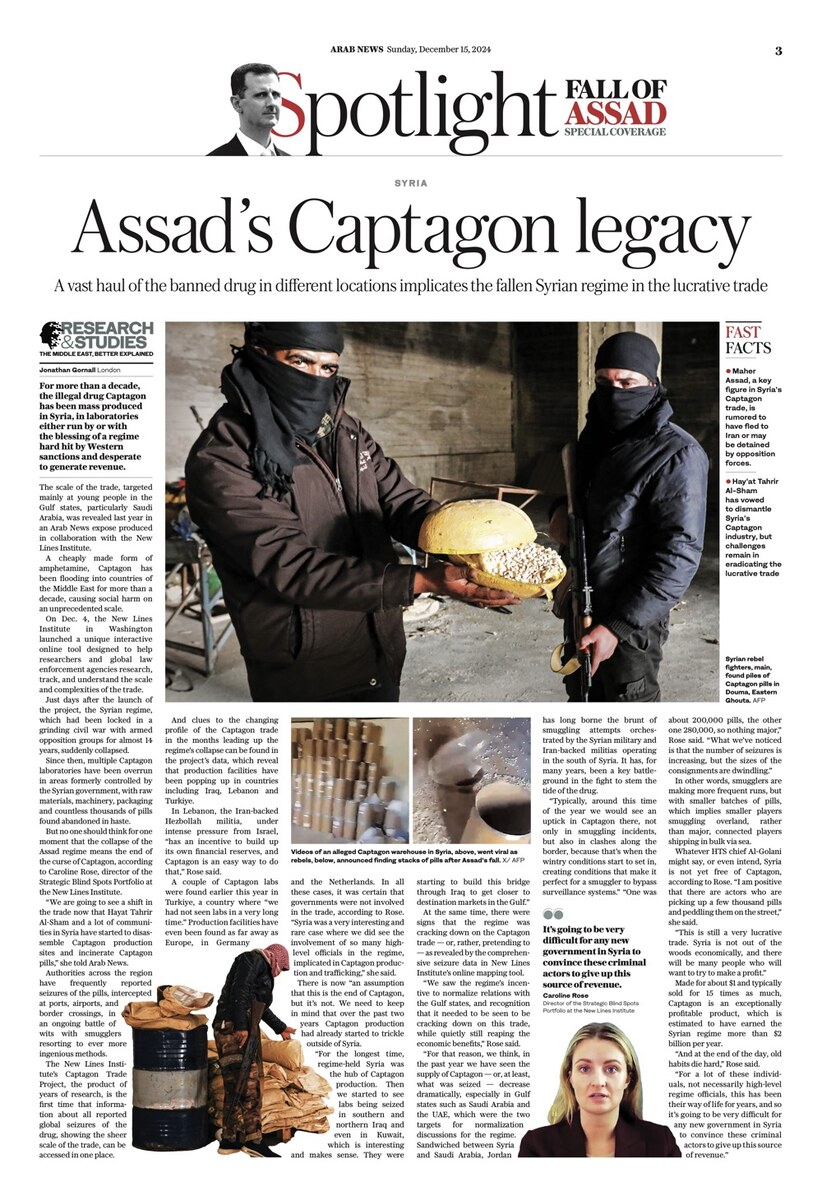
LONDON: For more than a decade, the illegal drug Captagon has been mass produced in Syria, in laboratories either run by or with the blessing of a regime hard hit by Western sanctions and desperate to generate revenue.
The scale of the trade, targeted mainly at young people in the Gulf states, particularly Saudi Arabia, was revealed last year in an Arab News expose produced in collaboration with the New Lines Institute.
A cheaply made form of amphetamine, Captagon has been flooding into countries of the Middle East for more than a decade, causing social harm on an unprecedented scale.
Embossed with its distinctive twin half moons logo, which gives the drug its Arabic street name, “Abu Hilalain,” or Father of the Two Crescents, the pills are easy to make, readily available, and relatively cheap to buy.
On Dec. 4, the New Lines Institute in Washington launched a unique interactive online tool designed to help researchers and global law enforcement agencies research, track, and understand the scale and complexities of the trade.
Just days after the launch of the project, the Syrian regime, which had been locked in a grinding civil war with armed opposition groups for almost 14 years, suddenly collapsed.
In the early hours of Sunday, Dec. 8, President Bashar Assad and his family fled to Moscow, where their Russian allies granted them asylum.

The ousted president, HTS leader Abu Mohammed Al-Golani said, had caused the country to become “a major Captagon factory in the world, and today Syria is being cleansed of it.” (AFP)
Since then, multiple Captagon laboratories have been overrun in areas formerly controlled by the Syrian government, with raw materials, machinery, packaging and countless thousands of pills found abandoned in haste.
But no one should think for one moment that the collapse of the Assad regime means the end of the curse of Captagon, according to Caroline Rose, director of the Strategic Blind Spots Portfolio at the New Lines Institute.
“We are going to see a shift in the trade now that Hayat Tahrir Al-Sham and a lot of communities in Syria have started to disassemble Captagon production sites and incinerate Captagon pills,” she told Arab News.
In his victory speech at the Umayyad Mosque in Damascus on Monday, HTS leader Abu Mohammed Al-Golani made a specific point of condemning the drug and Assad’s part in its production.
The ousted president, he said, had caused the country to become “a major Captagon factory in the world, and today Syria is being cleansed of it.”
It is “very clear that if you are a Captagon manufacturer who did not flee with the regime, you are now in trouble, Rose said.
“But I think what we’re going to see now is overspill, what people often call the ‘balloon effect.’ Production is being squeezed inside Syria, but we are going to see the emergence of larger-scale Captagon production facilities in a few countries where alarm bells have already been ringing.”
Authorities across the region have frequently reported seizures of the pills, intercepted at ports, airports, and border crossings, in an ongoing battle of wits with smugglers resorting to increasingly ingenious methods.

The New Lines Institute’s Captagon Trade Project, the product of years of research, is the first time that information about all reported global seizures of the drug, showing the sheer scale of the trade, can be accessed in one place.
And clues to the changing profile of the Captagon trade in the months leading up the regime’s collapse can be found in the project’s data, which reveal that production facilities have been popping up in countries including Iraq, Lebanon and Turkiye.
In Lebanon, the Iran-backed Hezbollah militia, under intense pressure from Israel, “has an incentive to build up its own financial reserves, and Captagon is an easy way to do that,” Rose said.
A couple of Captagon labs were found earlier this year in Turkiye, a country where “we had not seen labs in a very long time.” Production facilities have even been found as far away as Europe, in Germany and the Netherlands.
In all these cases, it was certain that governments were not involved in the trade, according to Rose. “Syria was a very interesting and rare case where we did see the involvement of so many high-level officials in the regime, implicated in Captagon production and trafficking,” she said.
While Assad himself carefully distanced himself from the trade, his brother Maher was heavily implicated with production and smuggling efforts in his role as commander of the Fourth Armored Division, a military unit whose primary mission was to protect the Syrian regime from internal and external threats.

Authorities across the region have frequently reported seizures of the pills, intercepted at ports, airports. (AFP)
Quite where he is now remains uncertain.
“I have heard that Maher and his Fourth Division commanders made their way through Iraq to Iran and are now in Tehran,” Rose said.
“However, other reports say HTS has found and detained him. That’s not confirmed yet. But if Maher is still there, it’s likely that a lot of members of the regime’s Captagon organization are also still in Syria.”
Either way, there is now “an assumption that this is the end of Captagon, but it’s not. We need to keep in mind that over the past two years Captagon production had already started to trickle outside of Syria.
“For the longest time, regime-held Syria was the hub of Captagon production. Then we started to see labs being seized in southern and northern Iraq and even in Kuwait, which is interesting and makes sense. They were starting to build this bridge through Iraq to get closer to destination markets in the Gulf.”
At the same time, there were signs that the regime was cracking down on the Captagon trade — or, rather, pretending to — as revealed by the comprehensive seizure data in New Lines Institute’s online mapping tool.
“We saw the regime’s incentive to normalize relations with the Gulf states, and recognition that it needed to be seen to be cracking down on this trade, while quietly still reaping the economic benefits,” Rose said.
“For that reason, we think, in the past year we have seen the supply of Captagon — or, at least, what was seized — decrease dramatically, especially in Gulf states such as Saudi Arabia and the UAE, which were the two targets for normalization discussions for the regime.
“We have cause to believe that the flow of Captagon was actually halted by the regime. They were stepping on the hose to create the appearance that they had stopped Captagon production, in the hope that it would bring the Gulf states to the table.

While Assad himself carefully distanced himself from the trade, his brother Maher was heavily implicated. (AFP)
“In fact, as we’ve seen with the finds in Syria over the past few days, they seem to have been stockpiling the drug. Most likely later on they would have flooded the market.”
Sandwiched between Syria and Saudi Arabia, Jordan has long borne the brunt of smuggling attempts orchestrated by the Syrian military and Iran-backed militias operating in the south of Syria. It has, for many years, been a key battleground in the fight to stem the tide of the drug.
Over the past few months, however, there have been telltale signs of changes in the nature of attempts to smuggle Captagon through Jordan to Saudi Arabia and beyond. “Unusually, we’ve not seen any seizures in Jordan since early November,” Rose said.
“Typically, around this time of the year we would see an uptick in Captagon there, not only in smuggling incidents, but also in clashes along the border, because that’s when the wintry conditions start to set in, creating conditions that make it perfect for a smuggler to bypass surveillance systems.”
In Saudi Arabia, meanwhile, the most recent recorded seizure was on Dec. 7 at the Al-Wadiah border crossing with Yemen. The two before that were both on Nov. 30, at the checkpoint on the King Fahd Causeway to Bahrain and on the other side of the country at the Port of Duba on the Red Sea.
“One was about 200,000 pills, the other one 280,000, so nothing major,” Rose said. “What we’ve noticed is that the number of seizures is increasing, but the sizes of the consignments are dwindling.”
In other words, smugglers are making more frequent runs, but with smaller batches of pills, which implies smaller players smuggling overland, rather than major, connected players shipping in bulk via sea.

There is now “an assumption that this is the end of Captagon, but it’s not,” said Caroline Rose. (AFP)
Whatever HTS chief Al-Golani might say, or even intend, Syria is not yet free of Captagon, according to Rose. “I am positive that there are actors who are picking up a few thousand pills and peddling them on the street,” she said.
“This is still a very lucrative trade. Syria is not out of the woods economically, and there will be many people who will want to try to make a profit.”
Made for about $1 and typically sold for 15 times as much, Captagon is an exceptionally profitable product, which is estimated to have earned the Syrian regime more than $2 billion per year.
“And at the end of the day, old habits die hard,” Rose said.
“For a lot of these individuals, not necessarily high-level regime officials, this has been their way of life for years, and so it’s going to be very difficult for any new government in Syria to convince these criminal actors to give up this source of revenue.”