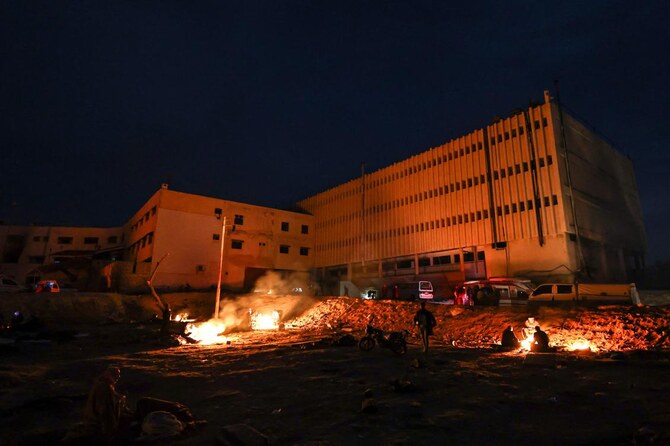
BEIRUT: Saydnaya prison north of the Syrian capital Damascus has become a notorious symbol of the inhumane abuses of the Assad clan, especially since the country’s civil war erupted in 2011.
The prison complex was the site of extrajudicial executions, torture and forced disappearances, epitomising the atrocities committed against his opponents by ousted president Bashar Assad.
When Syrian militants entered Damascus on Sunday after their lightning advance that toppled the Assad government, they announced they had seized Saydnaya and freed its inmates.
Some had been incarcerated there since the 19080s.
According to the Association of Detainees and Missing Persons of Saydnaya Prison (ADMSP), the militants liberated more than 4,000 people.
Photographs of haggard and emaciated inmates, some helped by colleagues because they were too weak to leave their cells, were circulated worldwide.
Suddenly the workings of this infamous jail that rights group Amnesty International had dubbed a “human abattoir” were revealed for all to see.
The prison was built in the 1980s during the rule of Hafez Assad, father of the deposed president, and was initially meant for political prisoners including members of Islamist groups and Kurdish militants.
But down the years, Saydnaya became a symbol of pitiless state control over the Syrian people.
In 2016, a United Nations commission found that “the Syrian Government has also committed the crimes against humanity of murder, rape or other forms of sexual violence, torture, imprisonment, enforced disappearance and other inhuman acts,” notably at Saydnaya.
The following year, Amnesty International in a report entitled “Human Slaughterhouse” documented thousands of executions there, calling it a policy of extermination.
Shortly afterwards, the United States revealed the existence inside Saydnaya of a crematorium in which the remains of thousands of murdered prisoners were burnt.
War monitor the Syrian Observatory for Human Rights in 2022 reported that around 30,000 people had been imprisoned in Saydnaya where many were tortured, and that just 6,000 were released.
The ADMSP believes that more than 30,000 prisoners were executed or died under torture, or from the lack of medical care or food between 2011 and 2018.
The group says the former authorities in Syria had set up salt chambers — rooms lined with salt for use as makeshift morgues to make up for the lack of cold storage.
In 2022, the ADMSP published a report describing for the first time these makeshift morgues of salt.
It said the first such chamber dated back to 2013, one of the bloodiest years in the Syrian civil conflict.
Many inmates are officially considered to be missing, with their families never receiving death certificates unless they handed over exorbitant bribes.
After the fall of Damascus last week, thousands of relatives of the missing rushed to Saydnaya hoping they might find loved ones hidden away in underground cells.
Saydnaya is now empty, and Syria’s White Helmets emergency workers group announced the end of search operations there on Tuesday, with no more prisoners found.
Several foreigners also ended up in Syrian jails, including Jordanian Osama Bashir Hassan Al-Bataynah, who spent 38 years behind bars and was found “unconscious and suffering from memory loss,” the foreign ministry in Amman said on Tuesday.
According to the Arab Organization for Human Rights in Jordan, 236 Jordanian citizens were held in Syrian prisons, most of them in Saydnaya.
Other freed foreigners included Suheil Hamawi from Lebanon who returned home on Monday after being locked up in Syria for 33 years, and also spent time inside Saydnaya.


![]()

The horror of Saydnaya jail, symbol of Assad excesses
Short Url
https://arab.news/9tg7q
The horror of Saydnaya jail, symbol of Assad excesses
- The prison complex was the site of extrajudicial executions, torture and forced disappearances
- When Syrian militants entered Damascus on Sunday after their lightning advance that toppled the Assad government, they announced they had seized Saydnaya and freed its inmates


Latest updates


© 2026 SAUDI RESEARCH & PUBLISHING COMPANY, All Rights Reserved And subject to Terms of Use Agreement.