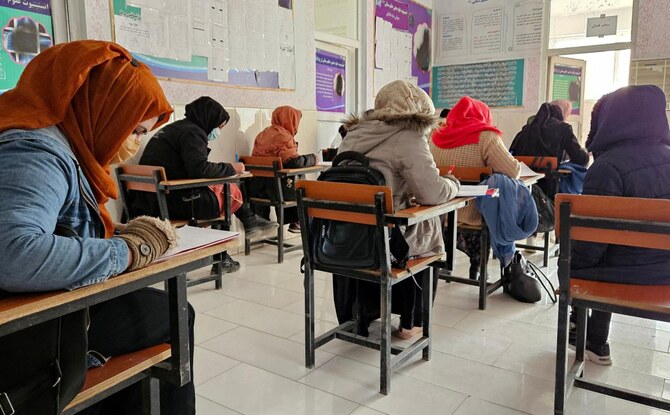
‘Lives at risk’: Women’s medical training ban threatens Afghan health sector

From her private hospital in Afghanistan’s capital, doctor Najmussama Shefajo predicts a rise in maternal mortality rates “within three or four years“. (AFP)
Short Url
Updated 13 December 2024
Follow

‘Lives at risk’: Women’s medical training ban threatens Afghan health sector

  • From her private hospital in Afghanistan’s capital, doctor Najmussama Shefajo predicts a rise in maternal mortality rates “within three or four years“

KABUL: From her private hospital in Afghanistan’s capital, doctor Najmussama Shefajo predicts a rise in maternal mortality rates “within three or four years,” following the latest restrictions on women’s education.
The Taliban’s supreme leader is reportedly behind a ban on women studying midwifery and nursing at training institutes across the country, already among the worst in the world for deaths in childbirth.
“We may not see the impact very quickly but after three to four years we will see the maternal mortality rate go up and up,” said Shefajo.
“People will for sure have more babies at home. But what about complications? What about operations? Many procedures cannot be done at home.”
Since the Taliban government banned women from universities two years ago, Shefajo has been giving on-the-job medical training, including in midwifery and nursing.
But she said she doesn’t have the capacity or facilities to take on every woman keen to learn in her hospital, despite no shortage of volunteers.
“Midwifery and nursing are like the two wings of the doctors; if the bird doesn’t have wings, it cannot fly,” she added, ducking behind curtains to treat patients.
Already Afghanistan is facing a “desperate shortage of trained health care workers, especially women,” according to the UN children’s agency UNICEF.
No official notice has been issued by the Taliban government, but health ministry sources and managers of training institutes said this month that they had been told to block women from classes.

Restricting medical training is the latest action against women’s education since the Taliban authorities swept to power in 2021, imposing rules the United Nations has called “gender apartheid.”
“In a country where women and children depend on female health professionals for culturally sensitive care, cutting the pipeline of future health providers would put lives at risk,” UNICEF Executive Director Catherine Russell said in a statement.
Training institutes had ensured women would continue to learn health care skills, such as midwifery and nursing, or laboratory work, pharmacy and dentistry.
The ban would impact about 35,000 women studying at medical training centers, according to a figure from a health ministry source.
“We are concerned about the effects on the already fragile health care system,” said Achille Despres, spokesperson for the International Committee of the Red Cross in Afghanistan, where the organization offers health services and training.
International NGO Doctors Without Borders (MSF), which runs some of its busiest maternity hospitals in Afghanistan, also warned of the consequences of the ban, given that the nation’s “medical needs... are huge.”
“There is no health care system without educated female health practitioners,” country representative Mickael Le Paih said in a statement.
Afghanistan and MSF already face a dearth of obstetrician-gynaecologists (OB-GYNs) in a country with high fertility rates where women often have children from a young age, Le Paih told AFP.
And demand is only likely to increase, he added, as almost half of Afghanistan’s population is under 15 years old, according to a 2022 health ministry report.
“You can imagine the impact in several years’ time when you will have a large number of women reaching childbearing age,” he said.
The ban will undoubtedly further strain access for the 70 percent of the population living in rural areas.
After news of a ban spread last week, some training facilities closed their doors immediately, while others rushed to hold final exams and graduations, as still others said they would open as normal after the winter break unless they received a written order.
Shefajo and others want to provide online lessons, but say the lack of practical experience would be detrimental to learning.
Hadiya, 22, recently finished her first year studying midwifery, after having been forced to quit computer science studies at university and English courses.
“We may have midwives now, but medicine is changing every day... and it is clear that the situation in Afghanistan in the field of child and mother health is getting worse,” Hadiya told AFP.
“It’s like we’re in a cage, all the girls are thinking of finding a way to leave here so we can at least continue our studies and reach our goals,” she said.
“When I see the situation in Afghanistan, I think no child should be born here.”


Hundreds march in silence to honor victims of Swiss bar fire that left 40 dead

Updated 6 sec ago
Follow

Hundreds march in silence to honor victims of Swiss bar fire that left 40 dead

CRANS-MONTANA: Hundreds marched in silence Sunday to honor the victims of the New Year’s Eve fire at a bar in the Swiss Alpine resort of Crans-Montana, which left 40 dead and many severely injured.
Somber mourners, many with reddened eyes, filed silently out of the chapel to organ music after the hourlong Mass at the Chapelle Saint-Christophe in Crans-Montana. Some exchanged hugs, others applauded, before joining the silent march up the hill to Le Constellation bar.
Many hundreds of people, some cradling flower bouquets, walked in the dense snaking procession in the bright sunlight past shuttered stores. Up on the mountain overlooking the town, snow machines sent plumes of white flakes into the air.
At the top of the street, in front of Le Constellation that is still largely shielded from view by white screens, the swelling crowd stood in near total silence, some weeping. Then they broke out into sustained applause — hands in gloves and mittens against the cold — as a stream of mourners and well-wishers deposited flower bouquets at a makeshift memorial piled with flowers, cuddly toys and other tributes.
“We are going through a moment of crushing darkness but we are going through it together,” one speaker said.
During the Mass, the Rev. Gilles Cavin spoke of the “terrible uncertainty” for families unsure if their loved ones are among the dead or still alive among the injured. “We pray for their friends hard hit by misery on this day that was meant to be one of festivities and friendship,” he said.
In the crowded pews, a grieving woman listened intently, her hands clasped tightly and sometimes clasping rosary beads, as speakers delivered readings in German, French and Italian.
Forty people died and 119 were injured in the blaze that broke out around 1:30 a.m. on Thursday at Le Constellation bar. Police have said many of the victims were in their teens to mid-20s.
By Sunday morning, Swiss authorities identified 24 out of the 40 fatalities. They include 18 Swiss citizens aged 14 to 31 years, two Italians 16 years old, one dual citizen of Italy and the United Arab Emirates also 16 years old, an 18-year-old Romanian, a 39-year-old French and a Turkish citizen, 18.
A grieving mother
One of the victims was 16-year old Arthur Brodard, whose mother had been frantically searching for him.
“Our Arthur has now left to party in paradise,” a visibly shaken Laetitia Brodard said in a Facebook story posted on Saturday night, speaking to camera. “We can start our mourning, knowing that he is in peace and in the light.”
Brodard’s frenzied search for her son reflected the desperation of families of the young people disappeared during the fire, who did not know whether their loved ones were dead or in the hospital.
Swiss authorities said the process of identifying victims was particularly hard because of the advanced degree of the burns, requiring the use of DNA samples. Brodard also had given her DNA sample to help in the identification process.
In her Facebook post, Brodard thanked those who “testified their compassion, their love” and to those who shared information as she anxiously searched and waited for news of her son. Other parents and siblings are still waiting in anguish.
Bar managers face a criminal investigation
Swiss authorities have opened a criminal investigation of the bar managers.
The two are suspected of involuntary homicide, involuntary bodily harm and involuntarily causing a fire, the Valais region’s chief prosecutor, Beatrice Pilloud, told reporters Saturday. The announcement of the investigation did not name the managers.
Investigators said Friday they believe sparkling candles atop Champagne bottles ignited the fire when they came too close to the ceiling of the crowded bar.
Authorities planned to look into whether sound-dampening material on the ceiling conformed with regulations and whether the candles were permitted for use in the bar. Officials said they also would look at other safety measures on the premises, including fire extinguishers and escape routes.
Swiss President Guy Parmelin announced a national day of mourning for the victims on Jan. 9.
France’s Health Minister Stéphanie Rist said 17 patients have received care in France, out of a total of 35 transferred from Switzerland to five European countries. Other patients were planned to be transferred to Germany, Italy and Belgium.