

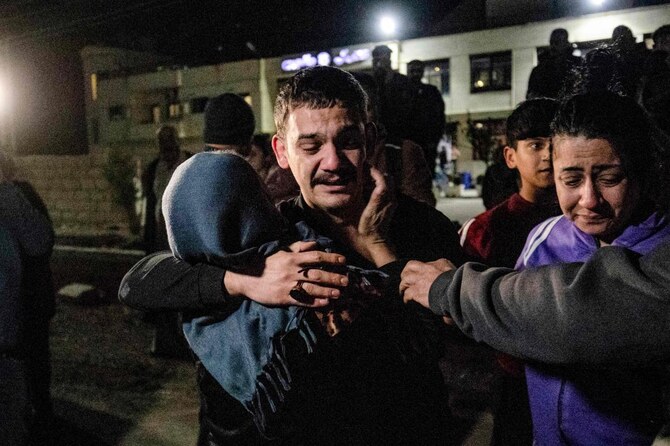
Freed Syrian prisoners return to their ‘death dormitory’

“Every day in this room, which used to be called ‘Steel 1 — the death dormitory,’ one to three people would die inside every day,” Hanania, 35, told Reuters. (AFP)
Short Url
Updated 13 December 2024
Follow

Freed Syrian prisoners return to their ‘death dormitory’

  • “Every day in this room, which used to be called ‘Steel 1 — the death dormitory,’ one to three people would die inside every day,” Hanania, 35, told Reuters

DAMASCUS:Basim Faiz Mawat stood in the Damascus cell that his fellow prisoners used to call the “death dormitory,” struggling to believe that the system that abused him for so long had been overthrown and his suffering had ended.
“I came here today only to see that truly nothing lasts forever,” the 48-year-old said as he and another freed prisoner, Mohammed Hanania, visited the detention center where their guards never showed mercy.
They were among thousands who spilled out of Syria’s prison system on Sunday after a lightning militia advance overthrew President Bashar Assad and ended five decades of his family’s rule. Many detainees were met by tearful relatives who thought they had been executed years earlier.
“Every day in this room, which used to be called ‘Steel 1 — the death dormitory,’ one to three people would die inside every day,” Hanania, 35, told Reuters.
“The sergeant was — when he didn’t lose someone, when someone didn’t die from weakness, he would kill him. He took them to the toilets and hit them with the heel of his shoe on their heads.”
Hanania walked on past long rows of empty cells. Names of prisoners — Mohammed Al-Masry, Ahmed and others — were scratched on walls with dates.
The floors were littered with rubble and discarded clothes. A row of blankets was still set out in one cell where prisoners had slept.
Both men looked up at an image on a wall of Assad, who is accused of torturing and killing thousands, abuses that were also rampant during his father Hafez’s reign of terror.
“No one could have believed this would happen,” said Mawat.

MASS EXECUTIONS
In another room, he stood beside a rusty blue ladder and described how he was blindfolded and forced to climb up the steps. Then his torturer would kick away the ladder and he would be suspended by his arms from the ceiling in agony.
“My shoulders were torn, and I couldn’t say a single word. No one could bear more than five or 10 minutes,” he said.
Rights groups have reported mass executions in Syria’s prisons. In 2017, the United States said it had identified a new crematorium at the Sednaya military prison on the outskirts of Damascus to dispose of hanged prisoners.
Syrians have flocked to the prisons looking for their loved ones. Some have been released alive, others have been identified among the dead and thousands more have not yet been found.
Syrian militia leader Ahmad Al-Sharaa — better known as Abu Mohammed Al-Golani — the main commander of the militants who toppled Assad, has said he will close the prisons and hunt down anyone involved in the torture or killing of detainees.
Assad fled to his ally Russia where he was granted asylum.
“At this stage, if everyone thinks about taking revenge, we have no solution other than to forgive,” Hanania said.
“But the criminal who has blood (on their hands) should be held accountable. I will leave my rights to be granted by God.”


US lawmakers press Israel to probe strike on reporters in Lebanon

Updated 11 December 2025
Follow

US lawmakers press Israel to probe strike on reporters in Lebanon

  • “The IDF has made no effort, none, to seriously investigate this incident,” Welch said
  • Collins called for Washington to publicly acknowledge the attack in which an American citizen was injured

WASHINGTON: Several Democratic lawmakers called Thursday for the Israeli and US governments to fully investigate a deadly 2023 attack by the Israeli military on journalists in southern Lebanon.
The October 13, 2023 airstrike killed Reuters videographer Issam Abdallah and wounded six other reporters, including two from AFP — video journalist Dylan Collins and photographer Christina Assi, who lost her leg.
“We expect the Israeli government to conduct an investigation that meets the international standards and to hold accountable those people who did this,” Senator Peter Welch told a news conference, with Collins by his side.
The lawmaker from Collins’s home state of Vermont said he had been pushing for answers for two years, first from the administration of Democratic president Joe Biden and now from the Republican White House of Donald Trump.
The Israeli government has “stonewalled at every single turn,” Welch added.
“With the Israeli government, we have been extremely patient, and we have done everything we reasonably can to obtain answers and accountability,” he said.
“The IDF has made no effort, none, to seriously investigate this incident,” Welch said, referring to the Israeli military, adding that it has told his office its investigation into the incident is closed.
Collins called for Washington to publicly acknowledge the attack in which an American citizen was injured.
“But I’d also like them to put pressure on their greatest ally in the Middle East, the Israeli government, to bring the perpetrators to account,” he said, echoing the lawmakers who called the attack a “war crime.”
“We’re not letting it go,” Vermont congresswoman Becca Balint said. “It doesn’t matter how long they stonewall us.”
AFP conducted an independent investigation which concluded that two Israeli 120mm tank shells were fired from the Jordeikh area in Israel.
The findings were corroborated by other international probes, including investigations conducted by Reuters, the Committee to Protect Journalists, Human Rights Watch, Amnesty International and Reporters Without Borders.
Unlike Welch’s assertion Thursday that the Israeli probe was over, the IDF told AFP in October that “findings regarding the event have not yet been concluded.”