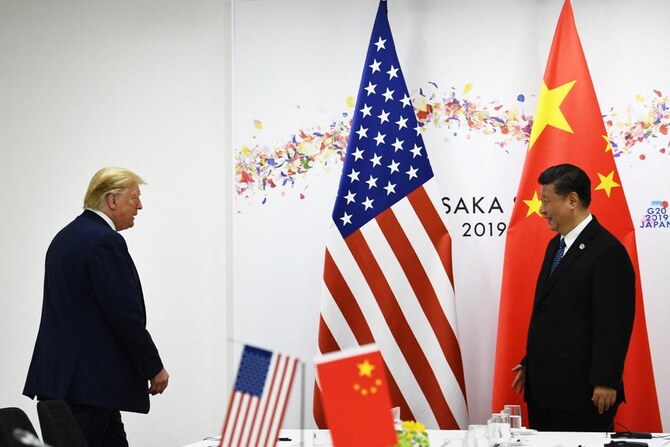
WASHINGTON: US President-elect Donald Trump has invited Chinese President Xi Jinping to attend his inauguration next month, CBS News reported on Wednesday, citing multiple sources.
The invitation to the Jan. 20 inauguration in Washington occurred in early November, shortly after the Nov. 5 presidential election, and it was not clear if it had been accepted, CBS reported.
The Chinese embassy in Washington did not immediately respond to a request for comment.
Trump said in an interview with NBC News conducted on Friday that he “got along with very well” with Xi and that they had “had communication as recently as this week.”
It would be unprecedented for a leader of China, a top US geopolitical rival, to attend a US presidential inauguration.
Trump has named numerous China hawks to key posts in his incoming administration, including Senator Marco Rubio as secretary of state.
The president-elect has said he will impose an additional 10 percent tariff on Chinese goods unless Beijing does more to stop trafficking of the highly addictive narcotic fentanyl. He also threatened tariffs in excess of 60 percent on Chinese goods while on the campaign trail.
In late November, China’s state media warned Trump that his pledge to slap additional tariffs on Chinese goods over fentanyl flows could drag the world’s top two economies into a mutually destructive tariff war.
Separately on Wednesday, China’s US Ambassador Xie Feng read a letter from Xi to a US-China Business Council gala in Washington, in which the Chinese leader said Beijing was prepared to stay in communication with the US
“We should choose dialogue over confrontation and win-win cooperation over zero-sum games,” Xi said in the letter.
Xie added that the two countries should not decouple supply chains. But Nicholas Burns, the US ambassador to Beijing, said in a prerecorded video address that China at times tried to “sugar coat” challenging and competitive relations.
“No amount of happy talk can obscure our profound differences,” Burns said. (Reporting by Jasper Ward, David Brunnstrom, Michael Martina and Costas Pitas; Editing by Cynthia Osterman)

Trump invites China’s Xi Jinping to attend inauguration, CBS News reports
https://arab.news/8sda3
Trump invites China’s Xi Jinping to attend inauguration, CBS News reports
New deadly clashes break out on Afghanistan-Pakistan border despite truce
- At least 5 people were killed, 5 injured on the Afghan side, Taliban authorities say
- Latest clash comes amid reports of back-channel negotiations between the two countries
KABUL: Overnight border clashes have broken out between Afghan and Pakistani forces, authorities in Afghanistan said on Saturday, as tensions between the neighbors escalated following a fragile ceasefire.
The latest exchange of fire that spanned Spin Boldak and Chaman, a key crossing between southeastern Afghanistan’s Kandahar province and Pakistan’s Balochistan, marked violations of a ceasefire that has been in place since October.
The truce brokered by Qatar and Turkey has mostly held for the past two months, after dozens were killed on both sides in what was the deadliest confrontation in years between Afghanistan and Pakistan.
But heavy gunfire and shelling erupted again late on Friday, with each side blaming the other for sparking the deadly violence.
“Unfortunately, last night the Pakistani side once again attacked Spin Boldak in Kandahar. The forces of the Islamic Emirate had to respond,” Hamdullah Fitrat, deputy spokesperson of Afghanistan’s Taliban government, told Arab News on Saturday.
He said five people on the Afghan side — including four civilians — were killed in the violence, while five others were injured.
Mosharraf Zaidi, spokesman for Pakistan’s prime minister, said that the Taliban “resorted to unprovoked firing” along their shared border.
“An immediate, befitting & intense response has been given by our armed forces. Pakistan remains fully alert & committed to ensuring its territorial integrity & the safety of our citizens,” he wrote on X.
Local residents in Spin Boldak told Arab News that Friday’s clashes forced families to flee their homes.
“Mortars and bullets smashed into houses and public places,” Samiullah Malang said. “It was difficult … (to) watch women and children flee on motorbikes, tractors and on foot in the cold night.”
Although the fighting largely subsided around midnight, sporadic gunfire continued into the morning, he added.
The overnight violence also reached the Friendship Gate, an official crossing point between Spin Boldak and Chaman, which was closed by Pakistan authorities after the fighting.
Clashes at the border have led to repeated closures of the key border crossing, devastating commerce and disrupting the movement of thousands.
“Every time Pakistan shuts the gate, our fruits rot inside the trucks,” said Afghan businessman Haji Rahmatullah. “Hotels are filled with patients waiting to cross for treatment.”
After the ceasefire agreement in October, subsequent talks for a long-term truce have so far yielded little progress. The latest deadly exchange of fire comes amid reports of back-channel negotiations between Afghan and Pakistani officials, which neither governments have openly confirmed.
Both sides remain deeply divided on core security issues and repeated clashes highlight the absence of an effective de-escalation mechanism, according to Asad Waheedi, a political analyst based in Kabul.
“The talks are not bearing fruit because the demands are unrealistic,” he said. “Pakistan asks the Taliban to guarantee the security of their country. This is impossible. Even when America had all its troops here, it could not guarantee Afghanistan’s security. The Taliban have no presence there (in Pakistan). It is an impractical demand.”
Clashes between Afghan and Pakistani forces along the Durand Line — their 2,640-km border — have occurred for decades but intensified after the Taliban took control of Afghanistan in 2021, following the withdrawal of US-led troops.
Pakistan accuses the Afghan Taliban of sheltering fighters from the banned Tehreek-e-Taliban Pakistan and allowing them to stage cross-border attacks — a charge Afghanistan denies, saying it does not allow its territory to be used against other countries.
The deadly violence in October was triggered by an unclaimed explosion in Kabul and another in the southeastern province of Paktika, for which the Afghan government blamed the Pakistani military.
“The facts show that the distance between them is huge,” Waheedi said. “Until the demands become practical, these talks will go nowhere, and the fighting will continue.”