

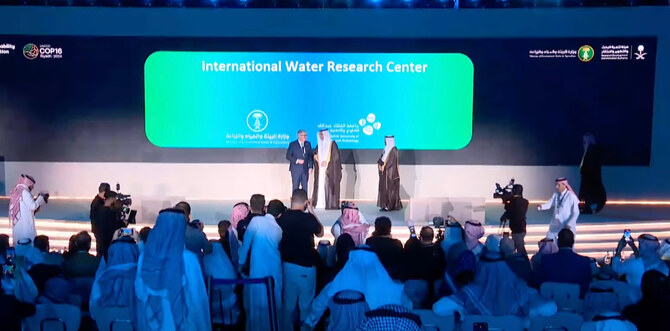

RIYADH: Saudi Arabia’s King Abdullah University of Science and Technology has officially launched the International Water Research Center, a groundbreaking initiative aimed at transforming global sustainability efforts.
The center was unveiled on Dec. 8 during COP16, with the Kingdom’s Minister of Environment Abdulrahman Al-Fadhli highlighting its focus on addressing critical challenges such as water scarcity, pollution, and the development of sustainable water solutions.
The center, a collaboration between KAUST and the Ministry of Environment, Water, and Agriculture, aligns with Saudi Arabia’s broader sustainability goals, including a target to recycle up to 95 percent of the country’s waste. This ambitious plan is projected to contribute SR120 billion ($31.99 billion) to the national gross domestic product.
In his speech, Al-Fadhli emphasized the center’s role in reshaping global water sustainability practices. “The International Water Research Center, hosted by KAUST in collaboration with MEWA and leading international research institutions, is set to redefine global approaches to water sustainability,” he said. “It will focus on solving water scarcity, pollution, and developing environmentally friendly solutions.”
Al-Fadhli also announced key strategic collaborations under MEWA’s partnership with KAUST, including a joint research initiative with the National Livestock and Fisheries Development Program, the National Research and Development Center for Sustainable Agriculture, Estidamah, and KAUST. The partnership aims to explore algae-based biostimulants to enhance soil quality and promote sustainable agriculture in the Kingdom.
Further advancing agricultural research, the minister highlighted the NCDP-KAUST Research and Innovation Partnership, which includes four major projects totaling SR100 million. These projects aim to drive innovation in the palm industry, furthering the Kingdom’s agricultural sustainability and economic development.
Another key initiative, the Environment Fund’s Sustainability Innovation Fellowships, was also introduced by Al-Fadhli. This fellowship provides postdoctoral researchers with an opportunity to develop innovative water treatment solutions, addressing critical environmental challenges through cutting-edge research.
On the future of agricultural education, the minister discussed a collaboration between NEOM and the University of Tabuk, which has launched a comprehensive program to address the shortage of skilled professionals in agricultural sustainability.
Al-Fadhli also presented the “Celebrating Innovators in Saudi” panel, honoring individuals who have significantly advanced sustainability and environmental research. The recipients of the Lifetime Achievement Award include Prof. Iqbal Ismail, Prof. Samir Al-Solimani, and several other distinguished academics.
The minister then introduced the Sustainability Innovation Challenge Awards, which recognize companies excelling in sustainable practices. This year’s winners include ACWA Power for its achievements in renewable energy, NADEC for its sustainable agriculture innovations, and Tadweer for its leadership in waste management and recycling.
Finally, Al-Fadhli announced the winners of the Sustainability Innovation Challenge in the desertification category. The top project, “Rebalancing and Fueling Plant Growth,” was awarded to a team from Princess Nourah Bint Abdulrahman University for their innovative approach to restoring ecosystems using drought-resistant seeds and biostimulants.
The Kingdom’s hosting of COP16 underscores its commitment to environmental protection and sustainability. As the largest multilateral conference Saudi Arabia has ever hosted, COP16 serves as a platform for mobilizing international cooperation to address the urgent environmental challenges facing the planet.


