


RIYADH: Experts attending COP16 here have emphasized the need to allocate more funds for sectors critical to land conservation and nature restoration because of the potential for greater global economic development and job creation.
Climate financing has nearly doubled over the past decade, with spending at about $1.3 trillion over the period 2021 to 2022, said Tillem Burlace, regional lead at 1t.org, World Economic Forum.
Burlace, who was speaking to Arab News on the sidelines of COP16, which began on Dec. 2 and ends Dec. 11, said that funds were not being allocated efficiently.
She said most of this financing flowed to energy (44 percent) and transport (29 percent), which remain “key” to reaching net-zero goals. However, investments in agriculture, forestry, and other land use have lagged, receiving just 4 percent.
Burlace stressed that this imbalance poses a significant challenge to achieving land degradation neutrality and drought resilience, two critical goals central to the UN Convention to Combat Desertification agenda at COP16 and beyond.
She said that research by the WEF indicates that transitioning to a sustainable “nature economy” could unlock $10 trillion in business opportunities and create 395 million jobs by 2030.
“Every dollar invested in restoring degraded lands brings between $7 to $30 in economic returns,” she said.
Burlace added that innovative financing models are needed to help aggregate capital while minimizing risks.
Princess Noura bint Turki Al-Saud said that the UNCCD often operates with limited political backing, insufficient financing, and fragmented implementation.
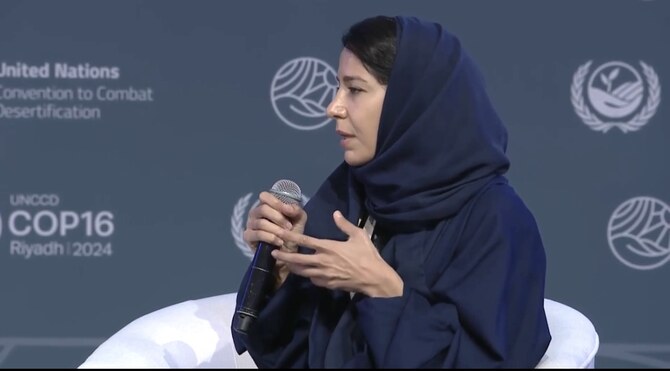
Speaking during a panel session at COP16, Princess Noura, a founding partner at Aeon Strategy, emphasized the challenges facing the convention.
“To achieve the convention’s transformative potential, it must be elevated as a political priority, fully integrated into international development plans, and backed by substantial financial and technical commitments.”
Princess Noura highlighted the persistent challenges in quantifying financial and capacity gaps necessary to implement effective land-restoration measures.
“The financial-needs assessment reveals a significant gap (because) of the 63 National Drought Plans evaluated, only nine countries have quantified their financial needs,” she explained.
Princess Noura said that in terms of reporting resource needs under the UNCCD’s progress indicators, only 13 of 38 countries have expressed their requirements in financial terms.
This lack of financial data, she added, reflects broader difficulties in calculating the costs of restoration, capacity building, and governance measures.
Princess Noura argued that investing in land restoration yields immense returns. Research shows that every dollar spent on land restoration can generate up to $30 in returns, she said.
“This is driven by the critical role that healthy land ecosystems play in global development.”
Princess Noura pointed out that half of the world’s gross domestic product depends directly and indirectly on healthy soil ecosystems, which underpin agriculture, food systems, and economic stability.
“Investing in land restoration is not just an environmental imperative — it is an economic necessity,” she stressed.
Capacity building across the project cycle was crucial, but it should be accompanied by targeted financial and technical support, Princess Noura said.
Her remarks reflect the growing consensus at COP16 on the importance of integrating sustainability into global economic and development policies.
Nigel Topping, the UN Climate Change High-Level Champion from the COP26 Presidency, emphasized the importance of translating environmental and social needs into financial terms to mobilize meaningful action from key decision-makers.
“If we don’t translate hectares or people into financial numbers, then we will not get CEOs, ministers — particularly ministers of finance — and fund managers around the table,” Topping said.
He underscored the importance of broadening the scope of financial needs assessments. “In the climate space, we spent a very long time obsessing about a small part of the need — the multilateral finance need,” Topping said.
It turns out this is only about 4 percent of the total finance that needs to mobilize, he added.
“Having a needs assessment showing the whole amount is very important in terms of setting a normative target, which we can then go about problem-solving,” Topping said.
He said such assessments were not only important for setting clear targets but also aligning public and private sector efforts to address systemic challenges including land degradation, drought, and biodiversity loss.


