

COP16: Saudi Arabia urges private sector to bridge land restoration funding gap

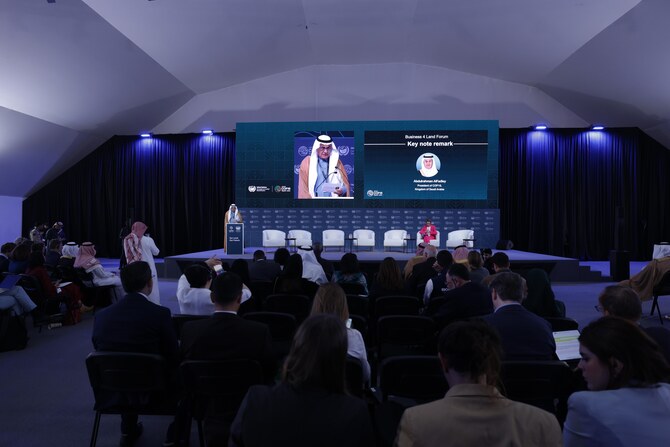
The appeal, made during Land Day, the first of the seven thematic days at COP16, aligns with the Kingdom’s vision to address the interconnected challenges of land degradation, desertification, and drought on a global scale. Supplied
Short Url
Updated 05 December 2024
Follow

COP16: Saudi Arabia urges private sector to bridge land restoration funding gap

RIYADH: Saudi Arabia’s UN Convention to Combat Desertification COP16 Presidency has called on the private sector to increase funding for land restoration efforts, highlighting a critical shortfall in private investment. 

The appeal, made during Land Day, the first of the seven thematic days at COP16, aligns with the Kingdom’s vision to address the interconnected challenges of land degradation, desertification, and drought on a global scale. 

According to a recent UNCCD report, only 6 percent of financial commitments for land resilience and drought restoration come from private sector sources. This underlines a funding gap, which threatens global efforts to combat land degradation.  

Deputy Minister for Environment and Advisor to the UNCCD COP16 Presidency, Osama Faqeeha, said: “If the international community is to deliver land restoration at the scale required, then the private sector simply must ramp up investment.”

He said that the latest UNCCD findings show a worrying funding gap in the efforts to combat land degradation, desertification, and drought.  

UNCCD findings have highlighted the cost of inaction, with the potential for the global economy to lose $23 trillion by 2050 due to land degradation, desertification and drought. 

Faqeeha underscored the responsibility of the private sector, adding: “For decades, businesses have profited from land. Now is the time to embrace restoration and invest in future-proofing the foundations of businesses, industries, and whole economies.” 

At COP16 in Riyadh, Faqeeha highlighted that Saudi Arabia is working to mobilize both the public and private sectors to further “incentivize investment, and ultimately, help unlock a potential trillion-dollar restoration economy.” 

During the COP16 opening press conference on Dec. 2, Faqeeha stated that businesses could help by investing in infrastructure and integrating drought resilience, sustainable land management, and climate resilience into their operations. 

The deputy minister emphasized that environmental protection must become a core element of business strategy: “That needs to be a visible and tangible financial contribution of the private sector in land conservation.” 

His calls for greater private sector involvement align with Saudi Arabia’s growing environmental initiatives, emphasizing the need for collaboration between government and businesses in addressing pressing ecological challenges.   

Delivering the keynote address at the Business for Land forum, Saudi Arabia’s Minister of Environment, Water, and Agriculture and COP16 President, Abdulrahman Al-Fadli, said: “Through our Presidency of COP16, we will work to make this COP a launchpad to strengthen public and private partnerships and create a roadmap to rehabilitate 1.5 billion hectares of land by 2030.”  

The Business for Land forum, held as part of Land Day, brought together leaders from business, government, and civil society to explore the role of finance, policy, and private enterprise in addressing land degradation.  

“We really need to look at the entire spectrum of capital that is available, from philanthropic, corporate social responsibility, development finance, blended, looking at subsidies, and also private equity, mainstream capital, and look at how we can continue to grow new opportunities,” said Gim Huay Neo, managing director of the World Economic Forum. 

The discussions on Land Day also highlighted the unique challenges facing rangelands — natural grasslands that sustain livestock and wildlife while serving as a crucial carbon reservoir.  

According to the UNCCD, rangelands account for 54 percent of all land cover but are facing acute degradation, with over 50 percent already degraded. 

Speaking on the importance of preserving these ecosystems, Faqeeha said: “Rangelands are a vital ecosystem for people around the world, nurturing lives and livelihoods.” 

He added: “The continued depletion of these vital lands is driving food insecurity, climate change, biodiversity loss, and forced migration.” 

Discussions on the theme Protecting and Restoring Rangelands provided participants with insights into science-backed solutions for combating land degradation, emphasizing the role of finance in the circular economy. 

Rio Conventions Synergies 

Land Day also featured the Rio Convention Synergies dialogue, which built upon progress made earlier this year at global events, including the UN General Assembly, CBD COP16 in Colombia, and COP29 in Azerbaijan.  

The dialogue focused on the interconnected challenges of land degradation, biodiversity loss, and climate change, exploring shared solutions to address these critical issues. 

Local efforts in sustainability 

The Kingdom’s Agricultural Development Fund is showcasing its commitment to environmental sustainability and sustainable agriculture at COP16. 

Through active participation in conference sessions and the exhibition, the ADF highlights its focus on vegetation cover restoration, water efficiency, and energy optimization.  

Spokesperson Habib Abdullah Al-Shammari emphasized the fund’s support for initiatives like the Sustainable Agricultural Rural Development Program, which finances rural farmers to optimize the sustainable use of agricultural and water resources, the Saudi Press Agency reported. 

Al-Shammari also noted the ADF’s backing for modern agricultural technologies, organic farming, and food processing to reduce waste and enhance local food security. 

With investments in cutting-edge technologies like artificial intelligence and robotics, and projects producing native tree seedlings using reclaimed water, the ADF’s efforts align with the broader sustainability and innovation themes of COP16. 

UNCCD COP16, taking place from Dec. 2–13, 2024, at Boulevard Riyadh World, marks the 30th anniversary of the UNCCD under the theme Our Land. Our Future. The conference aims to foster multilateral action on critical issues, including drought resilience, land tenure, and sand and dust storms.


Saudi youth turn to AI for art and culture

Updated 11 sec ago
Follow

Saudi youth turn to AI for art and culture

  • Creativity, heritage and technology converge in a new generation of artists

RIYADH: As Saudi Arabia’s Vision 2030 places creativity, culture and technological innovation at the core of national development, the impact of these priorities is becoming increasingly visible across a wide range of disciplines and practices.

Through the use of artificial intelligence, young Saudis are integrating technology into their creative work both as a practical tool and as a medium in its own right. In doing so, they are expanding their capabilities, exploring personal and collective identity, and finding new ways to preserve and reinterpret cultural heritage.

“AI gives young Saudis a new way to interact with their own cultural inheritance,” said Dmitry Zaytsev, founder of Dandelion Civilization, a platform designed to help individuals shape unique professional paths.

“Traditional design elements such as calligraphy or geometric motifs were once difficult to modify. Experimentation required resources and formal approval. AI removes that barrier and makes exploration immediate. A creator can test many versions of a pattern and see which ones still feel authentic to them,” he told Arab News.

According to Zaytsev, this emerging form of expression does not signal a rejection of tradition, but rather a deeper engagement with it. “The young creator discovers what can change and what must remain constant. AI becomes a sketchbook that allows culture to evolve through curiosity rather than fear. When creators correct a model or push it toward local rhythm, they strengthen rather than dilute cultural identity,” he explained.

Sarah AlBaiz, an art adviser, researcher and artist, uses code to blend visual art with concepts drawn from culture and philosophy. While her early practice focused primarily on painting, her trajectory shifted during the 2020 AI Artathon, a pioneering international event highlighting collaboration between humans and machines in artmaking, where she discovered how to merge her engineering background with her creative work.

DID YOU KNOW?

• Saudi youth are using AI as a creative tool to reinterpret heritage, from calligraphy to folklore.

• AI is helping artists experiment faster without the traditional barriers of resources or formal approval.

• The Kingdom is backing creative AI nationally, with programs like SAMAI aiming to empower 1 million Saudis for an AI-driven future.

Operating within the field of computational creativity, where technology actively participates in the artistic process, AlBaiz explores themes of finance and faith. “Because they’re two sides of who I am,” she said. “When you talk about values, for example, that is both a term used in finance and trade from an objective perspective, but also moral and spiritual value.”

“When you understand prompting in AI, you can get it to produce almost anything. But it’s also informed by the training data it has,” she said.

Sarah Albaiz's "Diriyah II (2020)" melds a traditional Saudi landmark with the avant-garde. This generative artwork rejuvenates the historic Alsalwa Palace in Diriyah. By infusing Munira AlTheeb's artistry through GAN style transfer, the piece stands as a testament to the evolving narrative of Saudi heritage. (Supplied)ed2edde

Rather than relying on a single platform, AlBaiz experiments with multiple AI models to test their limitations and audience reception. “I work a lot with language as well, so large language models are right up my street when it comes to computational creativity.”ee

Her work has gained international recognition. At the 2022 Islamic Arts Biennale in Jeddah, she co-created an artwork under the banner of Super Artistic AI that generated Al-Qatt Al-Asiri motifs from southern Saudi Arabia. The piece received an Audience Award.

Beyond her artistic practice, AlBaiz is developing an intelligent art advisory system aimed at helping users navigate the Saudi art landscape. Designed as an initial point of contact, the system would guide users through potential pathways before they engage with a human adviser.

Inverting established gender norms, Sarah Albaiz's digital collage reimagines masculinity. Set against a generative backdrop, its core message "real men cry" challenges familial WhatsApp discourses. (Supplied)

“It’s about understanding what role AI plays in the pursuit of what you want,” she said. “When I decided to focus on Qantara and building the advisory, I recognized that many of the systems required would need to be intelligent systems that offload a lot of work from me and the team.”

“When AI is an enabler rather than the end result, it becomes less intimidating because it feels risk-free for the end user,” she added.

Zaytsev echoed this idea, describing AI as a kind of rehearsal space. “Young people practice conversations, explore sensitive topics and organize their thoughts without social risk. This builds emotional clarity and confidence,” he said.

While generative tools such as large language models attract much of the attention, AI’s creative applications extend far beyond text and image generation.

Fairooz Alawami, trained as both an architect and engineer, uses AI to create self-expressive visual works inspired by dance.

Fairooz AlAwami's work

“My practice is focused on contextualizing movement,” she said. “Because of my architectural training, I work with 3D modeling software called Rhino, which includes a visual coding language. Within that environment, you can also write code in Python, JavaScript or C#.”

Alawami employs OpenPose to analyze videos of her dancing by mapping points across her body. She then applies another computer vision model, MIDAS, which converts images or videos into depth frames. “If OpenPose gives me a skeleton, MIDAS gives me depth,” she explained. The resulting data is fed into 3D modeling software, where it is refined and manipulated into finished artworks.

She began dancing at a young age. “I didn’t find it, it found me,” she said. Movement later became the foundation of her artistic practice, leading to her first major project around three years ago while completing her master’s degree using the Grasshopper plugin. At the time, the workflow was slow and fragmented, but the arrival of ChatGPT helped streamline the process by making it easier to write and learn code.

“I think my love for dance and my love for art and design came together in a way that felt uniquely me,” she said. “Once I found that space, I just ran with it. It is my singular voice.”

Her work also draws heavily on cultural and musical heritage. One recent project was inspired by folklore referenced in the iconic song “Al Leila wa Leila” by Umm Kulthum. Alawami extracted musical stems from the track and mapped them to characters within the narrative. “The vocals were Shahrazad, the storyteller, and each stem represented a different narrative element,” she said. Earlier works were influenced by Islamic architecture and the geometric patterns found throughout Saudi Arabia and the wider Arab world.

Opinion

This section contains relevant reference points, placed in (Opinion field)

“There are some incredible artists using generative AI to do very impressive things, and I don’t think I fall into that camp,” she said. “For me, AI is more like a skills-gap tool that helps me reach where I want to go.

“As humans, whether we realize it or not, the act of creating feeds us in some way. Lowering the barrier to entry makes creativity less intimidating.”

Today, Saudi Arabia’s creative sector is supported by expanding national infrastructure. Initiatives such as the Cultural Scholarship Program place Saudi students in more than 60 universities worldwide, spanning disciplines from archaeology and literature to design, filmmaking and culinary arts. In parallel, the Kingdom launched the SAMAI initiative last year, aiming to equip 1 million Saudis with the skills needed to engage confidently in an AI-driven world.

Within Vision 2030, culture, tourism, digitalization and AI are treated as strategic sectors rather than peripheral concerns. As Saudi Arabia develops its creative economy as a form of soft power, its youth are becoming increasingly digitally fluent. AI tools are now embedded within creative workflows, enabling a new generation to explore heritage, remix traditional aesthetics and develop narratives that resonate on a global stage.
