

Pakistan’s PIA to resume flights to Europe from Jan. 10 after four-year ban 

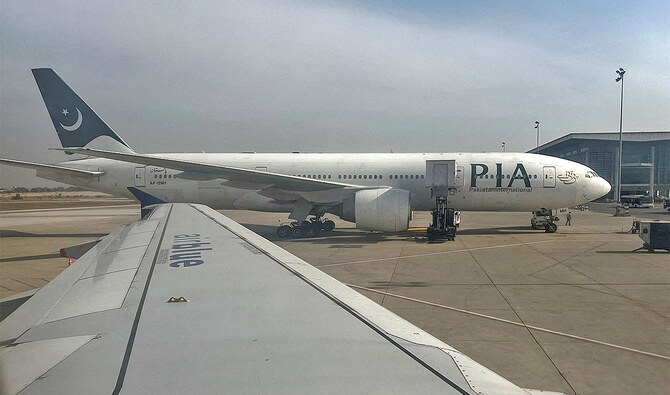
Pakistan International Airlines (PIA) passenger plane sits on tarmac, as seen through a plane window, at the Islamabad International Airport, Islamabad, Pakistan October 27, 2024. (REUTERS/File)
Short Url
Updated 07 December 2024
Follow

Pakistan’s PIA to resume flights to Europe from Jan. 10 after four-year ban 

  • PIA’s authorization was suspended in June 2020 over concerns of not complying with international aviation standards
  • Pakistan’s national flag carrier to resume Europe operations with Islamabad-Paris flight, will operate two flights per week

KARACHI: The state-owned Pakistan International Airlines (PIA) will resume its flights to Europe for the first time in four-and-a-half years on Jan. 10, 2025, an airline spokesperson confirmed on Saturday, after the EU aviation regulator lifted a ban on the national flag carrier. 

PIA’s authorization to operate in the EU was suspended in June 2020 over concerns about the ability of Pakistani authorities and its Civil Aviation Authority to ensure compliance with international aviation standards.

The suspension came days after Pakistan launched an investigation into the validity of pilots’ licenses issued in the country following a PIA plane crash that killed 97 people.

“On Jan. 10, 2025, PIA’s flight will depart from Islamabad for Paris,” the airline’s spokesperson said in a statement. “In the initial phase, two flights will be operated per week, which will be gradually increased.”

It said the flights will be operated on Fridays and Sundays, adding that the Jan. 10 flight will depart Islamabad at 11:30 am and arrive in Paris at 4:00 pm. 

The flight from Paris, meanwhile, will depart at 6:00 p.m. and arrive in Islamabad at 5:00 am. 

“The schedule is such that passengers will have breakfast in Pakistan and lunch in Paris,” the spokesperson said. 

Last Friday, Pakistan’s Prime Minister Shehbaz Sharif said the lifting of the ban would strengthen the national flag carrier’s reputation and bring financial benefits to the airline.

The ban was costing PIA nearly 40 billion Pakistani rupees ($144 million) in revenue annually, according to government records presented in parliament.

PIA and the government had been pressing the European Aviation Safety Agency (EASA) to lift the ban even provisionally. The government’s attempt to privatize the airline fell flat when it received only a single offer this year, that too well below its asking price.

In a statement, the PIA also vowed to abide by the EASA regulations as it welcomed the lifting of the ban.


PM calls for tapping gemstone reserves as Pakistan pushes for economic recovery

Updated 26 January 2026
Follow

PM calls for tapping gemstone reserves as Pakistan pushes for economic recovery

  • Pakistan this month approved first national policy framework for precious stones, aiming to lift annual exports to $1 billion
  • PM Shehbaz Sharif directs implementation of new policy framework, completion of Islamabad Gemstone Center by Aug. 2027

ISLAMABAD: Prime Minister Shehbaz Sharif on Monday called for tapping Pakistan’s vast gemstone reserves, Sharif’s office said, as Islamabad seeks to boost their exports to support economic recovery.

The development comes two weeks after Pakistan approved its first national policy framework for gemstones and precious stones, aiming to reform the sector, align it with international standards and lift annual exports to $1 billion within five years.

Pakistan has intensified efforts to monetize its untapped mineral resources, amid fiscal pressures and an International Monetary Fund-backed reform program. Over the past two years, Islamabad has hosted international minerals conferences and signed agreements with countries including the United States, Saudi Arabia and China to attract investment and move up the value chain in mining and minerals processing.

On Monday, PM Sharif presided over a meeting on the promotion of precious stones and minerals in Islamabad, at which he directed seeking services of relevant experts of international repute for the construction of proposed gemstone centers in Islamabad, Gilgit-Baltistan and Azad Kashmir, according to his office.

“There is a need to utilize the potential of gemstone reserves in Pakistan so that valuable foreign exchange can be earned from the exports of these precious stones,” Sharif was quoted as saying by his office.

Despite officials estimating Pakistan’s gemstone reserves at around $450 billion, formal exports remain negligible, at about $5.8 million annually, due to weak certification systems, limited domestic processing capacity, widespread smuggling and fragmented regulation across federal and provincial authorities.

Pakistan’s new policy framework includes geological mapping to accurately assess reserves, the establishment of internationally accredited laboratories and certification regimes and the creation of a dedicated authority to regulate and promote the sector. The government also plans to set up a National Warranty Office and centers of excellence to support training, research and value-added processing.

The prime minister directed the implementation of the policy framework and the completion of Islamabad Gemstone Center by Aug. 2027.

A location has been identified on the Constitution Highway for the establishment of a gemstone center in Islamabad, according to Sharif’s office. The center will provide international standard value addition services, certification, incubation center and trade center facilities.

“Exports should be increased through value addition in the gemstone industry,” he said, urging officials to work together with the governments of all provinces, Gilgit-Baltistan and Azad Kashmir to promote the industry.