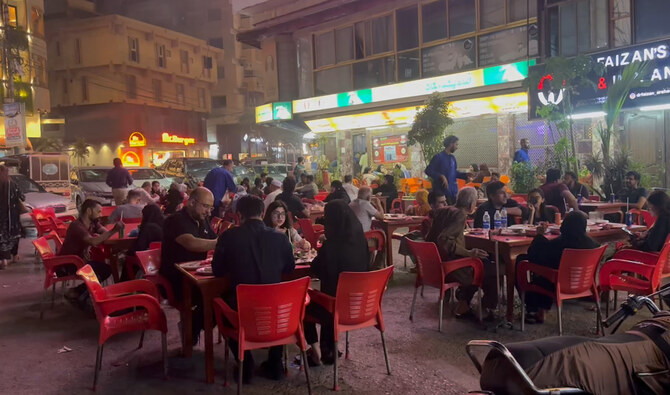
KARACHI: For over seven decades, the Bundoo Khan Restaurant has been a culinary landmark in the Pakistani port city of Karachi, delighting generations of food lovers with its signature kebabs, sizzling chicken tikkas and crunchy parathas.
Founded in 1948 by Al Hajj Bundoo Khan, a migrant from Meerut in present day India, the restaurant began as a humble barbecue stall on Karachi’s MA Jinnah Road, then known as Bandar Road, using family recipes passed down from a maternal uncle.
While the eatery was a hit from the beginning, it gained visibility when its innovative approach to grilling and marinating caught the eye of General Ayub Khan, who served as the president of Pakistan from 1958 until his resignation in 1969. Becoming a favorite of the president turned the small eatery into the talk of the town, and it began to draw large crowds from all walks of life.
“My father can be called the founder of barbecue [in Karachi],” Akber Bundoo Khan, the founder’s 62-year-old son, told Arab News.
“No one knew how to make tikka [like him], how kebabs were made, how parathas were made or how halwa was made.”
Indeed, barbeque has become synonymous with the Bundoo Khan name in Karachi, cementing its reputation as a must-visit destination for the city’s residents and a gathering place for politicians, government officials, actors and singers.
“This brand has been around for 76 years,” said Waqar Mehmood, Bundoo Khan’s grandson who oversees a branch in the city’s Sindhi Muslim area.
“When we first set up an exhibition [during the first few decades], the first person to visit was [Pakistan’s former president] Ayub Khan who gave us the first prize and a gold medal for our barbecue.”
Mehmood spoke about visits to the restaurant by General Ayub Khan’s family, as well as Pakistan’s former first lady Ranaa Liaquat Ali Khan, ex-premier Zulfiqar Ali Bhutto and the now jailed former Prime Minister Imran Khan. Legendary Pakistani actors like Muhammad Ali, Zeba and Waheed Murad were also loyal patrons and iconic singer Noor Jehan continued to request Bundoo Khan’s food until her last days before she passed away in 2000.
“Every day, I would personally take her double-spiced chicken tikka and six kebabs to the hospital,” he said.
The restaurant’s influence has also been immortalized in Pakistani music, with songs like Ahmed Rushdi’s 1954 hit “Bandar Road Se Keamari” and Mehdi Hassan’s 1977 track “Makhan Jesi Larki,” both mentioning the eatery.
Pakistani TV and film actor Behroze Sabzwari recalled childhood memories of visiting the original branch on MA Jinnah Road and meeting the restaurant’s founder, who passed away in 1987 at the age of 105.
“I lived and grew up in the area right behind the Bundoo Khan [Restaurant] in Jacob Line,” he told Arab News. “It wasn’t much, but you could get tikka for just 10 or 15 rupees [$0.05] and everything else as well. And believe me, the taste from those days of that halwa, that tikka, those kebabs, that paratha still lingers with me to this day.”
Asad Sohail, an engineer and regular customer, also recalled visiting Bundoo Khan as a child with his father and grandfather, saying dinner at the restaurant was a must after a night out at the movies.
“We used to come here with my grandfather, wearing shorts, when we were little. Then, as kids, we came with our father,” he said.
“Their barbecue, I haven’t tasted anything like it anywhere in Pakistan. It’s truly unique. Their kebabs are so tender, the marination is perfect, and the tikka, what can I say? It’s completely different from anything else.”
Today, while the restaurant keeps attracting new customers at all its branches in Karachi and across Pakistan as well as in Dubai and Madinah, the first branch on MA Jinnah Road has seen a decline in clients in recent years due to a rise in crime in the area.
Still, Akber Bundoo Khan’s son insists the original location will never shut down.
“This is our asset,” he said. “The flavor that started here has spread all over the world. It’s because of this taste that we’re famous ... Our identity, our entire legacy, has been built from here.”


![]()

Bundoo Khan: How one restaurant parlayed barbeque into a Karachi landmark
Short Url
https://arab.news/6jmjs
Bundoo Khan: How one restaurant parlayed barbeque into a Karachi landmark
- Founded in 1948, Bundoo Khan Restaurant is a mainstay for politicians, celebrities, and residents of the port city
- Eatery first gained prominence when its barbeque caught the eye of ex-president Ayub Khan at a local exhibition
Latest updates


© 2026 SAUDI RESEARCH & PUBLISHING COMPANY, All Rights Reserved And subject to Terms of Use Agreement.