South Korea president declares emergency martial law

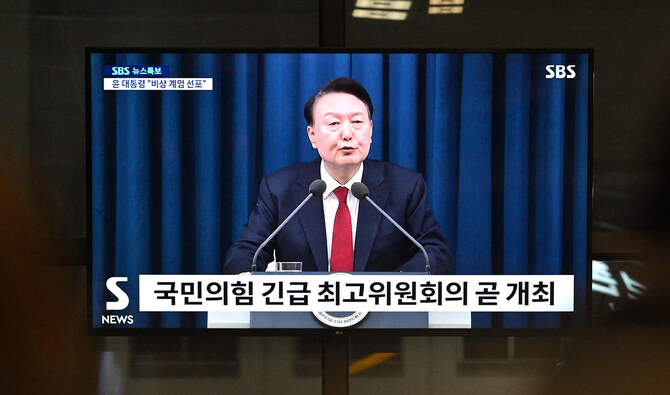
South Korea’s President Yoon Suk Yeol is seen speaking on a television in a train station in Seoul, on December 3, 2024. (AFP)
Short Url
Updated 03 December 2024
Follow

South Korea president declares emergency martial law

  • The surprise move comes as the ruling and opposition parties continue to bicker over next year’s budget bill
  • Opposition MPs last week approved a significantly downsized budget plan through a parliamentary committee

SEOUL: South Korea’s President Yoon Suk Yeol on Tuesday declared emergency martial law, saying the step was necessary to protect the country from “communist forces” amid parliamentary wrangling over a budget bill.
“To safeguard a liberal South Korea from the threats posed by North Korea’s communist forces and to eliminate anti-state elements... I hereby declare emergency martial law,” Yoon said in a live televised address to the nation.
“With no regard for the livelihoods of the people, the opposition party has paralyzed governance solely for the sake of impeachments, special investigations, and shielding their leader from justice,” he added.
The surprise move comes as Yoon’s People Power Party and the main opposition Democratic Party continue to bicker over next year’s budget bill. Opposition MPs last week approved a significantly downsized budget plan through a parliamentary committee.
“Our National Assembly has become a haven for criminals, a den of legislative dictatorship that seeks to paralyze the judicial and administrative systems and overturn our liberal democratic order,” Yoon said.
He accused opposition lawmakers of cutting “all key budgets essential to the nation’s core functions, such as combatting drug crimes and maintaining public security... turning the country into a drug haven and a state of public safety chaos.”
Yoon went on to label the opposition, which holds a majority in the 300-member parliament, as “anti-state forces intent on overthrowing the regime” and called his decision “inevitable.”
“I will restore the country to normalcy by getting rid of anti-state forces as soon as possible.”


Fourth Palestine Action activist ends hunger strike in UK prison

Protesters take part in a demonstration in support of "Defend Our Juries" and their campaign against the ban on Palestine Action
Updated 24 December 2025
Follow

Fourth Palestine Action activist ends hunger strike in UK prison

  • Amy Gardiner-Gibson began eating again after 49 days of protest
  • Govt rejects claims it ignored prison safety protocols

LONDON: A fourth Palestine Action activist imprisoned in the UK has ended her hunger strike.

Amy Gardiner-Gibson, who also uses the name Amu Gib, began eating again after 49 days of fasting, the campaign group Prisoners for Palestine said.

Qesser Zuhrah, another activist, ended her hunger strike last week after 48 days but said she might resume it next year, Sky News reported.

Four Palestine Action activists have now ended their hunger strikes while in prison, while four others are continuing to fast.

All of them are in prison on remand, awaiting trial for a series of high-profile alleged break-ins and criminal damage.

Palestine Action was proscribed as a terrorist organization and banned earlier this year.

On Tuesday, Swedish climate activist Greta Thunberg was arrested in central London at a rally in support of the hunger strikers.

The protesters are demanding that weapons factories in Britain with ties to Israel be shut down, as well as the removal of Palestine Action’s proscription.

They are also calling for immediate bail to be given to imprisoned pro-Palestine activists and an end to the alleged mistreatment of prisoners in custody.

Seven imprisoned members of Palestine Action have been transferred to hospital over the course of the hunger strike campaign. Doctors have highlighted concerns about the long-term impact of fasting on the activists.

Lawyers representing the group on Monday initiated legal action against the government over its alleged failure to follow prison safety regulations.

The government, however, has rejected this accusation, Sky News reported.

A Ministry of Justice spokesperson said: “Ministers do not intervene in individual cases. Where individuals are on remand, doing so would risk prejudicing ongoing legal proceedings and undermine the independence of the justice system.

“Concerns about welfare and process can be raised through established legal and administrative channels, including prison governors and ultimately the prison and probation ombudsman.

“Healthcare decisions are taken independently by qualified NHS professionals and appropriate care and oversight frameworks remain in place.”

The activists still on hunger strike include Heba Muraisi and Teuta Hoxha. Hoxha has been on remand for 13 months and her family told Sky News they feared she would die in prison.

Another of the activists, Kamran Ahmad, is believed to have been on hunger strike for 45 days and hospitalized three times.

Lewie Chiaramello, who has Type 1 diabetes, is on day 31 of his strike and taking part by fasting every other day.