- Body announced to identify suspects involved in “malicious campaign” against the state following opposition protests last month
- In Pakistan, with 110 million people online, social media has become a hotbed of unverified news, pictures and video clips
ISLAMABAD: Former Prime Minister Imran Khan’s Pakistan Tehreek-e-Insaf (PTI) opposition party has said a task force set up by the federal government this month to counter online ‘propaganda’ against the state was meant to target the party and its supporters, with digital rights activists warning that it set a “dangerous and chilling” precedent.
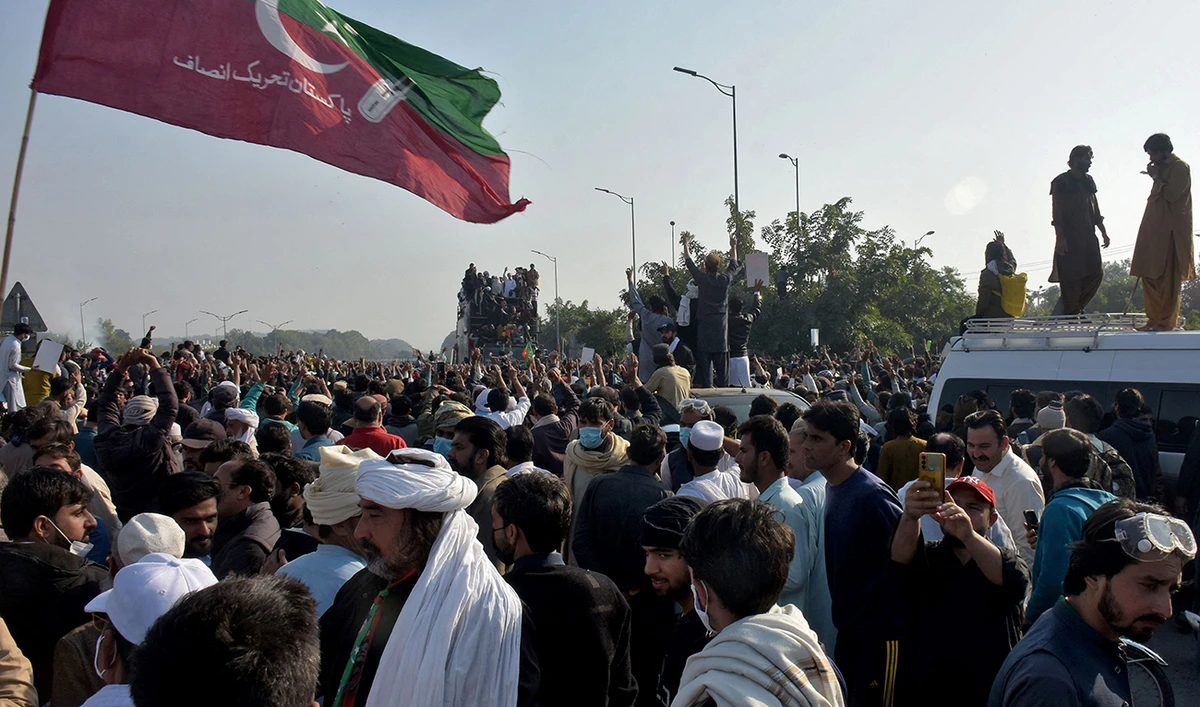
Thousands of supporters of the PTI stormed Islamabad last month, demanding Khan’s release from prison. The government said protesters killed four security officers in clashes.
The PTI says 12 supporters died and “hundreds” were injured as security agencies used live ammunition rounds to disperse protesters, which authorities deny. Party leaders have described the raid on the protest site as a “massacre,” with social media platforms awash with pictures and video footage that the government has called “fake propaganda” by PTI followers. The government also says there were no civilian casualties.
On Dec. 1, the government of Prime Minister Shehbaz Sharif announced a 10-member joint task force to identify and bring to justice suspects behind a “malicious campaign” to spread “concocted, baseless and inciting” online news, images and video content in the aftermath of the protests.
“The task force is just another sham committee to basically violate all human rights of PTI workers and leaders,” Khan’s close aide and PTI spokesperson Sayed Zulfikar Abbas Bukhari told Arab News.
“It is further an attempt to increase scrutiny and torture of PTI workers, using the recent massacre as an excuse to try to eliminate the party.”
Bukhari said the party had evidence, including burial records and death certificates, of at least 12 protesters killed, proving that the government’s claim there were no civilian casualties was false.
“We do believe that the government is doing a huge cover-up about the total deaths,” Bukhari added. “The death toll will only continue creeping further up as the government is doing all they can to cover this up.”
Speaking to the media last week, Planning Minister Ahsan Iqbal asked the PTI to share the names of its supporters who had been killed, saying the government had exercised “utmost restraint” to prevent bloodshed at the hands of what he described as a “violent mob.”
Last week, Pakistani journalist Mattiullah Jan was arrested after investigating claims of casualties in the PTI protest march, his lawyers said. He was released on bail on Sunday.
Arab News could not reach members of the task force or a government spokesperson for comment.
In Pakistan, a country of 240 million people, Internet use has risen at staggering rates recently owing to cheap 4G mobile Internet. Around 110 million Pakistanis were online this January, 24 million more than at the beginning of 2023, according to monitoring site DataReportal. In this environment, social media has become a hotbed of unverified news, pictures and video clips, according to fact checkers.
But digital rights also warn of the perils of deploying measures like task forces against online spaces.
Nighat Dad, executive director of the non-profit Digital Rights Foundation, said nothing could be “more dangerous and chilling” than setting up a task force without accountability mechanisms like parliamentary oversight.
“This move further entrenches a culture of impunity and raises serious concerns about transparency,” she told Arab News.
Instead of resorting to “draconian measures,” the government should have focused on building a “robust and responsive narrative” to counter disinformation and fake news.
“Establishing a task force without clearly outlining its own accountability in decision-making is a massive question mark on the government’s intent and process,” Dad added.
“Such measures not only stifle dissent but also undermine fundamental rights and democratic principles in Pakistan.”
Usama Khilji, a director at Bolo Bhi, an advocacy forum for digital rights, also said the announcement of the task force reflected shrinking democratic space in Pakistan:
“It shows the intolerance of the regime to accept any criticism from those who do not support them.”