

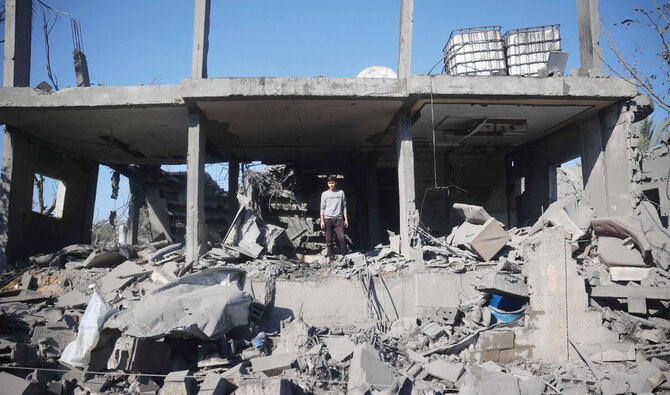

CAIRO: Israeli forces bombarded houses in several attacks in the northern Gaza Strip, including one airstrike that killed at least 15 people in a home sheltering displaced people in the town of Beit Lahiya, Palestinian medics said on Monday.
The three barely operational hospitals in the area were unable to cope with the wounded from the attack, and several other people were still missing, with rescue workers unable to reach them, the Palestinian Civil Emergency Service said.
Residents said clusters of houses were bombed and some set ablaze in Jabalia, Beit Lahiya, and Beit Hanoun, three towns on the northern edge of the Gaza Strip where the Israeli army has been operating for weeks.
They said Israeli drones had also dropped bombs outside a school sheltering displaced families in Beit Lahiya, part of what residents have described as a campaign to scare people into leaving.
Palestinians say Israel’s army is trying to drive people out of the northern edge of Gaza with forced evacuations and bombardments to create a buffer zone.
The Israeli army denies this and says it has returned to prevent Hamas fighters from regrouping in an area where it had previously cleared them out.
Israel launched its campaign in Gaza after Hamas-led fighters attacked Israeli communities on Oct. 7, 2023, killing 1,200 people and capturing more than 250 hostages, according to Israeli tallies.
Israel’s military campaign has killed more than 44,400 Palestinians and displaced most of the population, Gaza officials say. Vast swaths of the enclave lie in ruins.
A former Israeli defense minister accused Israel on Sunday of committing war crimes and ethnic cleansing in the Gaza Strip, drawing a sharp rebuke from government ranks.
Moshe Yaalon, a hawkish former general, told Israeli media that hard-liners in Prime Minister Benjamin Netanyahu’s far-right cabinet were looking to chase Palestinians from northern Gaza and wanted to re-establish Jewish settlements there.
On Monday, the Israeli military rejected Yaalon’s serious claims.
“The IDF (Israeli Defense Forces) operates under international law and evacuates civilians based on operational necessity for their protection,” it said.
Palestinian and UN officials said there were no safe areas in the Gaza Strip for the 2.3 million population, most of whom have been internally displaced.
In Gaza City, two Israeli air strikes killed five people, medics said.
Israel agreed to a ceasefire with Hezbollah last week that halted fighting in a conflict that has unfolded in Lebanon in parallel with the Gaza war.
But the Gaza war itself has ground on with only a single ceasefire that lasted for a week more than a year ago.
Officials in Cairo have hosted talks between Hamas and the rival Fatah group led by Palestinian President Mahmoud Abbas on the possible establishment of a committee to run post-war Gaza.
Egypt has proposed that a committee made up of non-partisan technocrat figures and supervised by Abbas’s authority should be ready to run Gaza straight after the war ends. Israel has said Hamas should have no role in governance.
An official close to the talks said progress had been made, but no final deal had been reached. Israel’s approval would determine whether the committee could fulfill its role.
Egyptian security officials have also held talks with Hamas on ways to reach a ceasefire with Israel.
A Palestinian official close to the mediation effort said Hamas stood by its condition that any agreement must bring an end to the war and involve an Israeli troop withdrawal, but Hamas would show the flexibility needed to achieve that.
Israel has said the war will end only when Hamas no longer governs Gaza and poses no threat to Israelis.
Israeli Foreign Minister Gideon Saar said on Sunday there was some indication of progress toward a deal to free Israeli hostages but that Israel’s conditions for ending the war had not changed.
White House national security adviser Jake Sullivan said the chances of a ceasefire and hostage deal were now more likely.


